23:41
Cardiovascular System Part 4 of 4 - Blood Flow
Vivo Phys - Evan Matthews
Overview
This video explains the relationship between blood pressure, resistance, and blood flow, building upon previous concepts of cardiac output and blood pressure. It details how blood flow is driven by pressure differences and opposed by resistance, primarily influenced by vessel diameter. The video also explores how the body regulates blood flow, particularly during exercise, highlighting the concept of sympatholysis and the redistribution of blood to active tissues. Finally, it introduces the arterial-venous oxygen difference (AVO2 difference) and its role in calculating overall oxygen consumption.
How was this?
Save this permanently with flashcards, quizzes, and AI chat
Chapters
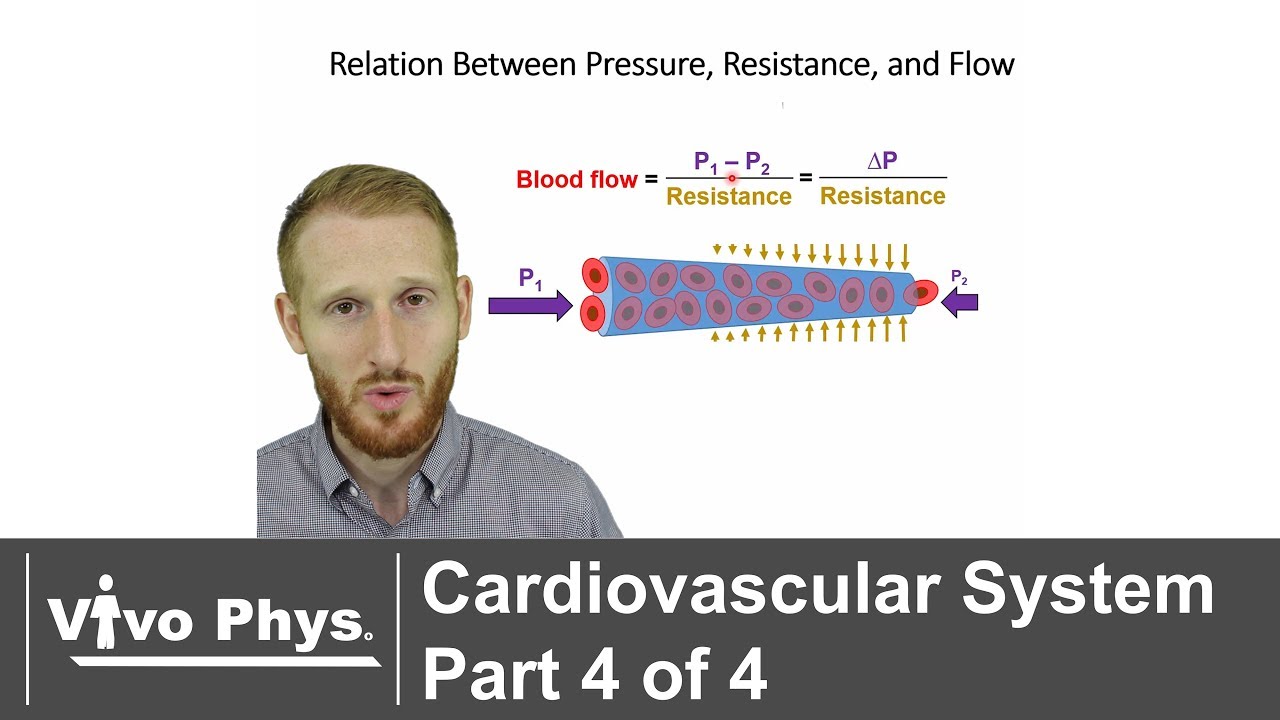
- Blood flow is determined by the difference in pressure between two points and the resistance to flow.
- The equation for blood flow is Flow = (Pressure 1 - Pressure 2) / Resistance.
- Resistance is primarily influenced by the diameter of blood vessels; narrower vessels increase resistance, slowing flow.
- This principle is analogous to cardiac output (CO = MAP / TPR), where MAP is mean arterial pressure and TPR is total peripheral resistance.
Understanding this fundamental equation is crucial because it explains the basic mechanics of how blood moves through the body and how various factors can alter this movement.
A highway analogy is used: a two-lane highway narrowing to one lane causes a traffic jam, similar to how vasoconstriction increases resistance and slows blood flow.
- Besides vessel diameter (radius), resistance is also affected by vessel length and blood viscosity.
- Longer vessels and thicker blood (higher viscosity) both increase resistance.
- However, vessel radius is the most significant factor because it is raised to the fourth power in the resistance equation, meaning small changes in radius have a large impact on resistance.
- The body actively changes vessel radius (vasoconstriction/vasodilation) to regulate blood flow, rather than significantly altering vessel length or blood viscosity.
Knowing that vessel radius is the primary adjustable factor for resistance helps explain how the body can rapidly control blood flow to different areas.
The video contrasts thin blood with low viscosity to thick blood with high viscosity, illustrating how blood thickness impacts resistance.
- A PVC is when the ventricles contract before they are supposed to, often before adequate filling with blood.
- PVCs lead to a significant drop in cardiac output and blood pressure because less blood is ejected.
- The body detects this drop via baroreceptors, triggering an increase in sympathetic activity.
- Increased sympathetic activity causes widespread vasoconstriction, raising vascular resistance to compensate for the low blood pressure.
This example demonstrates how a disruption in normal heart function can cascade through the cardiovascular system, affecting blood flow, pressure, and the body's regulatory responses.
Real-time data from an ECG, cardiac output monitor, blood pressure cuff, sympathetic activity sensor, and vascular resistance measurement shows a PVC causing a dip in cardiac output and blood pressure, followed by a spike in sympathetic activity and vascular resistance.
- During exercise, overall sympathetic activity increases, causing systemic vasoconstriction and raising blood pressure.
- However, active tissues (like exercising muscles) need *more* blood flow, not less.
- Sympatholysis is the local ability of tissues to override systemic sympathetic vasoconstriction signals.
- Byproducts of muscle contraction (e.g., decreased oxygen, increased CO2, nitric oxide) signal local blood vessels to dilate, ensuring increased blood supply to the working muscles.
- This mechanism prioritizes blood flow to areas that need it most, even when the rest of the body is experiencing vasoconstriction.
Sympatholysis explains how the body can simultaneously increase blood flow to active muscles while maintaining or increasing blood pressure for other vital functions during physical exertion.
When cycling, the leg muscles need more blood. Sympatholysis allows these muscles to dilate their blood vessels, ignoring the general sympathetic signal to constrict, thus receiving the necessary oxygen and nutrients.
- During heavy exercise, cardiac output increases dramatically, and blood flow is redistributed.
- Organs like the digestive system and kidneys receive a smaller *percentage* of blood flow due to vasoconstriction.
- The brain maintains a relatively constant blood flow.
- Skeletal muscles receive a vastly increased *percentage* and *absolute volume* of blood flow.
- Skin blood flow also increases significantly to help dissipate heat, especially in warmer conditions.
Understanding this redistribution highlights the body's priorities during exercise, ensuring that energy-demanding muscles get the resources they need while other functions are temporarily reduced.
At rest, skeletal muscles receive 15-20% of blood flow, but during heavy exercise, this jumps to 70-85%. Similarly, skin blood flow can increase from 4-5% at rest to up to 20% during exercise.
- The AVO2 difference measures the amount of oxygen extracted by tissues from the blood.
- It's calculated by comparing oxygen levels in an artery supplying a tissue to the oxygen levels in the vein draining that tissue.
- A larger AVO2 difference indicates that tissues are extracting more oxygen, typically because they are working harder and consuming more oxygen.
- This value, along with cardiac output, is used in the Fick equation to calculate total body oxygen consumption (VO2).
The AVO2 difference is a key indicator of metabolic activity and oxygen utilization by tissues, providing insight into how efficiently the body is meeting its energy demands.
If an artery delivers blood with 200 units of oxygen and the corresponding vein returns blood with 50 units, the AVO2 difference is 150 units, meaning the tissue extracted 150 units of oxygen.
Key takeaways
- Blood flow is a direct result of pressure differences and inversely related to resistance.
- Vessel diameter is the most critical factor the body uses to rapidly adjust vascular resistance and control blood flow.
- The cardiovascular system dynamically redistributes blood flow to meet the changing demands of different organs and tissues, especially during physical activity.
- Sympatholysis allows active tissues to locally override systemic vasoconstriction signals, ensuring they receive adequate blood supply.
- Understanding the interplay between cardiac output, blood pressure, resistance, and oxygen extraction is fundamental to comprehending cardiovascular function.
- The Fick equation links cardiac output, AVO2 difference, and oxygen consumption, providing a comprehensive view of the body's metabolic state.
Key terms
Blood FlowPressure GradientResistanceVessel DiameterVasoconstrictionVasodilationCardiac OutputMean Arterial Pressure (MAP)Total Peripheral Resistance (TPR)Premature Ventricular Contraction (PVC)BaroreceptorsSympathetic ActivitySympatholysisArterial-Venous Oxygen Difference (AVO2 Difference)Fick EquationOxygen Consumption (VO2)
Test your understanding
- How does a decrease in blood vessel diameter affect blood flow, and why?
- Explain the concept of sympatholysis and why it is essential for exercising muscles.
- What are the primary factors that influence vascular resistance, and which one does the body most readily manipulate?
- How does a premature ventricular contraction (PVC) impact cardiac output, blood pressure, and sympathetic nervous system activity?
- Describe how blood flow is redistributed during heavy exercise, comparing the needs of skeletal muscles to those of the digestive system.