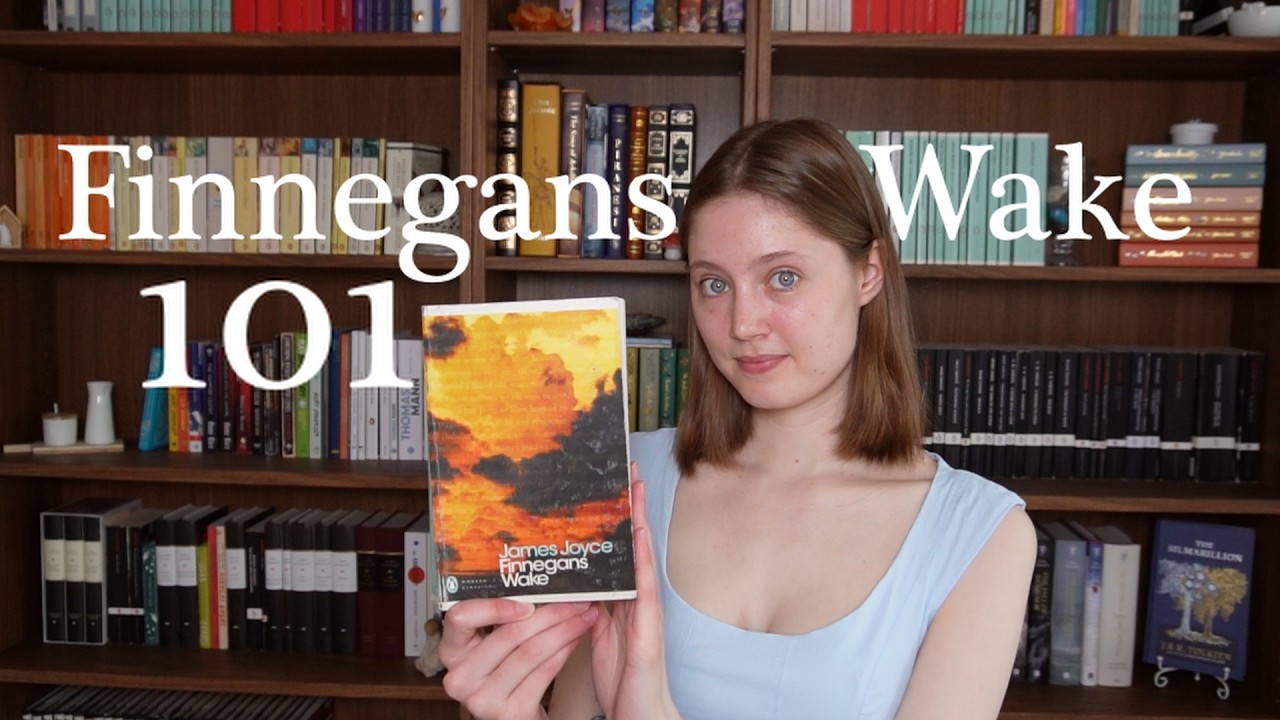
The most difficult Book ever written | Finnegans Wake
Vanisha Marie
Overview
This video provides an overview of James Joyce's Finnegans Wake, widely considered one of the most difficult books ever written. The presenter, having recently finished the book, aims to spare viewers the arduous reading experience by summarizing its core themes, structure, and intent. The summary delves into Joyce's use of Vico's philosophy of history, the cyclical nature of time and events, the central Earwicker family as archetypes, and the book's linguistic experimentation. It also touches upon the book's reception, its connection to Irish cultural identity and translation issues, and the presenter's personal, critical take on its artistic merit versus its intellectual complexity.
Save this permanently with flashcards, quizzes, and AI chat
Chapters
- Finnegans Wake is exceptionally difficult, arguably the hardest book ever written.
- Reading it is time-consuming, and a reader's guide is almost essential for comprehension.
- This video serves as a spoiler-filled overview to provide understanding without requiring a full read.
- The book is not a traditional narrative but an exploration of themes, language, and history.
- Joyce's work is heavily influenced by Giambattista Vico's philosophy of history, 'Corso e Ricorso'.
- Vico's theory posits history as a repeating loop of three ages: theocratic, aristocratic, and democratic.
- Joyce extends this by suggesting all of history happens simultaneously at a single point in time.
- This simultaneity means every event, word, and action has multiple, layered meanings.
- The Earwicker family (HCE, ALP, Shem, Shaun, Issy) serves as the central anchor in the narrative.
- HCE (Here Comes Everybody) represents everyman and the origin of humankind.
- ALP (A.L.P.) symbolizes the river of time and life.
- Their children embody all subsequent human offspring, making the family a representation of humanity's origins and history.
- Every character in the Wake is a variation of HCE or ALP.
- The book begins at its end, reflecting the cyclical nature and lack of clear beginnings or endings.
- A central motif is the 'fall,' referencing Adam's fall, mythological figures like Finn McCool, and HCE's alleged crime.
- HCE's crime, possibly voyeuristic and incestuous, occurs in Phoenix Park and is central to the narrative's conflict.
- The Wake is described as a 'novel of the night,' depicting a dream state whose dreamer is unknown (HCE or collective).
- The title 'Finnegans' (without an apostrophe) suggests a plural and possessive meaning, alluding to multiple 'Finnegans' or versions of HCE.
- The Oedipal event, a son replacing his father as his mother's husband, is a recurring motif.
- This represents the inevitable cycle of the young replacing the old.
- Within the Earwicker family, the twin sons Shem and Shaun vie for HCE's position.
- Due to the book's nature where all characters are variations of HCE, this conflict becomes a younger version of HCE replacing an older version.
- Incest is a natural consequence in a world where all characters are fundamentally the same, making the Oedipal theme central.
- Finnegans Wake is deeply concerned with the problem of translation, particularly the challenge of translating Irish literary tradition into English without losing its spirit.
- This translation issue was a significant political and cultural problem for Ireland, tied to its identity.
- Joyce's approach was to use language itself to construct and explore Irish and English identities.
- He created a composite language using 65 languages, blending words and creating neologisms.
- This linguistic experimentation strips language down to its phonetic and symbolic elements, sometimes requiring reading aloud.
- Joyce spent 17 years writing the Wake, constantly revising and complicating it.
- The book's reception has been divided, with many critics finding it impenetrable.
- Joyce's brother famously criticized the work as 'pose' and a display of 'super cleverness.'
- The presenter finds the book frustratingly obscure, questioning its status as 'good literature' if it's largely incomprehensible.
- Despite its intellectual brilliance, the presenter feels the work stems from insecurity and is ultimately 'pathetic' rather than brilliant.
- The Wake is a unique challenge, offering a rewarding but addictive experience for those who embrace difficulty.
- Understanding it requires immense effort, akin to learning a new language, and can feel like the brain is expanding.
- The book fundamentally alters how a reader perceives language, motifs, and even life itself.
- The presenter acknowledges leaving out vast amounts of detail, highlighting the impossibility of fully summarizing the book.
- The experience of reading it is deeply frustrating but also uniquely transformative, making the reader see the book's central themes everywhere.
Key takeaways
- Finnegans Wake is a deliberately complex work exploring human history, language, and consciousness through cyclical and simultaneous time.
- James Joyce used Giambattista Vico's philosophy of history as a structural basis for the book's looping narrative.
- The Earwicker family serves as universal archetypes representing humanity's origins and ongoing conflicts.
- The book's radical linguistic experimentation, blending multiple languages, aims to address issues of translation and cultural identity.
- Comprehending Finnegans Wake requires extensive effort, often necessitating reader's guides and deep linguistic analysis.
- Despite its intellectual depth, the book's extreme difficulty leads to debate about its artistic merit and accessibility.
- Reading Finnegans Wake can be a profoundly frustrating yet uniquely transformative experience that alters one's perception.
Key terms
Test your understanding
- How does James Joyce's interpretation of Giambattista Vico's 'Corso e Ricorso' differ from Vico's original theory, and how does this difference shape Finnegans Wake?
- In what ways do the Earwicker family members function as archetypes within Finnegans Wake, and what universal themes do they represent?
- What is the central problem of translation that Finnegans Wake attempts to address, and how does Joyce's linguistic experimentation reflect this problem?
- Why is Finnegans Wake considered a 'novel of the night' or a dream narrative, and whose dream might it be?
- What is the significance of the 'fall' motif in Finnegans Wake, and how does it connect various characters and events?