Algebra Introduction - Basic Overview - Online Crash Course Review Video Tutorial Lessons
The Organic Chemistry Tutor
Overview
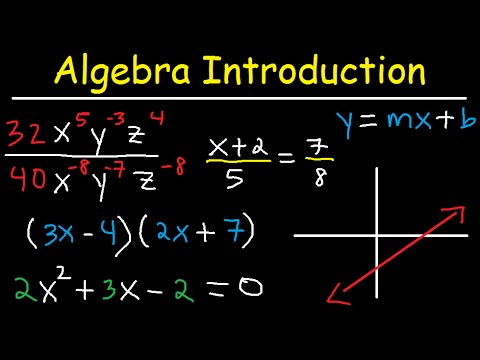
This video provides a comprehensive introduction to fundamental algebra concepts, covering operations with like terms, polynomial addition and subtraction, and multiplication of monomials, binomials, and trinomials. It delves into the properties of exponents, including multiplication, division, and raising exponents to another power, with clear explanations of why these rules work. The tutorial also covers factoring techniques for quadratic equations, solving equations with various complexities (including fractions, decimals, and square roots), and graphing linear equations using slope-intercept and standard forms. Finally, it explains how to write the equation of a line given a point and slope, two points, or a parallel/perpendicular line, demonstrating conversions between point-slope, slope-intercept, and standard forms.
Save this permanently with flashcards, quizzes, and AI chat
Chapters
- Like terms can be added or subtracted by combining their coefficients.
- Terms with different variables or exponents are not like terms and cannot be directly combined.
- Radicals with the same radicand are considered like terms.
- Polynomials can be simplified by combining like terms.
- Monomial: one term (e.g., 8x, 5x^2).
- Binomial: two terms (e.g., 5x + 6).
- Trinomial: three terms (e.g., x^2 + 6x + 5).
- Multiply a monomial by a polynomial by distributing the monomial to each term.
- Multiply binomials using the FOIL method (First, Outer, Inner, Last).
- When multiplying powers with the same base, add the exponents (x^a * x^b = x^(a+b)).
- When dividing powers with the same base, subtract the exponents (x^a / x^b = x^(a-b)).
- When raising a power to another power, multiply the exponents ((x^a)^b = x^(a*b)).
- Negative exponents can be made positive by moving the base to the other side of the fraction (x^-a = 1/x^a).
- When multiplying terms with coefficients and variables, multiply the coefficients and add the exponents of like variables.
- When dividing terms, divide the coefficients and subtract the exponents.
- Negative exponents in the numerator move to the denominator as positive, and vice versa.
- Simplify fractions by dividing common factors in the numerator and denominator.
- Isolate the variable by performing inverse operations on both sides of the equation.
- Distribute negative signs and combine like terms before solving.
- Clear fractions by multiplying both sides by the least common denominator.
- Cross-multiplication can be used to solve equations with two fractions set equal to each other.
- Multiply by powers of 10 to clear decimals.
- Equations of the form x^2 = k can be solved by taking the square root of both sides (x = ±√k).
- Factor quadratic expressions using techniques like difference of squares and factoring trinomials.
- Set each factor equal to zero to find the solutions.
- The quadratic formula (x = [-b ± √(b^2 - 4ac)] / 2a) can solve any quadratic equation.
- Slope-intercept form (y = mx + b) uses the slope (m) and y-intercept (b) for graphing.
- Standard form (ax + by = c) can be graphed by finding the x and y intercepts.
- The slope represents 'rise over run'.
- Point-slope form (y - y1 = m(x - x1)) is useful for writing equations given a point and slope.
- Convert between point-slope, slope-intercept, and standard forms.
- Parallel lines have the same slope.
- Perpendicular lines have slopes that are negative reciprocals of each other.
Key takeaways
- Mastering like terms is crucial for simplifying algebraic expressions.
- Understanding exponent rules is fundamental for simplifying and manipulating terms.
- Solving equations involves isolating the variable using inverse operations.
- Factoring and the quadratic formula are key methods for solving quadratic equations.
- Graphing linear equations relies on understanding slope and intercepts.
- Writing equations of lines requires a point and a slope, or equivalent information.
- Parallel lines share the same slope; perpendicular lines have negative reciprocal slopes.