59:39
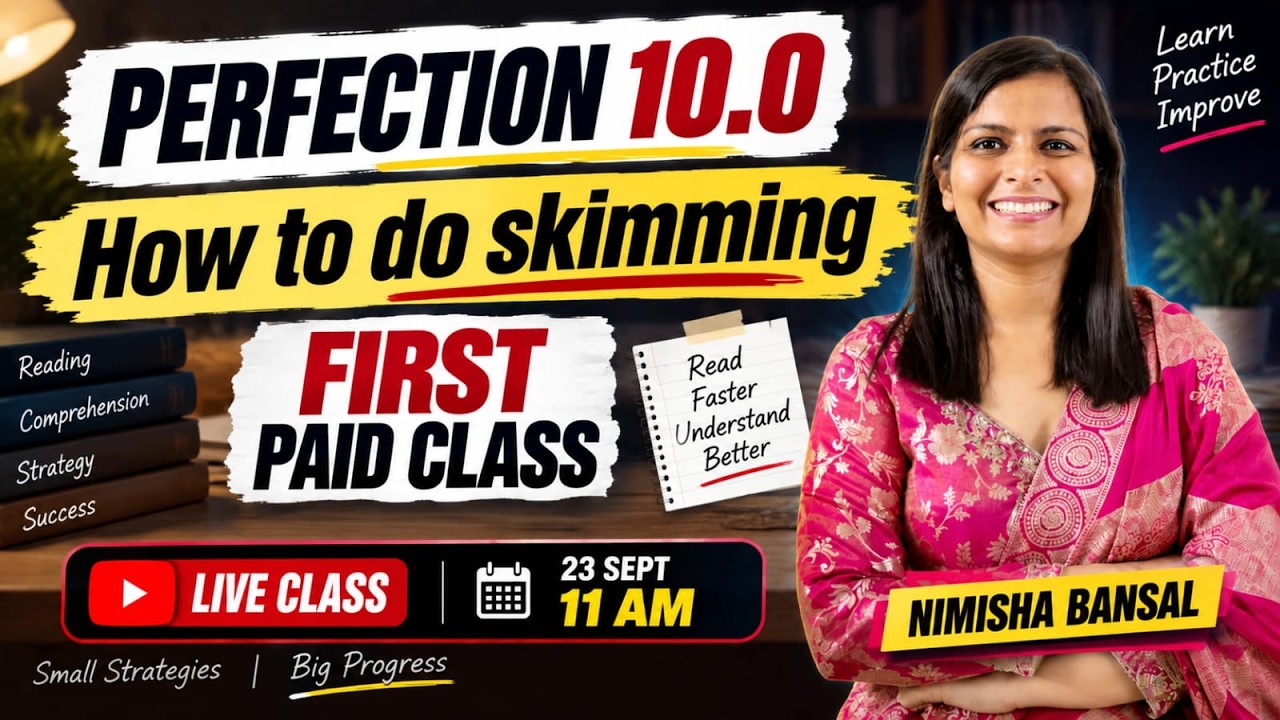
PERFECTION 10.0 | FIRST PAID CLASS | How to do skimming | Nimisha Bansal
NIMISHA BANSAL
Overview
This video introduces the concept of 'skimming' as a crucial reading technique for competitive exams, particularly in timed environments like the Prelims. The instructor, Nimisha Bansal, explains what skimming is, when to use it, and contrasts it with fast reading and normal reading. She outlines four key concepts for effective skimming, emphasizing focusing on nouns, verbs, and adjectives, skipping data and long names, ignoring unknown vocabulary, and understanding that complete comprehension isn't the goal. The video includes practical examples and exercises to help viewers grasp and apply skimming strategies to improve their reading comprehension skills.
How was this?
Save this permanently with flashcards, quizzes, and AI chat
Chapters
- Perfection 10.0 is a new series focused on improving exam-taking skills.
- The first class introduces skimming, a vital technique for time-constrained exams.
- Skimming helps manage time effectively in Reading Comprehension sections.
- The class aims to teach skimming strategies and will be followed by practice sessions.
Understanding skimming is essential for efficiently tackling reading comprehension passages in exams where time is limited, preventing candidates from running out of time.
The instructor mentions that in exams, there isn't enough time to read passages thoroughly, making skimming a necessary skill.
- Skimming is used for moderate to long passages (2+ paragraphs) that are not story-based.
- It's primarily used in Prelims exams due to time constraints, unlike fast reading used in Mains.
- Skimming involves reading quickly, focusing on specific word types, and aiming for a speed of about 25-30 seconds per paragraph.
- The goal is to identify the main topic and author's tone, not to understand every word.
Knowing when and what type of passages to skim helps learners apply the correct strategy, saving valuable time and improving accuracy in exams.
A 10-line paragraph with 8 words per line (approx. 80 words) should be skimmed in 25-30 seconds.
- Focus on nouns, verbs, and adjectives to grasp who did what and how they are.
- Skip over data, numbers, long names, and examples to maintain speed.
- Ignore difficult vocabulary words, as they rarely change the main idea of the passage.
- Accept that you won't understand everything; the aim is to get the topic and tone.
These concepts provide a structured approach to skimming, enabling learners to extract the most crucial information quickly without getting bogged down by details.
When skimming, ignore prepositions, conjunctions, adverbs, and interjections, focusing instead on nouns/pronouns, verbs, and adjectives.
- Skimming involves jumping through text, focusing on key words.
- Fast reading involves moving eyes left-to-right quickly without jumping, used in Mains exams.
- Normal reading, attempting to understand every word, is inefficient for exams and often leads to incomplete passages.
- The 'Chak De India' movie example illustrates the difference between skimming (identifying the movie and a few scenes) and fast reading (reading more detail left-to-right).
Distinguishing between these reading methods helps learners choose the appropriate technique for different exam sections and question types, optimizing their performance.
The instructor uses the 'Chak De India' movie review to demonstrate how skimming identifies the main topic (movie scenes) while fast reading provides more narrative detail.
- Learners are given a minute to skim a paragraph and identify the main idea.
- The instructor then reveals the main idea, and learners check if their understanding matches.
- The example passages focus on the movie 'Chak De India,' exploring its inspiration, themes, and impact.
- The exercise reinforces that even with unknown words, the main idea can be grasped through skimming.
Hands-on practice with immediate feedback helps solidify understanding of skimming principles and builds confidence in applying them to real passages.
In one exercise, learners skimmed paragraphs about the movie 'Chak De India' to identify its inspiration (a hockey match and poor infrastructure for women's sports) and its motivational themes.
- Skimming can be used to solve Reading Comprehension questions effectively.
- Strategy: Skim questions first, note keywords, then skim the passage for the main idea and answers.
- Vocabulary questions can be answered directly before skimming the passage to save time.
- This approach helps complete passages and potentially gain extra marks, especially in timed Prelims exams.
Integrating skimming into the question-answering process, especially by tackling vocabulary first, is a strategic advantage that can significantly improve scores and efficiency.
The instructor demonstrates answering vocabulary questions like 'poignant' and 'feasible' before or during the skimming process, showing how it saves time.
- A passage about nature and resources is skimmed to identify key concepts.
- Key concepts include the definition of a resource (accessible and practically exploitable), nature's self-restoration ability, and the difference between natural entities and resources.
- The example of petroleum illustrates that an entity is only a resource if it's accessible and usable.
- The passage highlights that humans generate waste, not nature, and that nature has regenerative and restorative qualities.
Analyzing a new passage using skimming reinforces the learned techniques and demonstrates how to extract core information and answer questions even on unfamiliar topics.
The passage used petroleum as an example to explain that an entity is only a resource if it is accessible and its exploitation is practical and culturally acceptable.
Key takeaways
- Skimming is a rapid reading technique focused on identifying the main topic and author's tone, not detailed comprehension.
- Effective skimming involves focusing on nouns, verbs, and adjectives while ignoring less critical elements like data, numbers, and complex vocabulary.
- Skimming is best suited for non-story-based, moderate-to-long passages in time-pressured exams like Prelims.
- Distinguishing between skimming, fast reading, and normal reading is crucial for applying the right strategy in different contexts.
- Practicing skimming regularly, even with unknown words, builds the ability to grasp the gist of a passage.
- Integrating skimming into the question-answering process, including tackling vocabulary questions first, can significantly improve exam performance.
- Nature's ability to restore and regenerate itself is a key principle, and humans are the primary generators of waste.
Key terms
SkimmingFast ReadingNormal ReadingReading ComprehensionPrelims ExamMains ExamResourceAccessibilityExploitationRegenerationRestoration
Test your understanding
- What are the primary types of words to focus on when skimming a passage, and why?
- Under what conditions should a learner choose skimming over fast reading or normal reading?
- How does ignoring difficult vocabulary contribute to the effectiveness of skimming?
- What is the strategic advantage of answering vocabulary questions before skimming the entire passage?
- Explain the difference between an entity and a resource, using an example from the video.