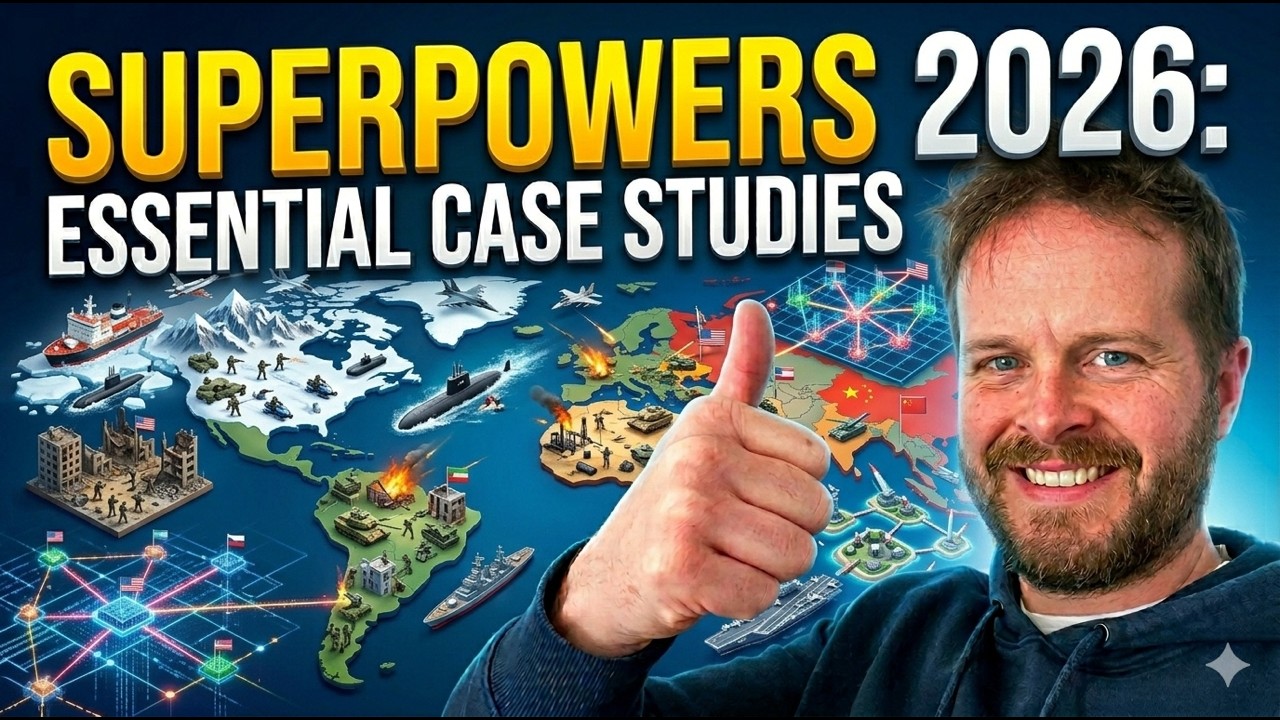
A-Level Edexcel Geography: Superpowers 2026 Essential Case Studies
Geography Geyser
Overview
This video explores the multifaceted nature of superpowers, moving beyond traditional military and economic might to encompass cultural, political, and resource dimensions. It analyzes various forms of power, including hard, soft, smart, and sharp power, and traces the historical evolution of global power structures from empires to unipolar, bipolar, and multipolar systems. The summary highlights emerging challenges to established superpowers, particularly the US, from rising powers like China, focusing on economic competition, technological races, environmental impacts, and geopolitical influence in developing regions. It emphasizes the dynamic and contested nature of global power in 2026.
Save this permanently with flashcards, quizzes, and AI chat
Chapters
- Superpower status relies on a multi-faceted approach, integrating military, economic, cultural, political, and resource pillars.
- Hard power involves coercion and direct force, exemplified by the US invasion of Venezuela to change its regime.
- Soft power uses persuasion and attraction, demonstrated by the US and UK's influence through higher education for global leaders.
- Smart power strategically combines hard and soft power elements, as seen with Saudi Arabia's Vision 2030 using sports investment to rebrand its image.
- Sharp power manipulates information spaces to destabilize democracies, often through election interference and AI bots, as exemplified by authoritarian tactics.
- Global power has evolved from direct colonial control (British Empire) to more indirect neo-colonial methods, especially after WWII.
- Neo-colonialism involves controlling nations through economic leverage and data, rather than direct military rule.
- China's Digital Silk Road, investing in digital infrastructure in the Global South, represents a modern form of neo-colonialism, potentially leading to debt traps and leverage over foreign policy.
- The shift from unipolar to bipolar or multipolar power structures is a key trend, with advantages and disadvantages for each pattern.
- Development theories like modernization and world systems theory help explain the rise of emerging powers challenging established hegemons.
- BRICS+ has expanded significantly, representing a substantial portion of the global population and GDP, and aiming for energy and financial influence.
- BRICS+ is pushing for financial sovereignty by reducing reliance on the US dollar through its New Development Bank, which offers loans in local currencies.
- The expansion of BRICS+ is challenged by internal fragmentation and rivalries, such as between Saudi Arabia and Iran, which can hinder consensus.
- China's Cross-Border Interbank Payment System (CIPS) is emerging as a bipolar alternative to the US-dominated SWIFT system, facilitating trade in yuan and bypassing US oversight.
- Superpowers engage in different models of crisis response: the US favors hard power intervention (e.g., Venezuela), while China acts as a diplomatic mediator (e.g., Iran-Saudi Arabia peace deal).
- The AI superpower race between the US and China is driving massive increases in global electricity demand and fossil fuel consumption for data centers.
- AI superclusters require vast amounts of water for cooling, exacerbating water scarcity issues, particularly in arid regions.
- Contested spheres of influence are evident in the Arctic and the South China Sea, leading to resource competition and increased military spending.
- Superpowers' environmental impact extends beyond fossil fuels to include significant water usage for AI cooling and competition for strategic minerals.
- Superpowers are actively shaping the internal politics of developing nations, sometimes leading to instability.
- The US employs a strategy of 'strategic submission by force,' intervening in countries like Iran and Venezuela to promote democracy, which critics view as a form of colonialism.
- China utilizes 'structural integration' through technology and trade, offering non-interventionist development initiatives and winning 'hearts and minds' in Africa and the Global South.
- Nations in the developing world are increasingly opting for China's stable, non-conditional approach over US interventionism, leading to stronger ties with Beijing.
- Existing superpowers like the US and EU face significant challenges from immense national debt and deindustrialization, potentially leading to a transition towards bipolar or multipolar power structures.
Key takeaways
- Superpower influence is a complex interplay of military, economic, cultural, and political factors, not reducible to a single dimension.
- The nature of global power is dynamic, evolving from direct colonial rule to sophisticated neo-colonialism and digital influence.
- Emerging economic blocs and alternative financial systems are challenging the long-standing dominance of the US dollar and Western financial institutions.
- Technological advancements, particularly in AI, present new geopolitical battlegrounds with significant environmental consequences.
- The competition between the US and China for influence in the developing world is a key driver of current geopolitical shifts.
- Established superpowers face internal economic pressures, such as high national debt, which could facilitate a transition to a multipolar world order.
- Understanding the different forms of power (hard, soft, smart, sharp) is essential for analyzing contemporary international relations.
Key terms
Test your understanding
- How does the concept of 'smart power' differ from 'hard power' and 'soft power', and what are the implications of this distinction for geopolitical strategy?
- What are the primary mechanisms through which China's 'Digital Silk Road' exemplifies neo-colonialism, and what are the potential consequences for participating nations?
- Explain the significance of BRICS+ and China's CIPS in challenging the existing global financial system dominated by the US dollar and SWIFT.
- How does the AI superpower race contribute to environmental challenges, and what are the implications for resource competition among nations?
- Compare and contrast the strategies employed by the US and China in engaging with developing nations, and analyze the potential long-term outcomes of these approaches?