#Environment/Ramsar/Biodiversity #CurrentAffairs2026#tnpscgroup1/2/2A/4 #group4 #group1 #group2
The Wisdom Academy
Overview
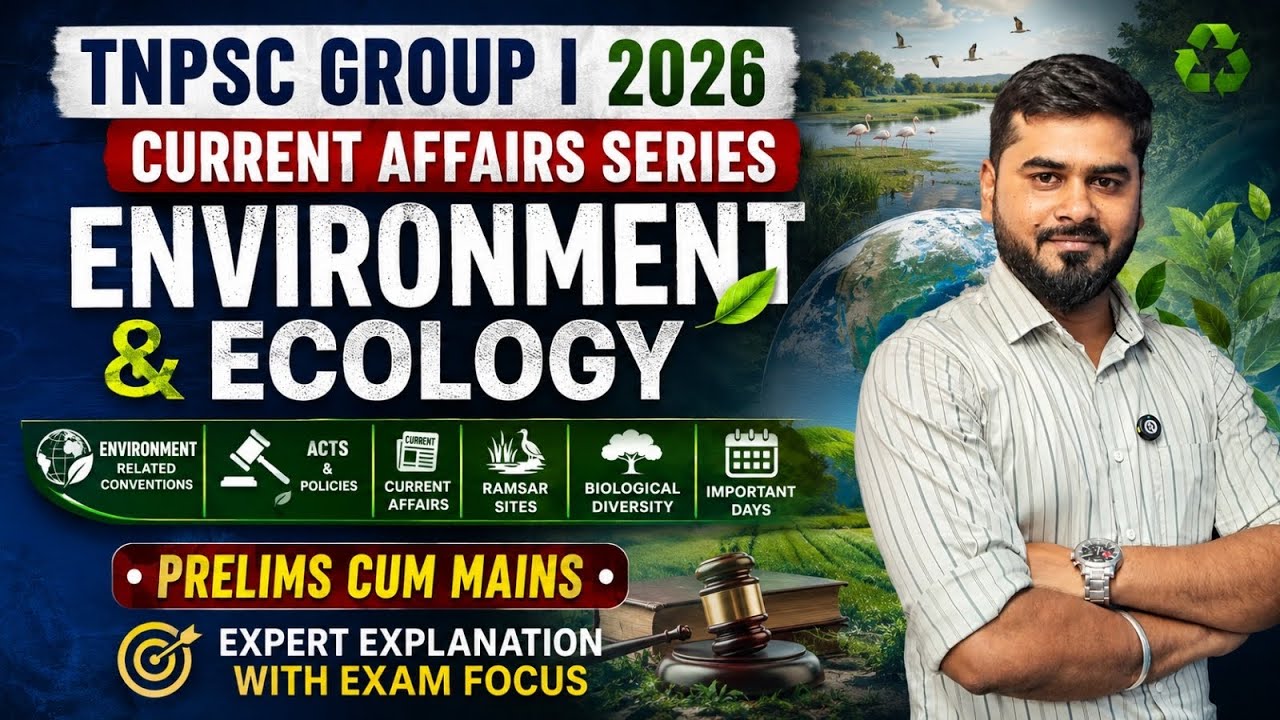
This video provides a comprehensive overview of environmental conventions, acts, and important dates, primarily focusing on their relevance for competitive exams like TNPSC Group 1. It begins by highlighting World Environment Day and India's declaration of its 100th Ramsar site. The video then delves into the history of environmental protection in India, starting from the 1972 Stockholm Conference and subsequent legislation like the Wildlife Protection Act and Project Tiger. It meticulously lists and explains various environmental days, international conventions (Ramsar, CITES, UNFCCC, CBD, etc.), and national acts. The latter half focuses on climate change, renewable energy targets, and specific initiatives like Project Tiger and the National Green Tribunal, emphasizing the importance of connecting current affairs with foundational knowledge for effective learning and exam preparation.
Save this permanently with flashcards, quizzes, and AI chat
Chapters
- The video emphasizes the importance of current affairs for competitive exams, particularly the upcoming Group 1 Prelims.
- It highlights World Environment Day (June 5th) and the recent declaration of India's 100th Ramsar site.
- The importance of understanding environmental acts, conventions, and important days is stressed for exam success.
- Learners are advised to connect current environmental news with established conventions for better retention.
- The 1972 Stockholm Conference, the first global summit on the environment, is identified as a pivotal event.
- Indira Gandhi's speech at Stockholm, linking poverty and pollution ('Poverty causes pollution'), is highlighted.
- Key Indian environmental legislation like the Wildlife Protection Act (1972) and the subsequent constitutional amendment (Article 48A) are discussed.
- The evolution of environmental laws, including the Water Act (1974), Forest Act (1980), and Environment Protection Act (1986), is traced.
- Major conservation initiatives like Project Tiger (1973) and Project Elephant (1992) are explained.
- The Biological Diversity Act of 2002 is discussed, emphasizing the need to protect all species for ecological balance.
- The establishment of the National Green Tribunal (NGT) in 2010 to handle environmental cases is noted.
- The significance of the 'Silent Spring' book by Rachel Carson (1962) in raising awareness about the harmful effects of pesticides like DDT is mentioned.
- A detailed list of important environmental days throughout the year is provided, from International Day of Clean Energy (Jan 26) to World Soil Day (Dec 5).
- The Ramsar Convention (1971) for wetlands and World Wildlife Day (March 3) are explained.
- The Vienna Convention (1985) and Montreal Protocol (1987) for ozone layer protection are discussed, including the shift from CFCs to HFCs and subsequent concerns about global warming.
- The Basel Convention (1989) on hazardous waste management and the Convention on Migratory Species (1979) are introduced.
- The Rio Earth Summit (1992) and its outcomes, including Agenda 21, the Convention on Biological Diversity (CBD), and the Framework Convention on Climate Change (UNFCCC), are discussed.
- The concept of Sustainable Development, coined by the Brundtland Commission (1987), is explained.
- The Paris Agreement (2015) and its goal to limit global warming to 1.5°C are highlighted.
- The video touches upon COP meetings (COP26, COP27, COP28) and their significance in climate negotiations.
- India's commitment to non-fossil fuel energy sources and its target of 500 GW capacity by 2030 are mentioned.
- The PM-KUSUM scheme and the PM Surya Ghar Muft Bijli Yojana for promoting rooftop solar installations are detailed.
- India's position as third globally in renewable energy capacity and Tamil Nadu's significant contribution are highlighted.
- The concept of 'Net Zero' targets for India (2070) and Tamil Nadu (2050) is introduced.
Key takeaways
- Environmental protection requires a multi-faceted approach involving legislation, international cooperation, conservation projects, and public awareness.
- Understanding the historical evolution of environmental laws and conventions is crucial for contextualizing current issues.
- International agreements like the Ramsar Convention, Montreal Protocol, and Paris Agreement play a vital role in addressing global environmental challenges.
- India has made significant strides in wildlife conservation (e.g., Project Tiger) and is actively pursuing renewable energy targets.
- Connecting current environmental news with foundational knowledge of acts and conventions significantly aids in exam preparation.
- Sustainable development aims to balance economic growth with environmental preservation for future generations.
- The role of international bodies like UNEP and NGT is critical in monitoring and enforcing environmental regulations.
Key terms
Test your understanding
- What is the significance of the 1972 Stockholm Conference in the history of environmental protection?
- How do international conventions like the Ramsar Convention contribute to wetland conservation?
- Explain the rationale behind conservation projects like Project Tiger and their ecological importance.
- What are the key objectives of the Paris Agreement, and how do they aim to address climate change?
- How are India's renewable energy targets, such as the 500 GW capacity goal, being pursued through initiatives like the PM Surya Ghar Muft Bijli Yojana?