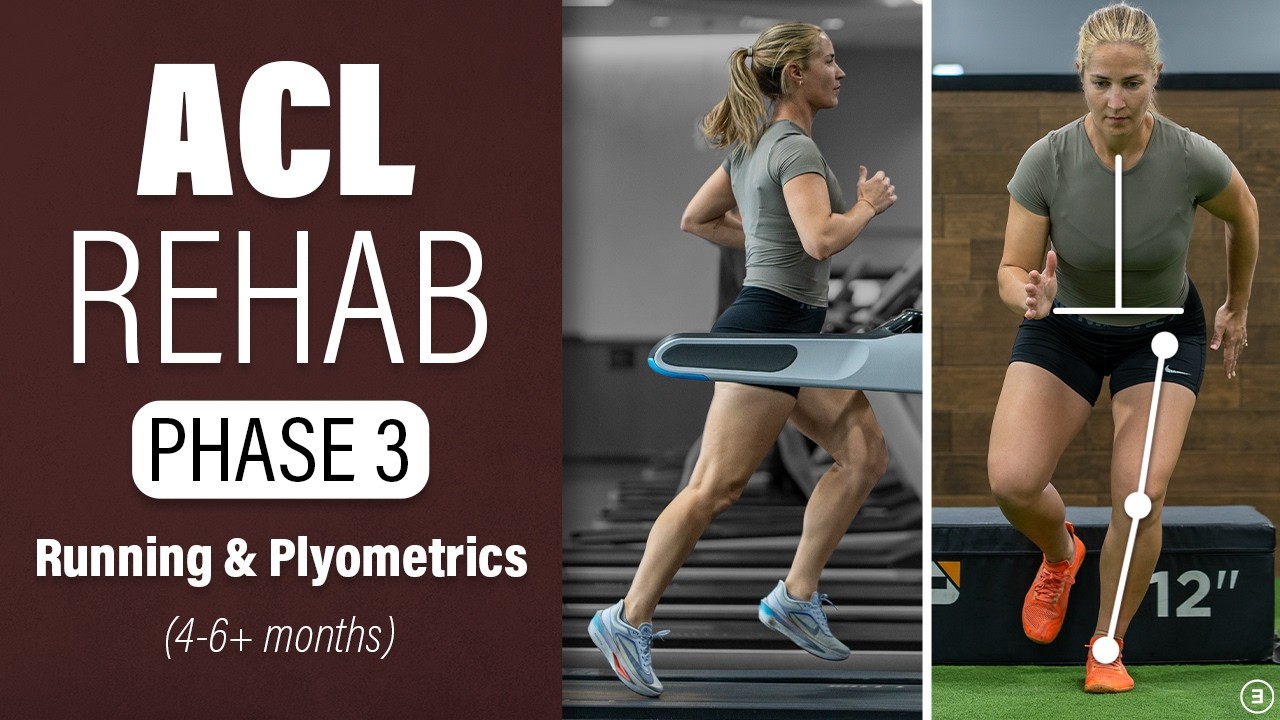
ACL Rehab: Phase 3 | 4 To 6+ Months (Jumping & Landing Exercises | Plyometrics | Running)
E3 Rehab
Overview
This video details Phase 3 of ACL rehabilitation, typically starting around 4-6 months post-surgery, focusing on advanced movements like running, jumping, landing, and plyometrics. It emphasizes the importance of a strong strength and conditioning foundation before progressing to these activities. The content covers specific exercise progressions, technique analysis in different planes of motion, and programming strategies, including integrating these exercises into existing strength routines. The video also outlines criteria for returning to running and discusses objective measures for assessing progress towards symmetry and functional recovery, stressing that rehabilitation is a long-term process.
Save this permanently with flashcards, quizzes, and AI chat
Chapters
- Phase 3 of ACL rehab focuses on running, jumping, landing, and plyometrics, typically starting around 4-6 months post-surgery.
- A strong strength and conditioning program is crucial for preparing the knee for higher-impact activities.
- Objective strength measures, like achieving 1x body mass on single-leg press and 2x on double-leg press for 8 reps, are key indicators for readiness.
- The approach prioritizes simplicity, optionality, and safety, with an emphasis on eccentric control (force absorption).
- Line hops and pogo progressions serve as introductory exercises, focusing on foot and ankle mechanics and then progressing to more complex techniques.
- Horizontal jumping progressions include submaximal and maximal broad jumps, progressing to single-leg variations.
- Vertical jump progressions start with countermovement jumps, allowing for self-regulated landing forces based on jump height.
- Advanced vertical jump techniques like drop jumps and depth jumps are introduced to develop reactive strength and maximize force output, with specific metrics like RSI (Reactive Strength Index) being important.
- Lateral movements, such as lateral squats and skater jumps, are essential for agility and sport-specific movements.
- Forward deceleration exercises, including lunges and step-and-land drills, train the body to absorb force efficiently.
- Proper technique in both frontal (side-to-side) and sagittal (front-to-back) planes is critical for knee health and preventing injury.
- Strategies to overcome weakness or compensate during deceleration include strengthening quadriceps, building confidence through practice, and using constrained variations of movements.
- Plyometric, jumping, and landing exercises can be integrated into existing strength training sessions, typically 2-3 times per week after a warm-up.
- Volume and intensity should be managed carefully, starting with lower sets and reps and avoiding maximal effort in every session.
- Returning to straight-line running requires meeting specific objective criteria, similar to those for jumping and landing, rather than just adhering to a timeline.
- A walk-jog progression is a common and controlled method to reintroduce running, gradually increasing jogging intervals and total distance.
- The ultimate goal of Phase 3 and beyond is achieving symmetry in strength, power, movement quality, and confidence between the involved and uninvolved limbs.
- Objective testing, including strength, hop tests, and jump analyses using tools like force plates, is crucial for identifying subtle deficits.
- While 80-90% symmetry is a common target, it's important to remember that ACL rehab is a long process, often taking 12 months or more.
- Phase 3 naturally blends into subsequent phases, with continuous striving for progress in all aspects of function and performance.
Key takeaways
- Phase 3 of ACL rehab is characterized by the introduction of running, jumping, landing, and plyometrics, requiring a solid strength foundation.
- Eccentric control, or the ability to absorb force, is paramount during landing and deceleration exercises.
- Progressions in plyometrics should be gradual, starting with simpler hops and jumps and advancing to more complex movements like drop jumps.
- Proper technique and biomechanical control in both frontal and sagittal planes are essential for preventing re-injury during dynamic movements.
- Integrating new exercises into a structured strength program requires careful management of volume and intensity.
- Returning to running should be guided by objective functional criteria rather than solely by time post-surgery.
- Long-term recovery focuses on achieving limb symmetry across various physical metrics, with patience and persistence being key.
Key terms
Test your understanding
- What are the primary types of exercises introduced in Phase 3 of ACL rehabilitation?
- Why is eccentric control particularly important during jumping and landing exercises?
- How can an individual assess their readiness to begin Phase 3 activities?
- What are the key differences in programming plyometric exercises compared to traditional strength training?
- What objective measures can be used to track progress towards symmetrical limb function by the end of Phase 3?