30:25
12th chemistry//the inner transition elements//lanthanoids
Edwin chemistry
Overview
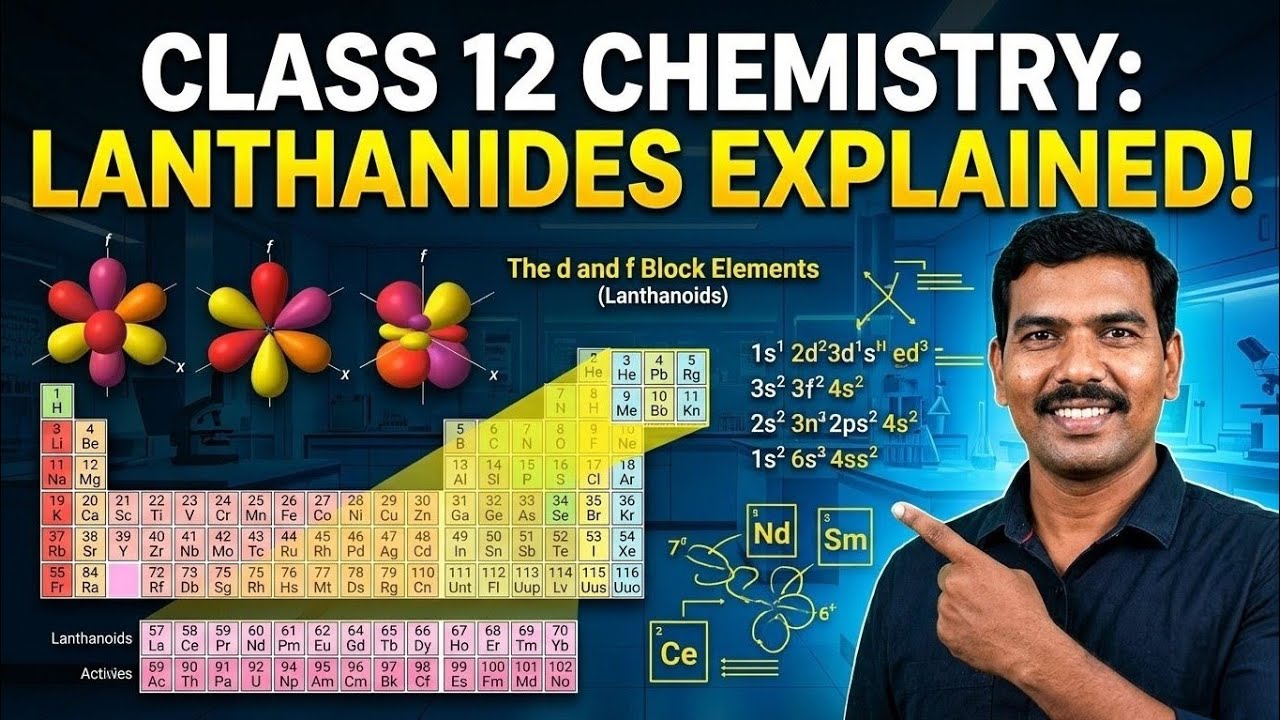
This video introduces the inner transition elements, specifically focusing on the lanthanoids. It explains their position in the periodic table, general electronic configuration, and key characteristics like atomic/ionic size, oxidation states, color, magnetic properties, ionization enthalpy, and reactivity. The discussion highlights the phenomenon of lanthanoid contraction and compares the reactivity of lanthanoids to aluminum, with examples of their reactions with halogens, acids, oxygen, sulfur, and carbon.
How was this?
Save this permanently with flashcards, quizzes, and AI chat
Chapters
- Inner transition elements, including lanthanoids and actinoids, are characterized by the filling of f-orbitals.
- Lanthanoids comprise 14 elements from Cerium (atomic number 58) to Lutetium (atomic number 71), following Lanthanum.
- Lanthanum itself is a d-block element and not technically an inner transition element, though its properties resemble the lanthanoids.
- These elements are called 'inner' transition elements because the differentiating electron enters the f-subshell of the anti-penultimate energy level (n-2).
Understanding the classification and position of lanthanoids is crucial for predicting their chemical behavior and relating them to other elements in the periodic table.
The series of lanthanoids starts after Lanthanum and includes elements like Cerium (Ce) and Lutetium (Lu).
- The general electronic configuration for lanthanoids is (n-2)f(1-14) (n-1)d(0-1) ns(2).
- Electrons fill the 4f subshell, with occasional electrons in the 5d subshell.
- Lanthanoid contraction is the gradual decrease in atomic and ionic radii across the lanthanoid series due to poor shielding by the 4f electrons.
- This poor shielding causes the nuclear charge to pull the valence electrons more strongly, reducing the size.
The unique electronic configuration and the phenomenon of lanthanoid contraction significantly influence the physical and chemical properties of these elements, particularly their size and reactivity.
As atomic number increases from Cerium to Lutetium, the atomic radius steadily decreases due to the increasing nuclear charge and the poor shielding effect of the 4f electrons.
- The most common oxidation state for all lanthanoids is +3, due to the loss of the two ns electrons and one (n-1)d or (n-2)f electron.
- Some lanthanoids exhibit additional stable oxidation states like +2 or +4.
- These exceptional states (+2, +4) are often achieved when they result in a half-filled or fully-filled f-subshell, conferring extra stability.
- Elements like Cerium (+4) and Terbium (+4) are strong oxidizing agents because they readily gain electrons to reach the more stable +3 state.
- Elements like Europium (+2) and Ytterbium (+2) can act as reducing agents, losing an electron to achieve the stable +3 state.
Understanding the variable oxidation states is key to predicting the redox behavior of lanthanoids and their applications as oxidizing or reducing agents.
Cerium (Ce) commonly exists as Ce+4, which is a strong oxidizing agent because it can easily reduce to the more stable Ce+3 state, often by oxidizing water to release oxygen.
- Lanthanoid ions exhibit color due to the presence of unpaired electrons in their 4f orbitals, allowing for f-f electronic transitions.
- Most lanthanoid ions are paramagnetic because they possess unpaired electrons.
- Exceptions like La+3 and Lu+3, which have no unpaired electrons, are diamagnetic.
- Some ions, like Ce+4 and Yb+2, which lack unpaired electrons in their f-orbitals, are diamagnetic despite appearing colored due to charge transfer transitions.
Color and magnetic properties are direct consequences of the electronic structure and presence of unpaired electrons, providing insights into the nature of bonding and electronic transitions.
The ion of Lanthanum (La+3) is colorless and diamagnetic because its 4f subshell is empty, while Lutetium (Lu+3) is also colorless and diamagnetic because its 4f subshell is completely filled (4f14).
- The first and second ionization enthalpies of lanthanoids are relatively low, similar to alkaline earth metals, reflecting the ease of losing outer electrons.
- The third ionization enthalpy is significantly higher, especially for elements that achieve a stable half-filled or fully-filled f-subshell configuration upon losing three electrons.
- Lanthanoids are reactive metals, comparable in reactivity to aluminum.
- They readily react with non-metals like oxygen, sulfur, and halogens, and also react with acids to produce hydrogen gas.
Ionization enthalpies explain the energy required to form ions, while reactivity patterns help in understanding their behavior in chemical reactions and forming compounds.
Like aluminum, lanthanoids react with oxygen to form their respective oxides (e.g., Lanthanum oxide, La2O3) and with halogens to form trihalides (e.g., Lanthanum chloride, LaCl3).
Key takeaways
- Lanthanoids are inner transition elements characterized by the filling of the 4f subshell, leading to unique chemical properties.
- Lanthanoid contraction causes a steady decrease in atomic size across the series due to poor f-orbital shielding.
- The +3 oxidation state is common for lanthanoids, but stable +2 and +4 states exist when they lead to half-filled or fully-filled f-orbitals.
- Color and magnetic properties of lanthanoid ions are directly linked to the presence and number of unpaired electrons in the 4f orbitals.
- Lanthanoids are reactive metals, exhibiting chemical behavior similar to aluminum, especially in their reactions with common non-metals and acids.
Key terms
Inner Transition ElementsLanthanoidsActinoidsLanthanoid ContractionElectronic ConfigurationOxidation StateParamagneticDiamagneticIonization Enthalpyf-orbitals
Test your understanding
- What defines an element as an 'inner transition element' based on its electronic configuration?
- Explain the phenomenon of lanthanoid contraction and its effect on atomic size.
- Why do some lanthanoids exhibit stable +2 or +4 oxidation states in addition to the common +3 state?
- How does the presence of unpaired electrons in the 4f orbitals influence the color and magnetic properties of lanthanoid ions?
- Compare the reactivity of lanthanoids with that of alkaline earth metals or group 13 elements like aluminum.