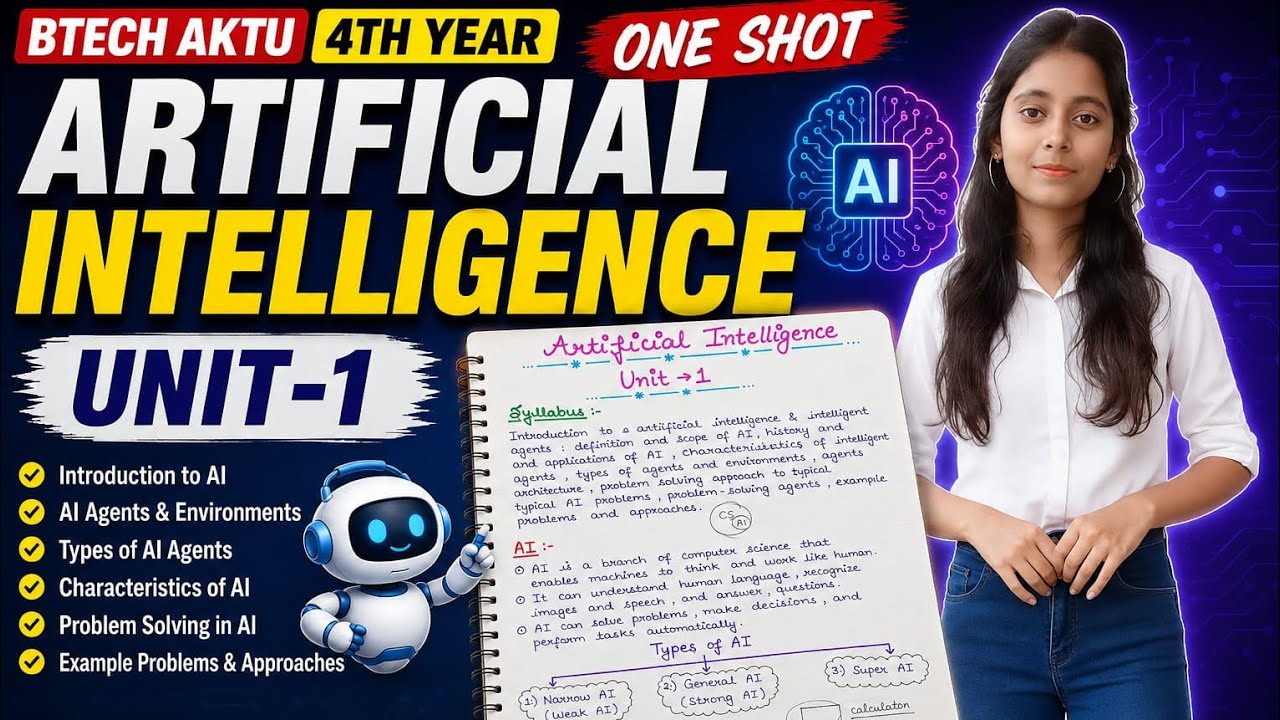
Artificial intelligence unit-1 Oneshot🔥| btech aktu #oneshot #unit1 #btech #aktu #4thyear #ai #notes
Coreconcepts:engineering
Overview
This video introduces Artificial Intelligence (AI) and Intelligent Agents, covering the definition, history, types, and scope of AI. It explains Narrow AI, General AI, and Super AI, and details AI's applications across various sectors like healthcare, education, banking, agriculture, transportation, security, and entertainment. The history of AI is traced from early concepts to modern advancements, including the 'AI Winter'. The video also discusses the drawbacks of AI, such as job loss and lack of human emotion. Finally, it delves into the concept of Intelligent Agents, their types (simple reflex, model-based, goal-based, utility-based, learning agents), characteristics (autonomy, perception, reactivity, proactiveness, learning ability, communication), and the problem-solving approach used by AI agents, including their architecture and components.
Save this permanently with flashcards, quizzes, and AI chat
Chapters
- AI is a branch of computer science enabling machines to think, reason, and act like humans, understanding language, recognizing patterns, and solving problems.
- AI can be categorized into Narrow AI (or Weak AI), designed for specific tasks (e.g., calculators, chatbots), and General AI (or Strong AI), capable of performing any intellectual task a human can.
- Super AI is a hypothetical future AI that would surpass human intelligence.
- Current AI applications predominantly utilize Narrow AI, while General AI remains under research.
- AI has a broad scope across various industries, including healthcare for disease detection and treatment suggestions, and education for personalized learning.
- In banking and finance, AI detects fraud and secures transactions; in agriculture, it monitors crops and predicts weather; in transportation, it powers self-driving cars and optimizes routes.
- AI enhances security through face recognition and threat detection, and in entertainment, it recommends content and is used in gaming and content creation.
- The applications of AI directly mirror its scope, demonstrating its wide-ranging impact on daily life and industry.
- Early ideas of AI emerged before 1950, with scientists imagining machines that could think like humans.
- AI officially began with the Dartmouth Conference in 1956, where John McCarthy coined the term 'Artificial Intelligence' and is considered the father of AI.
- The early development phase (1956-1970) saw rapid progress with programs solving math problems and playing games, but was limited by slow computers and memory.
- The 'AI Winter' (1970s-1980s) saw a slowdown in research due to computational limitations and unmet expectations, leading to reduced investment.
- Expert systems (1980s-1990s), machine learning (1990s-2010s), and deep learning (2010s-present) have driven modern AI's power and capabilities, enabling complex tasks like content creation.
- A significant drawback is potential job loss as AI automates tasks previously done by humans.
- AI lacks human emotions, feelings, and empathy, limiting its ability to understand nuanced human interactions.
- Current AI cannot use common sense or make decisions in unexpected situations, as General AI, which would possess such capabilities, is still under research.
- AI systems require continuous maintenance, updates, and monitoring, which are time-consuming and costly.
- AI's performance is heavily dependent on the quality and quantity of data; incorrect or incomplete data can lead to flawed results.
- An AI agent is a software program that perceives its environment, makes decisions, and takes actions autonomously to achieve goals.
- Types of AI agents include simple reflex agents (current situation only), model-based reflex agents (current + past info), goal-based agents (achieve specific goals), utility-based agents (optimize for best results), and learning agents (improve from experience).
- Intelligent agents possess characteristics like autonomy (independent operation), perception (sensing the environment), reactivity (responding to changes), proactiveness (goal-oriented planning), learning ability, and communication.
- The architecture of an intelligent agent involves an environment, sensors to perceive, an agent program to process and decide, and effectors to act.
- AI problem-solving involves defining the problem, identifying the initial state, setting a goal state, listing possible actions, searching for the best solution, executing it, and evaluating the outcome.
- A problem-solving agent is an intelligent agent specifically designed to find the best solution to a given problem.
- Key components of problem formulation include the initial state, goal state, possible actions, successor function (determining the next state), and path cost (cost to reach a state).
- The process ensures that AI systems can systematically approach and resolve challenges, optimizing for efficiency and effectiveness.
Key takeaways
- AI aims to replicate human intelligence in machines, enabling them to perform tasks like reasoning, learning, and problem-solving.
- The distinction between Narrow AI (task-specific) and General AI (human-like versatility) is fundamental to understanding current AI capabilities and future aspirations.
- AI's impact is vast, with applications transforming industries from healthcare and finance to transportation and entertainment.
- The historical development of AI, marked by periods of rapid advancement and 'AI Winters,' highlights the iterative nature of technological progress.
- While powerful, AI has limitations, including a lack of human emotion, common sense, and reliance on extensive data, necessitating careful consideration of its drawbacks.
- Intelligent agents are the core components of AI systems, characterized by their ability to perceive, decide, and act autonomously.
- A systematic problem-solving approach, involving defining states, actions, and costs, allows AI agents to find optimal solutions efficiently.
Key terms
Test your understanding
- What is the fundamental difference between Narrow AI and General AI, and provide an example of each?
- How has the history of AI, including periods like the 'AI Winter,' influenced its current development trajectory?
- Describe the key characteristics of an intelligent agent and explain why each is important for its functionality.
- Outline the steps involved in the problem-solving approach used by AI agents and explain the significance of each step.
- What are the main drawbacks of current AI systems, and how might these limitations impact their future applications?