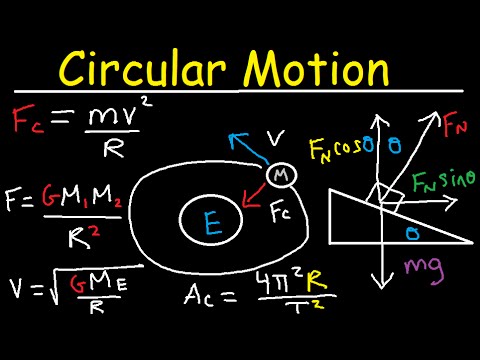
Centripetal Acceleration & Force - Circular Motion, Banked Curves, Static Friction, Physics Problems
The Organic Chemistry Tutor
Overview
This video explains the principles of centripetal acceleration and force, which are essential for understanding circular motion. It details how a force perpendicular to velocity causes an object to change direction, moving in a circle. The video explores various sources of centripetal force, including tension, gravity, and friction, and provides the formula for centripetal force (Fc = mv^2/r). It also covers related concepts like centripetal acceleration, frequency, period, and speed in circular motion, and applies these principles to real-world scenarios such as satellite orbits, banked curves, and vertical circles. Finally, it delves into Newton's Law of Universal Gravitation and its applications.
Save this permanently with flashcards, quizzes, and AI chat
Chapters
- When a force is parallel to velocity, an object speeds up; when anti-parallel, it slows down.
- A force perpendicular to velocity does not change the object's speed but changes its direction.
- This perpendicular force, called centripetal force, causes an object to move in a circular path.
- Centripetal force is always directed towards the center of the circle (center-seeking).
- Centripetal force is not a new type of force but is provided by other forces.
- Tension in a rope provides centripetal force for objects swung in a circle.
- Gravity provides the centripetal force for celestial bodies like the Moon orbiting Earth or Earth orbiting the Sun.
- Static friction between tires and the road provides centripetal force for cars turning.
- Normal force can provide centripetal force on curved roads or banked turns.
- The formula for centripetal force is Fc = mv^2/r.
- Centripetal force is directly proportional to mass and the square of velocity, and inversely proportional to the radius.
- Doubling the speed quadruples the centripetal force; tripling the radius reduces the force by a factor of nine.
- Centripetal acceleration (ac) is given by ac = v^2/r and also points towards the center of the circle.
- Centripetal acceleration can also be expressed in terms of period (T) as ac = 4π^2r/T^2.
- Frequency (f) is the number of revolutions per second.
- Period (T) is the time taken for one complete revolution, and T = 1/f.
- The speed (v) of an object in circular motion is the circumference (2πr) divided by the period (T), so v = 2πr/T.
- These relationships allow calculation of speed and acceleration using period or frequency.
- In horizontal circles, tension or friction often provides the centripetal force, but weight must also be considered for accurate tension calculations.
- In vertical circles, the tension or normal force varies with position, being greatest at the bottom and least at the top.
- At the top of a vertical circle, the minimum speed required to maintain circular motion occurs when the tension approaches zero.
- The minimum speed at the top of a vertical circle is √(gr).
- Gravity is a force of attraction between any two objects with mass.
- The gravitational force is directly proportional to the product of the masses and inversely proportional to the square of the distance between their centers (F = Gm1m2/r^2).
- The gravitational constant (G) is approximately 6.67 x 10^-11 N m^2/kg^2.
- This law explains planetary orbits, satellite motion, and the acceleration due to gravity on different celestial bodies.
- Gravitational acceleration (g) on a planet's surface is calculated as g = GM/r^2, where M is the planet's mass and r is its radius.
- Gravitational acceleration decreases with altitude.
- The speed and period of a satellite in orbit can be calculated by equating gravitational force to centripetal force.
- For a satellite, v = √(GM/r) and T = 2π√(r^3/GM), where r is the distance from the planet's center.
Key takeaways
- An object moving in a circle experiences a centripetal force directed towards the center, which changes its direction but not its speed.
- Various forces like tension, gravity, and friction can act as the centripetal force, depending on the situation.
- The magnitude of centripetal force is directly related to mass and the square of velocity, and inversely related to the radius of the circular path.
- Understanding the relationship between centripetal force and acceleration is key to solving circular motion problems.
- Frequency and period are essential measures for describing the rate and duration of circular motion.
- Newton's Law of Universal Gravitation governs the attractive force between any two masses, explaining phenomena from planetary orbits to weight on different celestial bodies.
- The acceleration due to gravity on a planet depends on its mass and radius, and decreases with altitude.
- Satellites maintain orbit when the gravitational force provides the exact centripetal force needed for their speed and altitude.
Key terms
Test your understanding
- What is the primary effect of a force acting perpendicular to an object's velocity?
- How does doubling an object's speed affect the centripetal force required to keep it moving in a circle of the same radius?
- What are at least three different physical forces that can provide the centripetal force necessary for circular motion?
- How does the gravitational force between two objects change if the distance between them is tripled?
- What is the relationship between the centripetal acceleration of a satellite and the gravitational force exerted by the planet it orbits?