1:36:04
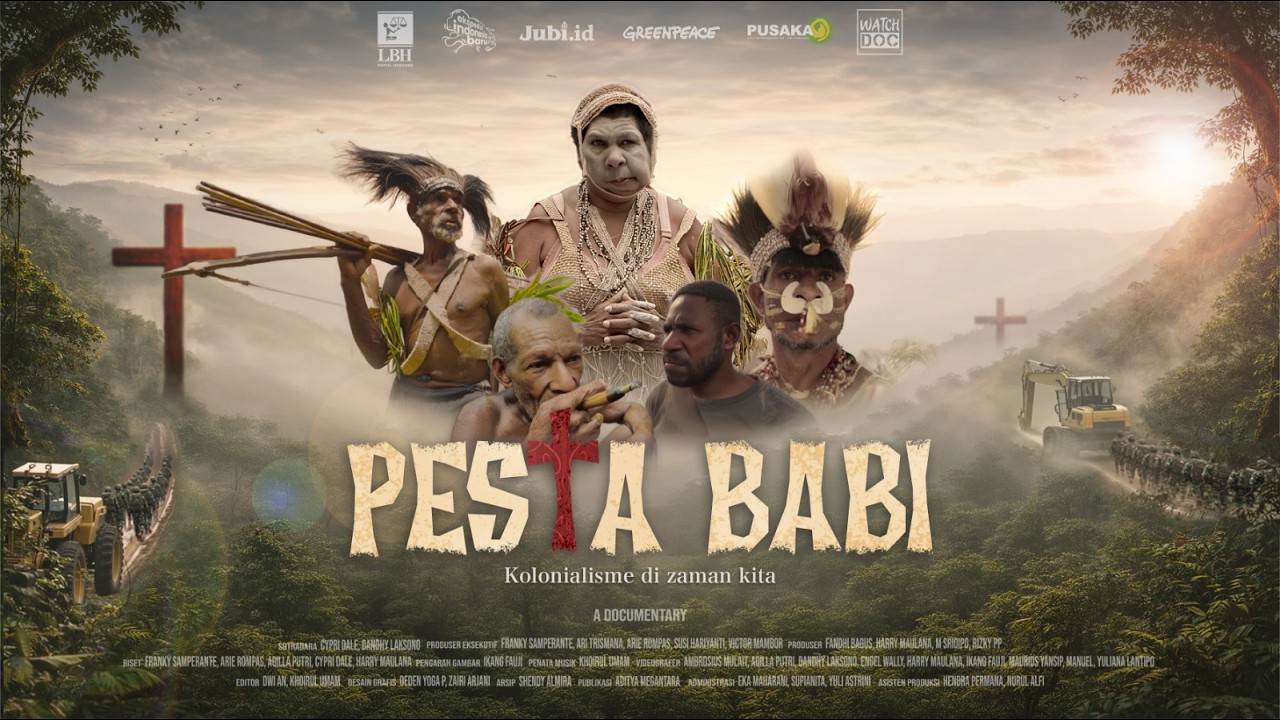
PESTA BABI: Kolonialisme di Zaman Kita - (Official Full Movie)
Redaksi JubiTV
Overview
This video exposes the ongoing colonial practices in Papua, Indonesia, where vast tracts of rainforest are being converted for industrial agriculture and energy projects. It highlights the resistance of indigenous communities, such as the Awyu and Muyu tribes, who use cultural practices like erecting red crosses and holding traditional feasts as forms of protest against government and corporate encroachment. The film details how these projects, driven by national strategic interests for food and energy security, threaten the environment, cultural heritage, and the very existence of indigenous peoples, mirroring historical patterns of exploitation and displacement.
How was this?
Save this permanently with flashcards, quizzes, and AI chat
Chapters
- Indigenous communities in South Papua, like the Awyu and Muyu tribes, are using cultural symbols as a form of resistance against large-scale government projects.
- The Awyu people erect large red crosses, symbolizing a prohibition and a declaration of war against those who threaten their ancestral lands and forests.
- The Muyu people organize traditional pig feasts ('Awon Atatbon') as a way to consolidate their community and prepare for potential threats, a practice requiring ten years of preparation.
- These cultural acts are not merely symbolic but represent a deep connection to the land and a strategy to defend their way of life against external pressures.
Understanding these cultural symbols and practices is crucial to grasping the depth of indigenous resistance and their profound connection to their ancestral lands, which are under threat.
The Awyu tribe erects a 17-meter-long wooden cross as a symbol of their resistance against the Indonesian government's plans to convert 2.5 million hectares of forest for industrial plantations.
- The Indonesian government is implementing a 'National Strategic Project' to develop 2.5 million hectares of land in Papua for industrial food and energy crops.
- This project includes vast areas for rice paddies (1.3 million hectares), sugarcane for sugar and bioethanol (560,000 hectares), palm oil for biodiesel (400,000 hectares), and livestock farming (380,000 hectares).
- The project is driven by ambitions for national food and energy self-sufficiency, aiming to reduce reliance on imports and promote biofuels.
- Ten companies, all owned by a single family, are involved in this massive land conversion project.
This chapter explains the scale and objectives of the government's development plan, revealing the immense pressure on Papua's natural resources and indigenous territories.
The project plans to convert 1.3 million hectares into rice paddies and 560,000 hectares for sugarcane to produce bioethanol, which will be blended into gasoline (E-10).
- Indigenous individuals like Yasinta Moiwend, Natalis Buer, Vincen Kwipalo, Franky Woro, and Wilem Kimko represent the diverse impacts on Papuan communities.
- Communities are losing their traditional lands, forests, and swamps, which are vital for their food, economy, and cultural practices.
- The projects are often accompanied by military presence, intimidation, and a lack of consultation with local populations, who are treated as if Papua is 'empty land'.
- Many indigenous people lack the capital, resources, or skills to participate in or benefit from the new agricultural systems, leading to displacement and marginalization.
This section illustrates the human cost of the development projects, showing how they directly disrupt the lives, livelihoods, and cultural integrity of indigenous peoples.
Yasinta Moiwend from the Marind tribe in Merauke has lost her forest and swamp areas, crucial for her livelihood, due to the construction of a 135-kilometer road and the planned conversion of 1 million hectares into rice fields.
- The projects are linked to powerful business figures, such as Haji Isam (Andi Syamsudin Arsyad) of Jhonlin Group and the Fangiono family, who are major players in the palm oil, sugar, and bioenergy industries.
- These business leaders have strong ties to political figures, including former and current government officials and ministers, suggesting a symbiotic relationship benefiting both industry and politics.
- The scale of these agro-industrial ventures, particularly in bioenergy (biodiesel and bioethanol), is driven by national policies and ambitions, often overriding local concerns.
- Historical parallels are drawn to past colonial practices, where resource exploitation enriched foreign powers and local elites at the expense of indigenous populations.
Understanding the influence of powerful business and political elites is key to recognizing the systemic nature of resource exploitation and its historical roots in colonialism.
The Jhonlin Group, owned by Haji Isam, is a major contractor for the food and energy project, utilizing massive machinery like 2,000 excavators, and is linked to figures like former President Joko Widodo and current President Prabowo.
- The presence of the Indonesian military in Papua is significantly higher than the national average, with soldiers often involved in non-combat operations, including guarding government and corporate projects.
- The military's involvement is justified by the government as necessary for national security, including protecting food and energy resources, framing these projects as 'operations other than war'.
- This militarization exacerbates existing tensions and trauma among indigenous communities, who have a long history of experiencing violence, displacement, and human rights abuses dating back to the 1960s.
- The large military presence is disproportionate to the armed resistance from groups like the OPM, suggesting a broader strategy of control and resource management.
This section highlights how militarization is intertwined with resource extraction and state control, perpetuating a cycle of conflict and dispossession in Papua.
There is one soldier for every 100 Papuans, a ratio significantly higher than the national average, with many soldiers involved in guarding development projects rather than direct combat.
- A significant portion of the land allocated for the National Strategic Project is dedicated to producing crops for biofuels (biodiesel from palm oil, bioethanol from sugarcane and cassava), rather than solely for food security.
- The push for bioenergy, such as the E-10 mandate for gasoline, requires vast amounts of land, potentially leading to the clearing of an additional 800,000 hectares of forest for sugarcane cultivation in Papua alone.
- This shift from food production to fuel production creates a direct conflict between human consumption needs and vehicle fuel demands, potentially driving up food prices globally.
- The environmental consequences include deforestation, destruction of ecosystems, pollution of water sources, and loss of biodiversity, impacting traditional livelihoods dependent on these natural resources.
This chapter reveals the hidden agenda behind the 'food and energy' projects, emphasizing the environmental trade-offs and global implications of prioritizing biofuel production over sustainable land use.
The government's plan to increase bioethanol content in gasoline to 10% (E-10) requires an estimated 1.3 million hectares for sugarcane, with 500,000 hectares of this planned for Papua, transforming forests into fuel farms.
- The current land grabs and resource exploitation in Papua are framed as a continuation of historical colonial practices, where external powers and local elites benefited at the expense of indigenous peoples.
- Historical examples, from Dutch colonial sugar plantations in Java and Suriname to British sugar estates in Fiji and Spanish plantations in the Caribbean, illustrate the long-standing pattern of exploiting land and labor for profit.
- The projects in Papua, particularly the large-scale cultivation of sugarcane for bioethanol and palm oil for biodiesel, mirror these historical patterns, with indigenous lands being converted for industrial purposes.
- The film argues that despite modern advancements, the fundamental dynamics of exploitation, displacement, and the prioritization of economic gain over human and environmental well-being persist, akin to historical colonialism.
Drawing parallels between past and present colonialism helps learners understand that the struggles in Papua are not isolated incidents but part of a long historical continuum of exploitation.
The video compares the current large-scale land concessions for sugarcane in Papua to the Dutch colonial 'cultuurstelsel' (cultivation system) in Java, where indigenous people were forced to grow cash crops for export.
Key takeaways
- Indigenous resistance in Papua utilizes cultural practices and symbols as powerful tools against land appropriation and environmental destruction.
- Indonesia's National Strategic Project for food and energy is a massive land-use transformation with significant environmental and social consequences for indigenous communities.
- Powerful business conglomerates and political elites are deeply involved in these projects, benefiting from policies that prioritize industrial agriculture and biofuels over local needs and environmental sustainability.
- The militarization of Papua is intrinsically linked to the protection of these development projects, exacerbating historical conflicts and human rights concerns.
- The drive for biofuels like biodiesel and bioethanol is a major factor behind the land conversion, creating a global competition between food and fuel production.
- Current events in Papua echo historical patterns of colonialism, where resource exploitation enriches elites while indigenous populations face displacement and cultural erosion.
- The voices and agency of indigenous women are crucial in resisting these changes and advocating for the protection of their ancestral lands and cultural heritage.
Key terms
ColonialismIndigenous ResistanceNational Strategic Project (PSN)Food EstateBiofuelBiodieselBioethanolLand ConcessionAncestral LandsMilitarizationCultural PracticesAgribusiness
Test your understanding
- How do indigenous communities in Papua use cultural practices like red crosses and traditional feasts as forms of resistance against government development projects?
- What are the primary goals of Indonesia's National Strategic Project in Papua, and what are the main types of land use planned?
- Describe the impact of these large-scale agricultural and energy projects on the lives and livelihoods of specific indigenous individuals and communities mentioned in the video.
- What is the connection between powerful business elites, political figures, and the implementation of the food and energy projects in Papua?
- How has the militarization of Papua been justified in relation to these development projects, and what are the historical and social consequences of this military presence?