36:53
L8: Parts of speech(verb, noun & pronoun)
IIT Madras - B.S. Degree Programme
Overview
This video introduces the fundamental concept of parts of speech in English, focusing on verbs, nouns, and pronouns. It explains that parts of speech are categories of words based on their function within a sentence. The video details the characteristics of verbs as action or state-of-being words that carry tense and are essential for sentence formation. It then defines nouns as naming words for people, places, things, or ideas, and introduces their classifications. Finally, it explains pronouns as words that replace nouns to avoid repetition and improve sentence flow, providing examples of both subject and object pronouns.
How was this?
Save this permanently with flashcards, quizzes, and AI chat
Chapters
- Parts of speech are categories that classify words based on their function and role in a sentence.
- There are eight main parts of speech in English: nouns, pronouns, verbs, adjectives, adverbs, prepositions, articles, and conjunctions.
- Understanding parts of speech is crucial for mastering English grammar and improving language proficiency.
- This lesson will focus on verbs, nouns, and pronouns.
Knowing the different parts of speech provides a framework for understanding how sentences are constructed and how words interact, which is essential for both comprehension and effective communication.
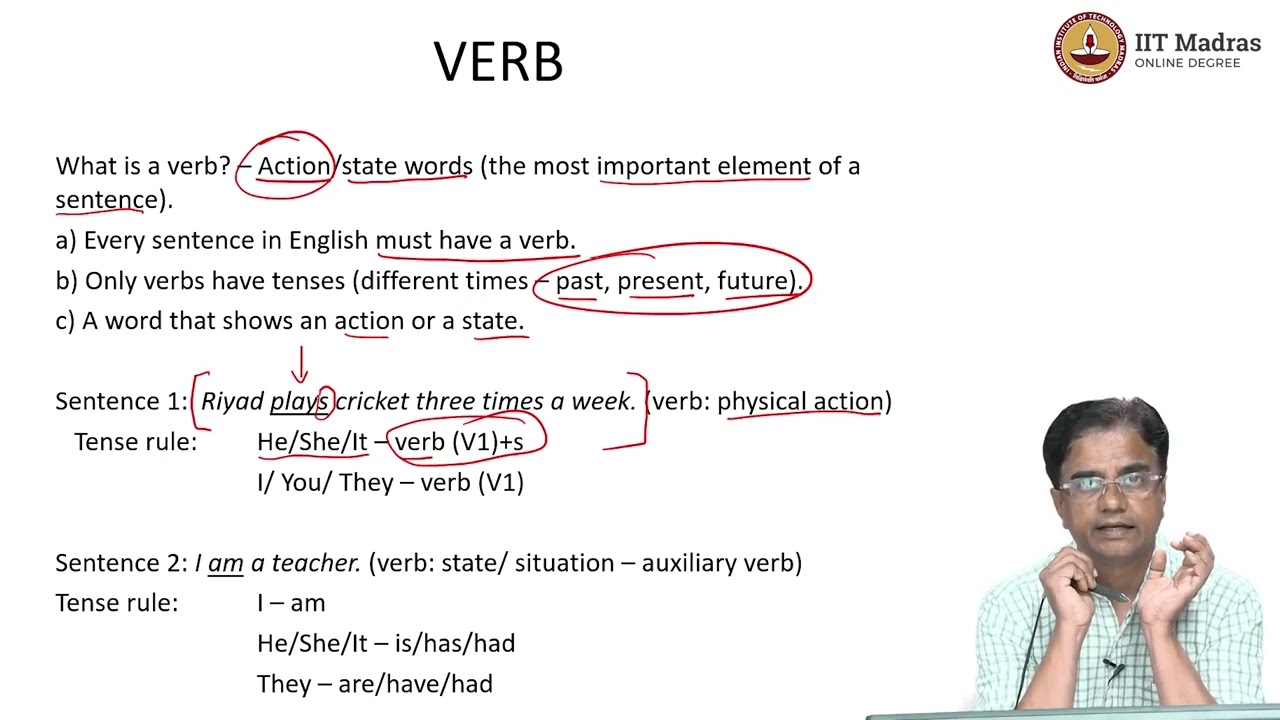
- Verbs are words that express actions or states of being.
- Every sentence must contain a verb; without one, it is not a complete sentence.
- Verbs are the only part of speech that carry tense (past, present, future), indicating when an action or state occurs.
- Verbs can be action verbs (e.g., 'play') or auxiliary/helping verbs that indicate state (e.g., 'am', 'is', 'are').
Verbs are the engine of sentences, driving the action or describing the state, and their correct use is fundamental to forming grammatically sound and meaningful expressions.
In 'Riyad plays cricket,' 'plays' is an action verb indicating a present tense activity. In 'I am a teacher,' 'am' is an auxiliary verb indicating a state of being in the present tense.
- Nouns are words that name people, places, things, animals, feelings, or ideas.
- Nouns can be classified as countable (e.g., 'cat', 'book') or uncountable (e.g., 'water', 'gravity').
- Further classifications include proper nouns (specific names like 'Arjun'), class nouns (referring to a whole category like 'cat'), collective nouns (groups like 'cabinet'), abstract nouns (ideas like 'gravity'), and material nouns (substances like 'gold').
- Identifying features of nouns include their ability to be made plural and their typical placement after articles or prepositions.
Nouns provide the subjects and objects within sentences, giving substance and specificity to our communication by naming the entities involved.
In 'Arjun went to Greece for vacation with his family,' Arjun (person), Greece (place), vacation (thing/event), and family (group) are all nouns.
- Pronouns are words that take the place of nouns in a sentence.
- They are used to avoid repetition and make sentences sound more natural and less awkward.
- Pronouns can be subject pronouns (e.g., 'I', 'he', 'she', 'they') or object pronouns (e.g., 'me', 'him', 'her', 'them').
- The correct use of pronouns, especially regarding agreement with the noun they replace, is important for clarity.
Pronouns streamline sentences by acting as shortcuts for nouns, preventing redundancy and improving the flow and readability of written and spoken language.
Instead of saying 'Rahul went to Kerala with Rahul's mother. He really enjoyed spending time with Rahul's mother,' we use pronouns: 'Rahul went to Kerala with his mother. He really enjoyed spending time with his mother.'
Key takeaways
- Parts of speech categorize words by their grammatical function, essential for understanding sentence structure.
- Verbs are critical as they denote action or state and are the sole carriers of tense, making them indispensable to every sentence.
- Nouns name entities and can be categorized by countability, specificity, and type (proper, class, collective, abstract, material).
- Pronouns substitute for nouns to enhance sentence fluency and avoid repetition.
- Mastering verbs, nouns, and pronouns is a foundational step toward grammatical accuracy and confidence in English.
- The choice of verb often depends on the singularity or plurality of the subject.
- Pronouns like 'you' grammatically take plural verb forms even when referring to a single person.
Key terms
Parts of SpeechVerbAction WordState of BeingTenseAuxiliary VerbHelping VerbNounNaming WordCountable NounUncountable NounProper NounClass NounCollective NounAbstract NounMaterial NounPronounSubject PronounObject Pronoun
Test your understanding
- What are the two primary functions of verbs in a sentence?
- Why is it important for every sentence to have a verb?
- How do nouns function within a sentence, and what are the main categories they can be divided into?
- What is the main purpose of using pronouns in English sentences?
- Explain the difference between an action verb and an auxiliary verb with examples.