The Reconquista: Part I – Dr. Roy | Museum of the Future: Lessons from the Past
Dr. Roy Casagranda
Overview
This video explores the historical context leading up to the Reconquista in Iberia, focusing on the complex cultural and political shifts that shaped the region. It begins by examining the origins of community property divorce law, tracing its lineage through Visigothic and Islamic Spain to Texas. The narrative then delves into the decline of the Roman Empire, the migrations of Germanic tribes, and the initial settlement of Iberia by various groups, including Celts and Romans. The subsequent Arab conquest of Iberia in the 8th century is detailed, emphasizing the initial lack of religious conflict and the establishment of the Umayyad Emirate of Cordoba. The summary highlights the cultural and intellectual flourishing under Umayyad rule, particularly in Cordoba, and touches upon the evolving dynamics between Muslim, Christian, and Jewish populations, setting the stage for later conflicts.
Save this permanently with flashcards, quizzes, and AI chat
Chapters
- Community property divorce law, found in some US states like Texas, has surprising historical origins.
- This law's lineage can be traced back through Spanish and Mexican legal systems, despite those societies historically having restrictions on divorce.
- The actual origin lies not with the Visigoths, who had very limited divorce conditions, but with Islamic law in Al-Andalus.
- Islamic law allowed for divorce as a contractual matter, and to prevent men from easily divorcing wives to 'upgrade,' a law was enacted where all marital wealth was split upon divorce, significantly reducing divorce rates.
- The Roman Empire in the 3rd century AD began to collapse due to internal strife, overextension, and technological limitations in communication and supply.
- Emperor Diocletian attempted to stabilize the empire by dividing it into four administrative regions (the tetrarchy), and later emperors like Constantine reunified and then split it into Eastern and Western halves, but the decline continued.
- The Roman Empire's conversion to Christianity did not halt its unraveling.
- Germanic tribes, fleeing the Huns, sought refuge within the Roman Empire but were mistreated, leading to rebellions, such as the Goths, who eventually invaded Spain.
- Iberia (the Iberian Peninsula) was inhabited by various groups before the arrival of Germanic tribes and later the Arabs.
- Most modern European languages, including English, Spanish, and Italian, are not native European but derived from Indo-European (Aryan) migrations that began around 3,200 years ago.
- The Celts were among the early Aryan invaders, spreading across northern Iberia and beyond.
- Other groups like the Latins, Greeks, and Carthaginians also had influence, and the Romans eventually conquered the region, naming it Hispania.
- Unique linguistic groups like the Basque, who speak a native European language, and the Galicians, with strong Celtic roots, persisted despite Romanization.
- Following the collapse of the Western Roman Empire, Germanic tribes, including the Vandals and Visigoths, invaded and settled in Iberia.
- The Visigoths eventually established a kingdom in Iberia, but their rule was marked by internal conflicts.
- The Vandals, known for their mathematical skills, migrated from Iberia to North Africa, conquering it and even sacking Rome, leading to the term 'vandalize'.
- The Visigothic kingdom was not a unified or stable entity, setting the stage for external conquest.
- In 710 AD, an Arab expedition led by Tariq ibn Ziyad, likely with the assistance of disgruntled Visigoths, crossed the Strait of Gibraltar into Iberia.
- The conquest was rapid, taking only three years (711-714 AD) to subdue most of the peninsula, with the Visigothic kingdom collapsing after the death of King Roderic.
- The initial Arab Empire was diverse, with a Muslim minority ruling over a Christian and other religious majority, indicating that the conquest was not initially a religious war.
- The Arabs established their capital first in Seville and then moved it to Cordoba, creating the Umayyad Emirate of Al-Andalus, which marked the first major break from the larger Arab Empire.
- The Umayyad Emirate of Cordoba, established by Abd al-Rahman I, was a state with a Muslim minority ruling a predominantly Christian population.
- To survive and thrive, the Umayyads fostered a policy of tolerance, integrating Christians and Jews into the bureaucracy and military.
- Rulers like Abd al-Rahman I and his successors, such as Abd al-Rahman II and Abd al-Rahman III, presided over periods of significant cultural and intellectual growth.
- Figures like Ziryab, a polymath slave, introduced innovations in music (flamenco's roots), fashion, cuisine (three-course meal), hygiene, and education, transforming Cordoban society.
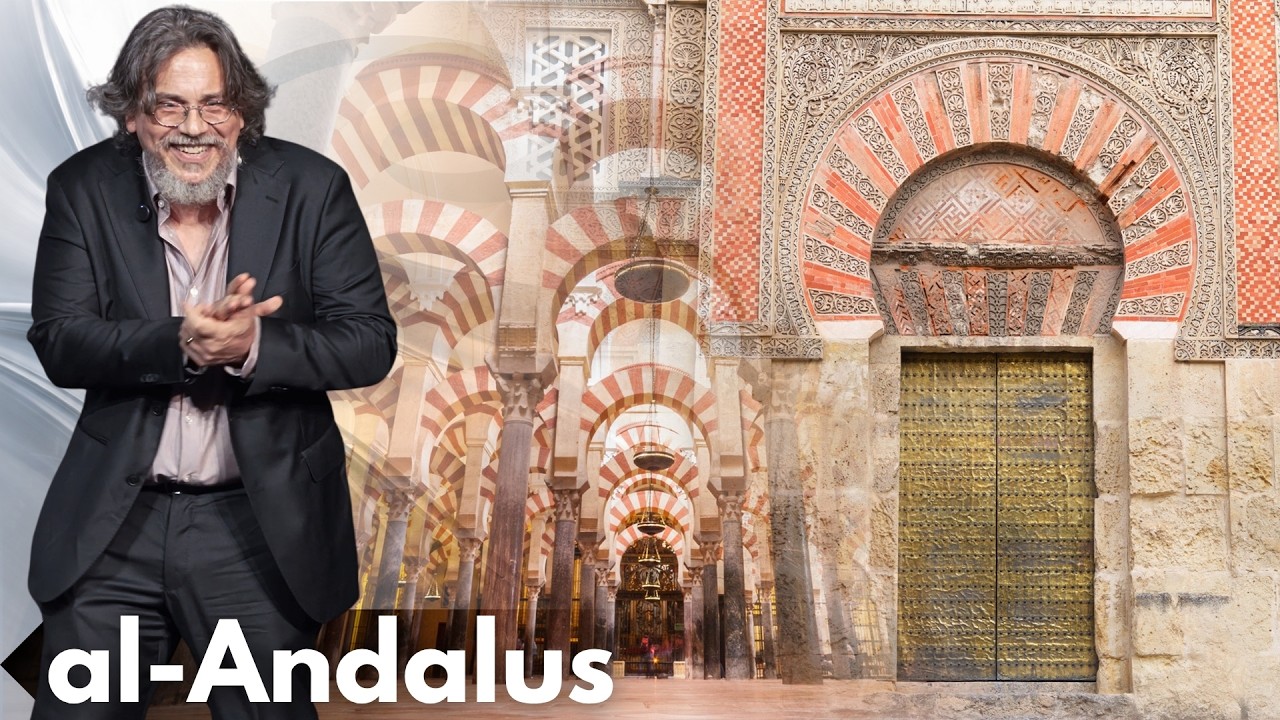
- The construction of the Great Mosque of Cordoba, blending Roman, Visigothic, and Islamic architectural styles, symbolizes this era of cultural synthesis and architectural achievement.
- Historical narratives are often distorted by modern biases, leading to anachronistic interpretations of past conflicts, such as viewing the Umayyad conquest as a purely Muslim-Christian war.
- The 'Reconquista' is a complex term, as the continuous presence of a Christian population in the north (Asturias) and the changing demographics over centuries challenge the idea of simply 're-conquering' lost territory.
- Internal divisions within the Muslim population, like the Syrian-Yemeni split, and external pressures, such as Berber revolts and Viking raids, tested the stability of Al-Andalus.
- The 'Song of Roland,' a French epic, misrepresents the historical encounter between Charlemagne and the Umayyads, portraying it as a Christian-Muslim conflict when it was more about political alliances and Basque resistance.
- The Umayyad rulers, despite their power, often ruled as a minority, necessitating policies of tolerance and cooperation with Christian and Jewish populations to maintain stability.
Key takeaways
- Legal systems, like community property divorce law, often have deep, non-obvious historical roots that span multiple cultures and eras.
- The fall of empires is rarely sudden but a gradual process influenced by internal weaknesses and external pressures.
- Iberia was a crossroads of cultures long before the Reconquista, shaped by migrations and conquests from various peoples.
- The Arab conquest of Iberia was not initially a religious war but a political and military expansion that led to a unique period of cultural synthesis.
- The Umayyad Emirate of Cordoba fostered an environment of tolerance and intellectual achievement, making it a leading center of learning in medieval Europe.
- Historical interpretations are often colored by present-day biases, requiring critical analysis to understand past events accurately.
- The concept of 'Reconquista' is debated, as the continuous presence of Christian kingdoms in the north and the evolving nature of Iberian society complicate a simple narrative of 're-conquest'.
Key terms
Test your understanding
- How did Islamic legal principles, rather than Visigothic ones, influence the development of community property divorce law found in some parts of the United States?
- What were the primary factors that contributed to the decline and eventual collapse of the Western Roman Empire?
- Describe the diverse populations and cultural influences present in Iberia prior to the Arab conquest.
- What were the key characteristics of the Umayyad Emirate of Cordoba, and how did it foster a period of cultural and intellectual flourishing?
- How do modern biases and nationalist sentiments distort our understanding of historical events like the Arab conquest of Iberia and the 'Song of Roland' narrative?