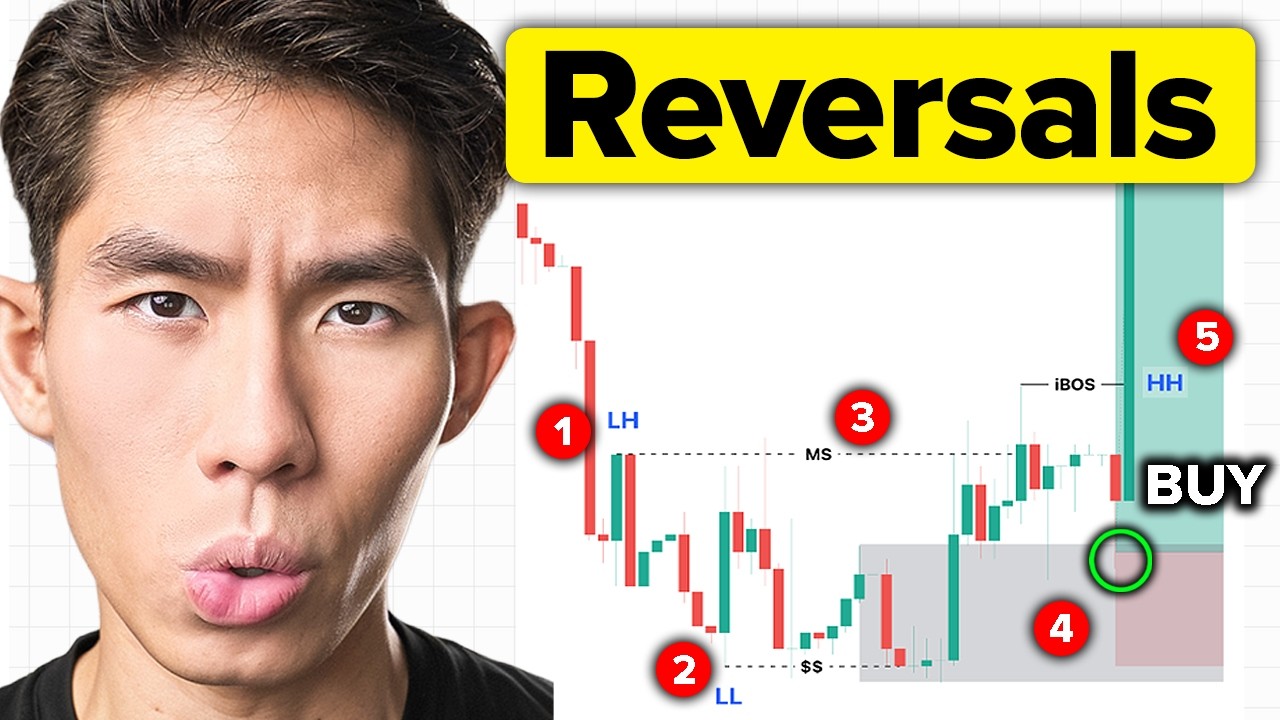
How to Trade Reversals PERFECTLY | Full Course
The Trading Geek
Overview
This video course teaches a structured, five-step process for trading market reversals, emphasizing confirmation over prediction. It argues that most traders fail by attempting to call exact tops and bottoms, driven by ego rather than a sound strategy. The course outlines a method that involves understanding the higher time frame narrative, waiting for price to reach key supply or demand zones, observing candlestick patterns for momentum shifts, confirming reversals with liquidity sweeps and structural breaks, and finally entering trades with clear confirmation. The presenter uses personal trading examples to illustrate the application of this framework, highlighting the importance of patience, discipline, and avoiding common pitfalls like premature entries.
Save this permanently with flashcards, quizzes, and AI chat
Chapters
- Most traders lose money by trying to predict exact market tops and bottoms, driven by ego rather than a reliable strategy.
- The market rewards consistent accuracy over time, not heroic, low-probability predictions.
- Jumping into trades based on perceived extended price action without confirmation leads to significant losses.
- A proper reversal trading strategy focuses on high-probability setups with clear confirmation, not guesswork.
- Before looking for reversals, determine the current market context: who is in control (buyers or sellers)?
- Identify the overall trend direction on higher time frames to establish a trading bias.
- This narrative dictates institutional money flow, which is what successful traders aim to align with.
- Trading reversals only makes sense when they align with or offer a counter-trend opportunity within a larger, understood context.
- Do not trade in the 'middle of nowhere'; wait for price to reach significant supply or demand zones.
- Once price reaches a zone, observe candlestick patterns for signs of waning momentum (e.g., smaller candles, doji).
- This observation indicates a potential shift in control between buyers and sellers at a critical price level.
- Fading momentum in approaching candles suggests that the current trend is losing strength.
- A liquidity sweep occurs when price rapidly moves to take out previous highs or lows (stop losses or pending orders).
- Reversals often happen after a liquidity sweep, as institutions use this to enter positions against the crowd.
- Failing to wait for a liquidity sweep means you might become the liquidity yourself, getting stopped out prematurely.
- Sharp, V-shaped reactions in price are often indicative of a liquidity sweep.
- A market shift is confirmed when price breaks a significant structural level (e.g., the last higher low in an uptrend or higher high in a downtrend).
- This break signifies that the prevailing trend has officially changed, with the opposing force now in control.
- This is the final confirmation needed before entering a reversal trade.
- The shift from demand to supply (or vice versa) is evident in this structural break.
- The presenter breaks down a profitable trade using the five-step framework on the EUR/USD pair.
- The trade involved identifying a bearish higher time frame bias, waiting for price to hit a supply zone, observing a liquidity sweep and market shift, and entering on confirmation.
- Proper stop-loss placement above a recent high prevented the trader from being stopped out during a minor pullback.
- The trade highlights that preparation, journaling, and discipline are key to profitability, not just the entry signal.
- Reversals often occur around the opening of major trading sessions (London, New York) due to increased institutional volume.
- Do not confuse slowing momentum (e.g., smaller candles, dojis) with actual confirmation; wait for liquidity sweeps and market shifts.
- Always consider the higher time frame narrative; misalignment can lead to failed trades.
- Avoid being the liquidity by waiting for confirmation and proper stop-loss placement.
- Trading reversals requires patience, discipline, and adherence to a process, not ego-driven predictions.
Key takeaways
- Trading reversals successfully requires a structured, five-step confirmation process, not prediction.
- Always establish a higher time frame bias to understand the dominant market narrative and institutional flow.
- Wait for price to reach significant supply or demand zones before considering a reversal trade.
- Observe candlestick patterns for momentum shifts, but do not treat them as standalone confirmation.
- Liquidity sweeps and structural market shifts are essential confirmation signals for high-probability reversal entries.
- Patience and discipline are paramount; avoid premature entries and becoming the liquidity.
- Trading is a process of preparation, execution, and reflection, not just clicking buy/sell buttons.
Key terms
Test your understanding
- What is the primary reason most traders fail when attempting to trade reversals?
- How does understanding the higher time frame narrative help in trading reversals?
- Why is waiting for price to reach a supply or demand zone crucial before looking for a reversal?
- What are the key confirmation signals that indicate a high-probability reversal is likely to occur?
- How can a trader avoid becoming 'the liquidity' when trading reversals?