4:22
Central dogma of molecular biology | Chemical processes | MCAT | Khan Academy
khanacademymedicine
Overview
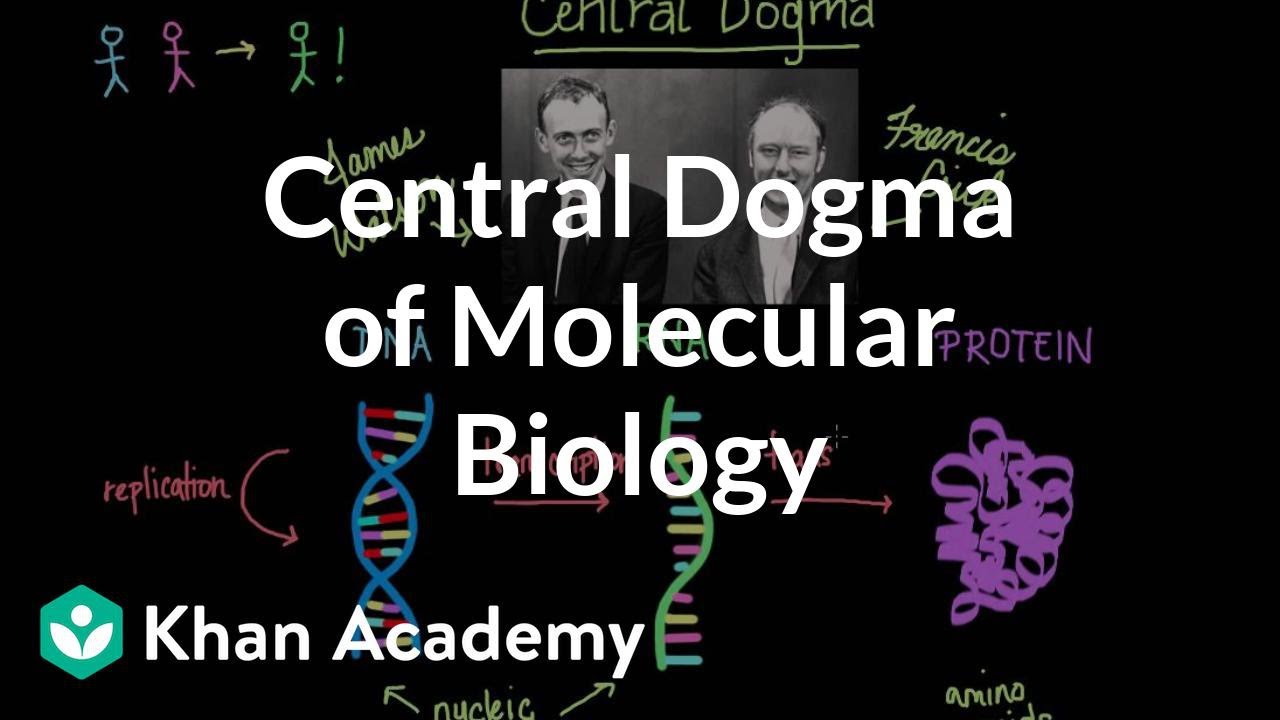
The central dogma of molecular biology describes the fundamental flow of genetic information within biological systems. It explains how the genetic code stored in DNA is used to create functional proteins, the workhorses of the cell. This process involves three key steps: DNA replication (copying DNA), transcription (DNA to RNA), and translation (RNA to protein). Understanding this flow is crucial for comprehending how genetic information dictates an organism's traits and functions.
How was this?
Save this permanently with flashcards, quizzes, and AI chat
Chapters
- The central dogma explains how genetic information from parents creates a complete organism.
- Discovered by Watson and Crick, it details the transfer of sequential information.
- A simplified summary is 'DNA makes RNA makes protein'.
This concept provides a foundational understanding of how genetic instructions are converted into the molecules that perform cellular functions, explaining the link between our genes and our physical characteristics.
The process explains how the genetic information inherited from parents is used to build a human being.
- DNA and RNA are nucleic acids made of nucleotides.
- Proteins are polymers made of amino acids.
- Information storage begins with DNA.
Identifying the distinct roles and building blocks of DNA, RNA, and proteins is essential for understanding the specific steps involved in genetic information transfer.
DNA, RNA, and proteins are all linear polymers, meaning their individual units (monomers) are linked in a chain.
- Replication is when DNA makes a copy of itself.
- Transcription is the process of copying DNA's information into RNA.
- Translation is the process of using RNA's information to synthesize proteins.
- The sequence of monomers in each polymer carries specific information.
These three processes represent the core mechanisms by which genetic information is maintained, accessed, and utilized to build cellular machinery.
The sequence of nucleotides in DNA serves as a template to determine the sequence of nucleotides in RNA, which in turn dictates the sequence of amino acids in a protein.
- Replication is easy to remember because DNA is making a copy of itself.
- Transcription involves changing from one nucleic acid 'language' (DNA) to another (RNA), like changing one written form to another ('script').
- Translation involves changing from a nucleic acid 'language' to an amino acid 'language', like translating between different languages.
Using analogies and word associations can help solidify the distinctions between transcription and translation, which are often confused.
Thinking of 'transcription' as a 'script' helps remember it's a change between similar forms (nucleic acids), while 'translation' is a change to a different form (nucleic acid to protein).
Key takeaways
- The central dogma outlines the fundamental flow of genetic information: DNA -> RNA -> Protein.
- DNA serves as the stable storage for genetic blueprints.
- RNA acts as a temporary messenger molecule, carrying instructions from DNA.
- Proteins are the functional molecules built based on the RNA instructions.
- Replication ensures genetic information is passed accurately during cell division.
- Transcription converts DNA information into a portable RNA format.
- Translation decodes the RNA message into a specific sequence of amino acids to build proteins.
Key terms
Central DogmaDNA (Deoxyribonucleic acid)RNA (Ribonucleic acid)ProteinNucleotidesAmino acidsReplicationTranscriptionTranslationPolymerMonomer
Test your understanding
- What is the primary function of the central dogma of molecular biology?
- How does the sequence of nucleotides in DNA relate to the sequence of amino acids in a protein?
- Explain the difference between transcription and translation in terms of the molecules involved and the type of information transfer.
- Why is DNA replication essential for living organisms?
- How can the terms 'transcription' and 'translation' be remembered using analogies?