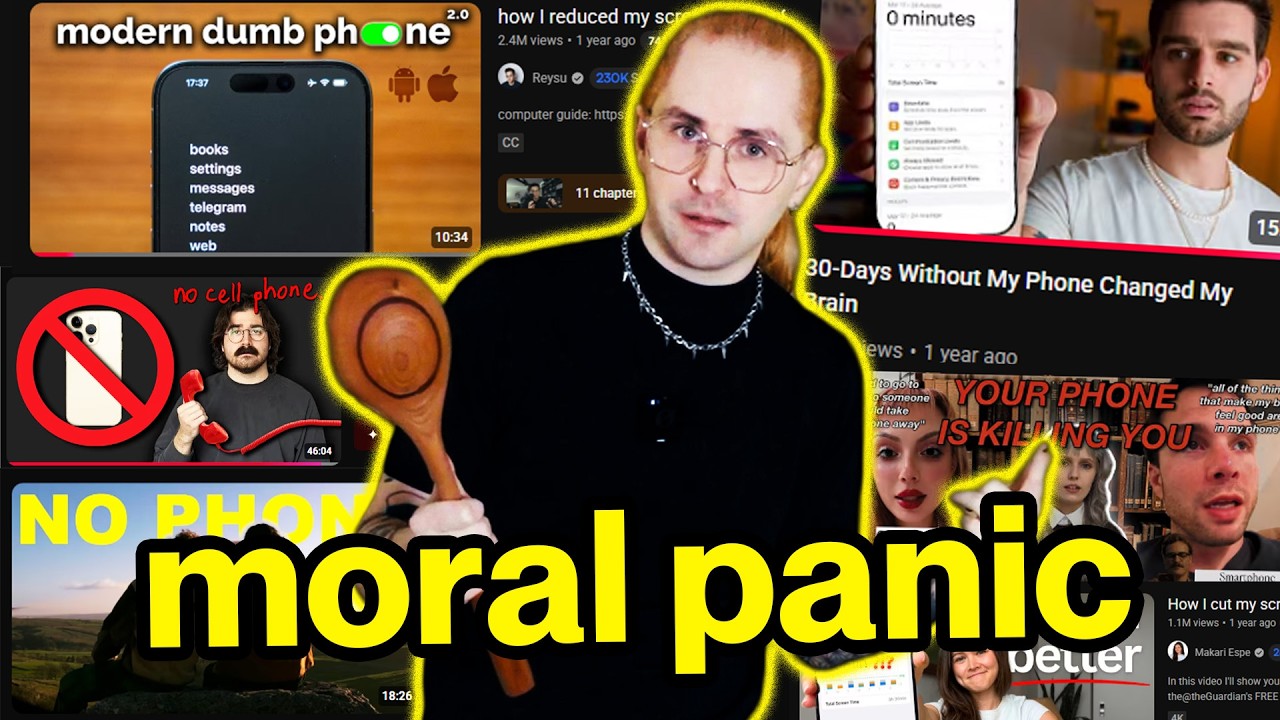
Your Phone Is Not The Problem
Crimes New Roman
Overview
This video argues that the widespread dissatisfaction and attention problems people experience are not caused by technology like smartphones or social media, but by a deeper cultural shift known as 'Technopoly.' Technopoly, a concept from Neil Postman, describes a state where technology and its associated values (efficiency, measurement, progress) become the dominant, unquestioned framework for understanding the world, replacing older systems of meaning like religion or tradition. The video critiques the common solutions like screen time limits or dumb phones as mere techniques that don't address the root cause: the erosion of human purpose and meaning, which technology cannot provide. Instead, it advocates for actively engaging with the world and using technology as a tool to pursue meaningful goals.
Save this permanently with flashcards, quizzes, and AI chat
Chapters
- The common belief that smartphones, apps, or the internet cause crippling dissatisfaction and attention issues is a misdiagnosis.
- Solutions like screen timers, dumb phones, or going analog are ineffective because they treat symptoms, not the underlying disease.
- Technological 'snake oil' fails because it doesn't address the fundamental lack of meaning or direction people experience.
- The 'death of God' (Nietzsche's concept) has led to technology becoming the new, unacknowledged deity, dictating our values and worldview.
- Technology is not just machinery but any system of procedures or rules that shapes how we act, think, and relate to each other.
- Every technology has an 'ideological bias,' predisposed to value certain things and amplify specific skills or attitudes.
- Invisible technologies like grading systems or IQ tests operate without scrutiny, shaping our reality by assuming their neutrality and inevitability.
- Historically, technologies were tools serving external purposes defined by culture (religion, ethics).
- The mechanical clock is a prime example of a technology that began to reorganize culture, shifting focus from divine service to measurable efficiency and the concept of 'time is money.'
- This shift marks the beginning of 'technocracy,' where technology's biases start to override tradition, religion, and ethics, stealing authority and redefining truth.
- Technopoly is the extreme form where technology becomes the sole source of meaning and the only lens through which the world is viewed, making alternatives invisible.
- The dismantling of traditional frameworks of meaning (religion, philosophy, psychology) left technology as the only surviving belief system.
- Technology provides 'technique' (how to do things) but cannot provide 'meaning' (why we do them), yet we increasingly conflate the two.
- The focus shifts from asking 'why' we invent things to simply celebrating the 'invention' itself, driven by principles like efficiency and progress.
- Life becomes quantified by metrics (screen time, steps, followers) that are precise but often meaningless, serving as a substitute for genuine purpose.
- This is exacerbated by the fact that technology is highly profitable, making it difficult to challenge.
- Research often shows social media has little to no impact on mental health, yet moral panics persist.
- The focus on censorship, screen limitations, and bans is a misguided response to the problem.
- Figures like Jonathan Haidt promote a narrative of technological harm based on flawed data or misinterpretations of correlation as causation.
- Solutions like screen time apps or digital detoxes are disguised technologies that reinforce Technopoly's core assumption that the right tool will save you, rather than fostering understanding.
- These 'solutions' often assume the problem is quantitative (too much time) rather than qualitative (lack of purpose).
- The core issue is aimlessness, a cultural condition stemming from economic precarity, collapsed communities, and a sense of helplessness.
- Blaming individuals for 'phone addiction' ignores these systemic issues and the monetization of this void by tech companies.
- True solutions involve active engagement with the world and pursuing meaningful goals, using technology as a tool, not an escape.
- Purpose is found in action, in contributing to something beyond oneself, and in balancing caution with optimism.
- Running away from technology is cowardice; using it intentionally for meaningful pursuits is freedom.
Key takeaways
- Our dissatisfaction stems from a cultural void of meaning, not from the technology we use.
- Technopoly is a state where technology and its values (efficiency, measurement) dominate our worldview, replacing older systems of meaning.
- Technology offers 'technique' but not 'meaning'; we mistakenly seek purpose in tools designed for efficiency.
- Common solutions like screen limits or dumb phones are ineffective because they are disguised technologies that don't address the root cause of aimlessness.
- True engagement with life requires having a purpose or goal that technology can then serve as a tool for.
- Blaming individuals for technology misuse ignores broader cultural conditions like economic precarity and collapsed communities.
- Meaning is found in active engagement and pursuing goals beyond oneself, not in avoiding technology or seeking passive serenity.
- We must learn to use technology intentionally, guided by our own purposes, rather than letting its inherent biases dictate our actions.
Key terms
Test your understanding
- What does the speaker mean by 'Technopoly,' and how does it differ from simply using technology?
- Why are solutions like screen time limits or dumb phones considered ineffective in the context of Technopoly?
- How does the concept of 'ideological bias' apply to everyday technologies, and what are its implications?
- What is the fundamental difference between 'meaning' and 'technique,' and why is this distinction crucial in understanding our relationship with technology?
- How can individuals move from a state of aimlessness and passive technology use to active, purposeful engagement?