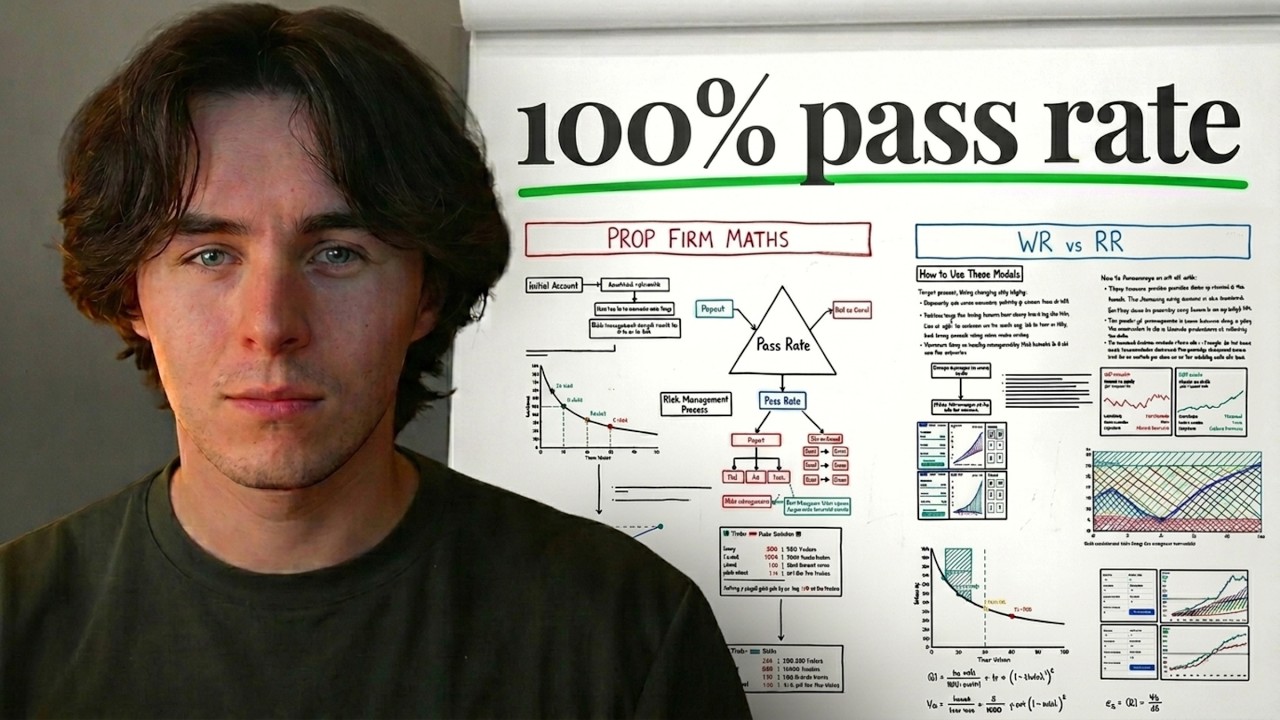
How To Pass Prop Firms Using Simple Maths
tomtrades
Overview
This video explains that passing prop firm trading challenges relies more on understanding basic mathematics and statistics than on a highly profitable trading strategy. The presenter argues that most traders fail not because they can't make money, but because they don't manage risk effectively within the strict drawdown limits set by prop firms. Key to success is choosing the right account size, optimizing the relationship between win rate, risk-reward ratio, and position sizing, and understanding prop firm-specific rules like consistency and end-of-day drawdown. By focusing on consistency and low variance, traders can significantly increase their pass rates, even with a minimal edge.
Save this permanently with flashcards, quizzes, and AI chat
Chapters
- The 50K futures account is recommended for most traders due to its lower cost and easier-to-meet targets.
- This account typically has a $2,000 max drawdown (4% of the account size) and a $3,000 profit target (6% of the account size).
- Larger accounts, while offering more capital, are significantly harder to pass due to tighter relative drawdown rules.
- Opting for cheaper accounts reduces the financial risk of repeated failed challenges.
- Prop firm challenges are designed to be difficult, often leading traders to fail even with profitable strategies.
- Failing is usually due to exceeding the maximum drawdown, not a lack of profitability.
- Profitability is determined by the combination of risk-reward ratio and win rate.
- Hitting the profit target is less challenging than staying within the strict drawdown limits.
- Win rate and risk-reward ratio are inversely correlated; higher risk-reward means a lower win rate.
- High variance, characterized by large swings in equity (big wins and big losses), is a primary reason traders fail.
- Low variance, achieved through a high win rate and lower risk-reward, leads to a smoother equity curve and reduces the likelihood of hitting the max drawdown.
- Strategies with high risk-reward ratios, even if profitable, often have high variance and are detrimental to passing prop firm challenges.
- The effective trading capital is limited by the maximum drawdown, not the total account size (e.g., $2,000 on a 50K account).
- Position sizing must be adjusted to reflect this smaller effective capital to avoid exceeding drawdown limits.
- Higher position sizing directly increases the maximum drawdown risk.
- A higher win rate allows for slightly larger position sizes while maintaining a high pass rate and faster challenge completion.
- Prop firms often implement rules like consistency rules and end-of-day (EOD) trailing drawdowns that significantly reduce pass rates.
- A consistency rule limits the profit contribution from any single day (e.g., 40-50% of total profit).
- EOD trailing drawdown means the drawdown limit adjusts upwards with profits, making it harder to recover from losses.
- High-risk reward, low-win rate strategies are particularly vulnerable to these rules due to their inherent variance.
- Choosing prop firms without consistency rules can boost pass rates by 12-15%.
- The goal for passing prop firm challenges should be to maximize the pass rate, not necessarily the profitability of the strategy itself.
- A strategy with zero edge but optimized for low variance (high win rate, low risk-reward) can be more profitable overall in prop challenges than a profitable strategy with high variance.
- Consistent returns, even from a small edge, lead to higher pass rates and better overall returns on challenge costs.
- Prioritizing low risk-reward (e.g., 0.5 to 1:1) and high win rates (60-70%+) is key to success.
Key takeaways
- Prop firm challenges are primarily tests of risk management and statistical probability, not just trading profitability.
- The 50K futures account is often the most practical choice for new traders due to its balance of cost and difficulty.
- Focus on a high win rate and a lower risk-reward ratio to minimize trading variance and increase consistency.
- Position sizing must be calculated based on the maximum drawdown limit, not the total account balance.
- Be aware of and avoid prop firm rules like consistency limits and end-of-day trailing drawdowns, as they significantly decrease pass rates.
- Optimizing for a high pass rate, even with a minimal trading edge, leads to greater overall profitability in prop trading.
- Consistency of returns is more important than the magnitude of individual profitable trades for passing prop firm challenges.
Key terms
Test your understanding
- Why is understanding basic mathematics more critical for passing prop firm challenges than having a highly profitable trading strategy?
- How does the choice of account size (e.g., 50K vs. larger accounts) affect the difficulty of passing a prop firm challenge?
- Explain the relationship between win rate, risk-reward ratio, and trading variance, and how it impacts a trader's ability to stay within drawdown limits.
- How should position sizing be adjusted when trading prop firm challenges, considering the maximum drawdown rule?
- What are the 'consistency rule' and 'end-of-day trading drawdown,' and why do they make passing prop firm challenges more difficult?