2:48
What is herd immunity?
vaccinestoday
Overview
This video explains the concept of herd immunity, a phenomenon where a sufficient portion of a population is immune to a disease, thereby protecting those who are not immune. It illustrates how vaccination coverage impacts disease spread, showing that higher vaccination rates lead to significantly reduced transmission. The video emphasizes that herd immunity is crucial for public health, as it shields vulnerable individuals who cannot be vaccinated.
How was this?
Save this permanently with flashcards, quizzes, and AI chat
Chapters
- A 'naïve' population has no prior exposure to a disease or vaccine.
- When a disease is introduced, it spreads rapidly among individuals who are not immune.
- Each infected person (shown in red) can transmit the pathogen to others.
Understanding how diseases spread in an unprotected population is the baseline for appreciating the impact of interventions like vaccination.
Visualizing the spread of red circles representing infected individuals through a population of people.
- With 50% of the population vaccinated (green circles), disease spread is significantly slowed.
- Vaccinated individuals are directly protected.
- An additional group (shown in purple) is indirectly protected because the pathogen's spread is curbed by the vaccinated individuals around them; this is herd immunity.
- Vaccinated individuals act as barriers, preventing the disease from reaching susceptible people.
This demonstrates that even partial vaccination can create a protective effect for the entire community, not just those vaccinated.
Seeing how the spread of red circles is limited when 50% of the population is green (vaccinated), with some individuals becoming purple (indirectly protected).
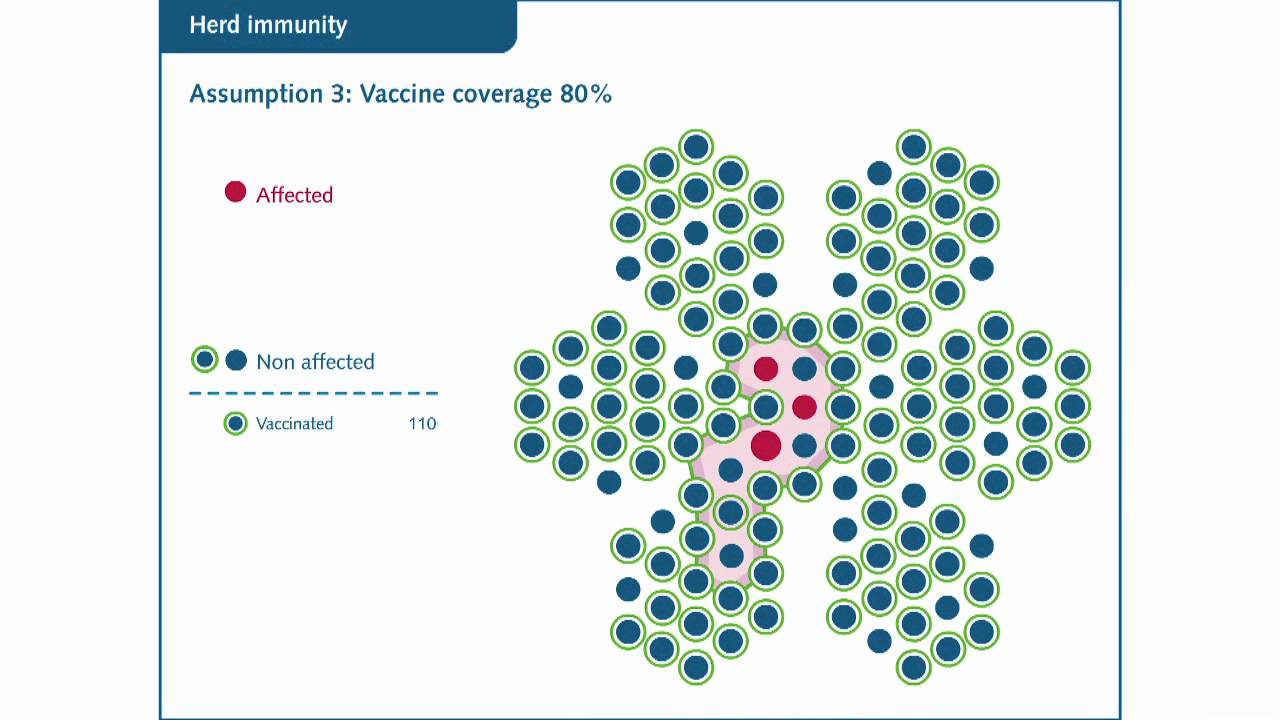
- At 80% vaccination coverage, disease spread is contained very quickly.
- Herd immunity is fully established, protecting a large majority of the population.
- High vaccination coverage is the public health rationale for widespread vaccination programs.
- This level of immunity protects not only those who can be vaccinated but also those who cannot, such as infants or immunocompromised individuals.
This highlights the critical threshold for achieving effective herd immunity and underscores why public health policies aim for high vaccination rates to protect the most vulnerable.
Observing the minimal spread of red circles when 80% of the population is green (vaccinated), with a large proportion of the remaining population being purple (indirectly protected).
Key takeaways
- Herd immunity occurs when a large enough percentage of a population is immune to a disease, making its spread unlikely.
- Vaccination is a primary method for achieving herd immunity.
- Higher vaccination coverage leads to more effective containment of infectious diseases.
- Herd immunity provides indirect protection to individuals who cannot be vaccinated.
- Achieving herd immunity is a key goal of public health vaccination strategies.
- The spread of a disease is significantly reduced when immune individuals act as barriers to transmission.
Key terms
Herd immunityNaïve populationVaccination coveragePathogenImmuneInfectiousnessPublic health policies
Test your understanding
- What is herd immunity and how does it differ from individual immunity?
- Why is a 'naïve population' a key concept when discussing disease spread?
- How does increasing vaccination coverage from 50% to 80% change the dynamics of disease spread?
- What is the public health significance of achieving herd immunity?
- Explain how vaccinated individuals contribute to the protection of unvaccinated individuals within a community.