6:40
Characteristics of Human Language - By Language & Linguistics
Linguistics With Tia
Overview
This video explores the six key characteristics that distinguish human language from animal communication. It delves into displacement, allowing communication about things not present in time or space; arbitrariness, where word sounds lack inherent meaning; productivity, enabling the creation of novel utterances; double articulation, the two-layered system of sounds and meanings; cultural transmission, highlighting language as a learned behavior; and discreteness, where language uses distinct units of sound and meaning. Understanding these features is crucial for appreciating the complexity and power of human language.
How was this?
Save this permanently with flashcards, quizzes, and AI chat
Chapters
- Displacement allows humans to discuss past, future, or hypothetical events, transcending the immediate environment.
- This feature enables communication across time and space, unlike animal communication which is tied to the present situation.
- Humans can intentionally convey false information, a capability not seen in animal communication systems.
Displacement is fundamental to planning, storytelling, and abstract thought, allowing us to learn from the past and shape the future.
Dogs barking in response to an immediate stimulus, versus humans discussing plans for a vacation next month.
- Arbitrariness means there's no natural or inherent connection between the sound of a word and its meaning.
- Different languages use entirely different words for the same concept (e.g., 'dog' in English vs. 'Hund' in German).
- While generally arbitrary, some linguistic features like onomatopoeia (e.g., 'tik-tok') and iconicity (e.g., 'small') create a resemblance between sound/form and meaning.
Arbitrariness explains why languages are so diverse and why learning a new language requires memorizing arbitrary sound-meaning pairings.
The English word 'water' has no inherent sound connection to the liquid it represents, unlike the sound a water droplet might make.
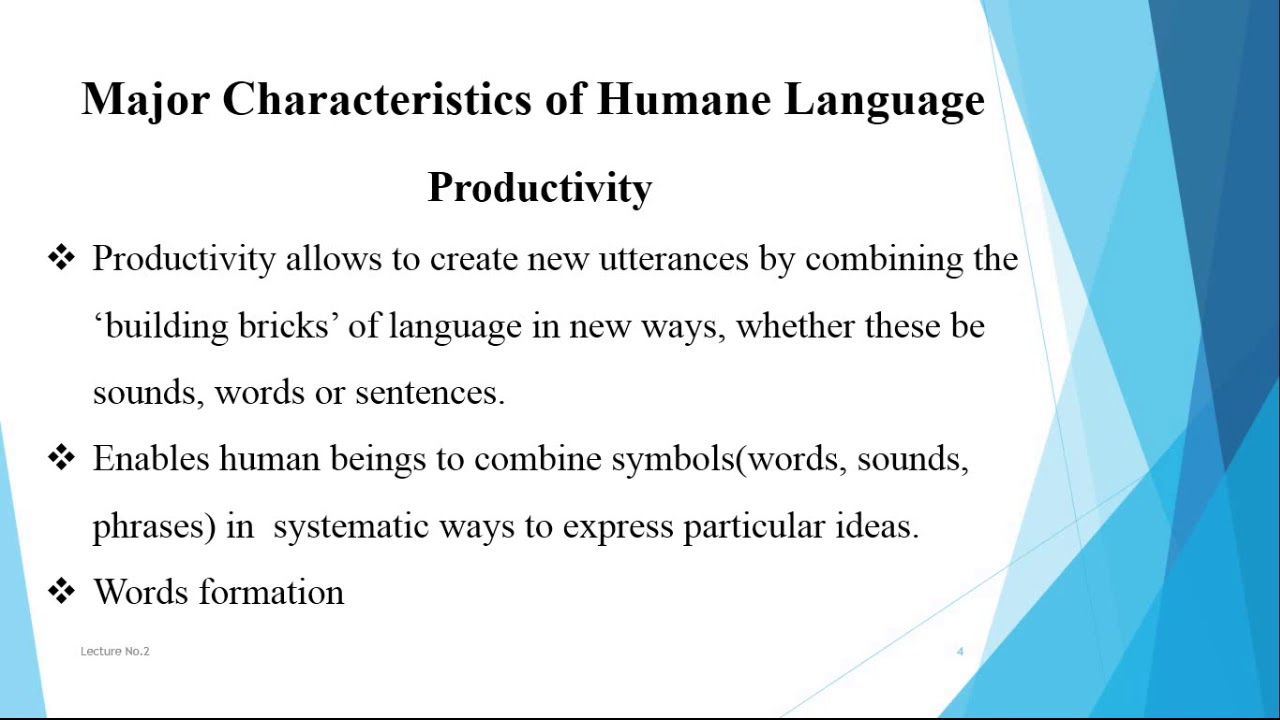
- Productivity allows us to create an unlimited number of new sentences and expressions by combining existing words and structures in novel ways.
- This feature is like using building blocks to construct new ideas, enabling unique communication for every situation.
- Animal communication systems are typically fixed and cannot generate new messages.
Productivity is the engine of linguistic innovation, allowing us to express complex, nuanced, and entirely new thoughts.
Combining the words 'I', 'will', 'go', 'to', 'the', 'store', 'later' to form a new, meaningful sentence that might not have been spoken before.
- Human language has two distinct layers: meaningless sounds (phonemes) and meaningful units (morphemes/words).
- At the first level, a limited set of sounds (phonemes) are combined.
- At the second level, these sounds are combined to create words and sentences with meaning, allowing for a vast number of distinct messages.
This dual structure makes language efficient, allowing a small set of sounds to generate an enormous vocabulary and infinite expressions.
The sounds /p/, /æ/, /t/ are meaningless individually but combine to form the meaningful word 'pat'.
- Language is not genetically inherited; it is learned from the social environment and culture.
- Children acquire language by interacting with speakers around them.
- Even if born into one linguistic community, a child adopted into another will learn the language of their adoptive environment.
Cultural transmission explains how languages spread, evolve, and how linguistic diversity is maintained across generations.
A child born to Spanish parents in Spain but adopted and raised in an English-speaking family in the US will learn English as their first language.
- Discreteness means language is composed of distinct, individual units of sound (phonemes) and meaning (words).
- Small changes in sound create distinct words with different meanings (e.g., 'pat' vs. 'bat').
- Language relies on vocalization, verbal components, and the discrete nature of its sounds and words.
Discreteness allows for precise communication, ensuring that subtle differences in pronunciation lead to clear distinctions in meaning.
The difference between the words 'pair' and 'bare' is a single phoneme change, creating two entirely different meanings.
Key takeaways
- Human language is uniquely flexible, allowing us to talk about anything, anytime, anywhere.
- The sounds of words are mostly arbitrary; their connection to meaning is a social convention, not a natural law.
- We can generate endless new sentences by creatively combining language's basic units.
- Language operates on two levels: meaningless sounds that combine to form meaningful words.
- Language is primarily learned through social interaction, not passed down genetically.
- Small distinctions in sound are crucial for differentiating word meanings.
- These characteristics collectively empower humans with complex thought and communication far beyond animal capabilities.
Key terms
DisplacementArbitrarinessProductivityDouble ArticulationCultural TransmissionDiscretenessPhonemeOnomatopoeiaIconicity
Test your understanding
- How does displacement allow humans to communicate about concepts that are not physically present?
- Why is the arbitrariness of language significant for understanding linguistic diversity?
- Explain how productivity enables the creation of novel utterances in human language.
- What are the two layers of double articulation, and why are they important for language structure?
- How does cultural transmission differ from genetic inheritance in language acquisition?