Denoising Autoencoders | Deep Learning Animated
Deepia
Overview
This video explains the concept of denoising autoencoders, a type of neural network used for removing noise from images. It starts by defining image noise and common noise models like Gaussian and Poisson noise. The core of the video focuses on how denoising autoencoders are trained using mean squared error to reconstruct clean images from noisy inputs. It then delves into the theoretical underpinnings, connecting the autoencoder's learning process to the manifold hypothesis and, more formally, to Tweedie's formula, which links the denoising operation to the score of the noisy data distribution. This provides a rigorous mathematical understanding of how these models effectively clean images by guiding them towards regions of higher data density.
Save this permanently with flashcards, quizzes, and AI chat
Chapters
- Image noise refers to random variations in pixel values that degrade image quality, appearing as graininess or specks.
- Noise can originate from various sources, such as low lighting conditions or imperfections in imaging devices.
- Common mathematical models for noise include Gaussian noise (additive, with variations following a normal distribution) and Poisson noise (often seen in CT scans).
- The amount of Gaussian noise can be controlled by the standard deviation (sigma) of its distribution.
- A denoising autoencoder is a neural network with an encoder, a latent space, and a decoder.
- Its goal is to take a noisy input image and output a clean, or less noisy, version.
- Training uses paired data: both the original clean image and its corrupted noisy version.
- The training objective is to minimize the mean squared error (MSE) between the autoencoder's output and the original clean image, not the noisy input.
- The space of all possible images is vast, but meaningful images (like numbers or faces) occupy a tiny, lower-dimensional subset called a manifold.
- Adding noise to an image can be thought of as perturbing a data point on the manifold, causing it to drift slightly outside.
- A denoising autoencoder learns a transformation that projects these noisy points back onto the manifold.
- This process not only removes noise but also implicitly learns the underlying structure and patterns of the manifold itself.
- The training objective (minimizing MSE between output and clean image) means the network approximates the Minimum Mean Squared Error (MMSE) estimator.
- The MMSE estimator is known to be the mean of the posterior distribution.
- The posterior distribution represents the likelihood of a clean image given a noisy observation.
- Therefore, the neural network learns to output the average (mean) of the possible clean images that could have produced the observed noisy image.
- A score function is the gradient of the log-probability density of a distribution, providing information about data structure without needing to normalize.
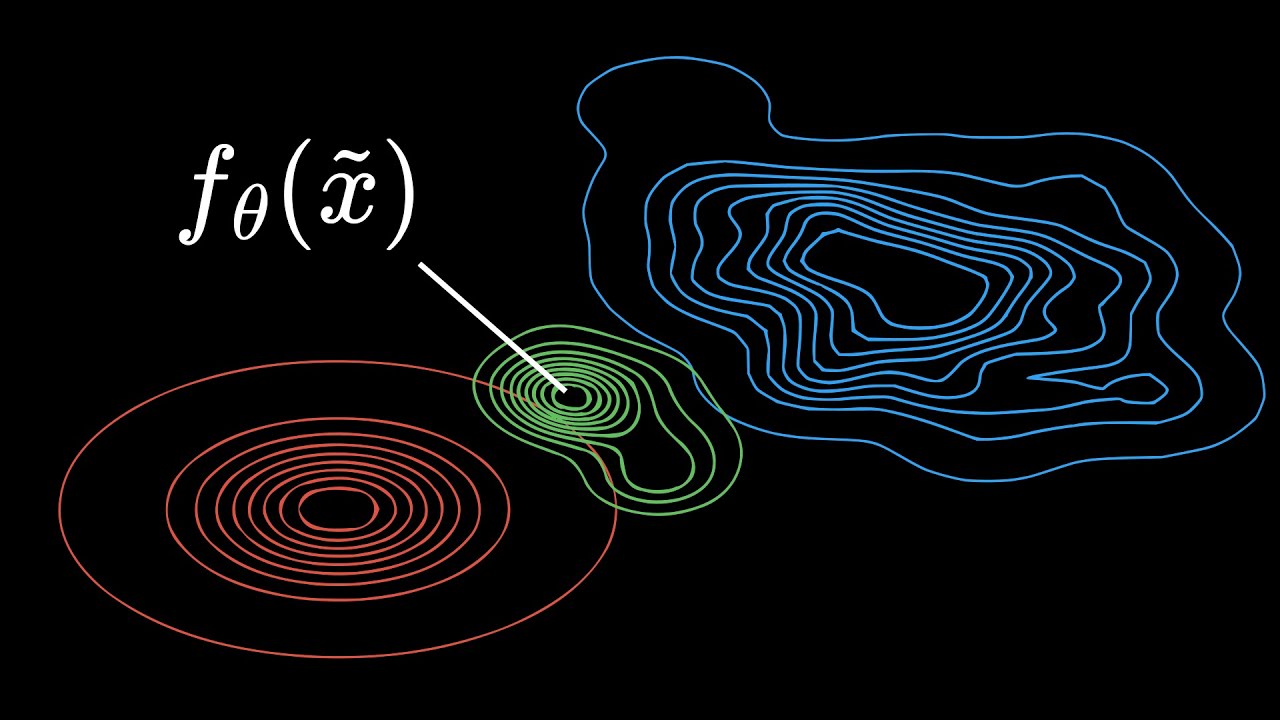
- Adding Gaussian noise to data is equivalent to convolving (or 'blurring') the underlying data distribution.
- Tweedie's formula (from 1956) provides a direct link between the posterior mean (what the autoencoder estimates) and the score of the noisy data distribution.
- This means the denoising autoencoder is effectively learning to approximate the score of the smoothed data distribution.
- Approximating the score of the noisy distribution means the network's output is related to taking a small step in the direction of this score.
- This step moves the noisy input closer to regions of higher density in the original, clean data distribution.
- This rigorously explains the intuition of projecting noisy data back onto the data manifold.
- The network implicitly learns the structure of the clean data distribution by learning its score function.
Key takeaways
- Denoising autoencoders learn to remove noise by reconstructing clean images from corrupted versions, trained using mean squared error against the original clean data.
- The manifold hypothesis suggests that meaningful data lies on a lower-dimensional manifold, and denoising involves projecting noisy data back onto this manifold.
- The autoencoder's training objective mathematically equates to approximating the Minimum Mean Squared Error (MMSE) estimator, which is the mean of the posterior distribution.
- Tweedie's formula establishes a crucial link: denoising autoencoders learn the score function of the noisy data distribution.
- Learning the score function allows the model to estimate the direction towards higher data density, effectively guiding noisy inputs towards realistic representations.
- The process is mathematically equivalent to taking gradient steps in the direction of the score, rigorously explaining how noise is removed and structure is recovered.
Key terms
Test your understanding
- What is the primary goal of a denoising autoencoder, and how does its training objective differ from a standard autoencoder?
- How does the manifold hypothesis provide an intuitive explanation for the effectiveness of denoising autoencoders?
- What does it mean for a neural network to approximate the Minimum Mean Squared Error (MMSE) estimator?
- Explain the concept of a score function and its relationship to probability distributions.
- How does Tweedie's formula connect the task of denoising with the score of the noisy data distribution?