AI-Generated Video Summary by NoteTube
GCSE Tutorial - Set Notation and Venn Diagrams - Shading, Intersections (higher and foundation)
ukmathsteacher
Overview
This video tutorial explains set notation and Venn diagrams for GCSE level mathematics. It defines a set as a collection of objects (elements or members) and introduces the concept of a universal set. The tutorial demonstrates how to populate a Venn diagram using given set notation, illustrating with an example of prime numbers and multiples of two. It then applies Venn diagrams to solve problems, such as determining the number of pupils who own only a laptop or neither device, given data on ownership of laptops and iPods. The video also covers shading different regions of a Venn diagram based on set operations like union, intersection, and complement (not). Finally, it extends these concepts to probability, showing how to calculate probabilities of various set combinations using Venn diagrams and basic algebra.
Want AI Chat, Flashcards & Quizzes from this video?
Sign Up FreeChapters
- •A set is a collection of objects called elements or members.
- •The universal set (U) contains all possible elements for a given context.
- •Venn diagrams use rectangles for the universal set and circles for individual sets.
- •Elements are placed within the appropriate regions of the Venn diagram.
- •Example: Universal set of positive integers from 1 to 12.
- •Set A: Prime numbers; Set B: Multiples of two.
- •Placing numbers based on whether they belong to Set A, Set B, both, or neither.
- •Identifying the intersection (A and B) and the union (A or B).
- •Scenario: 70 pupils, iPods and laptops ownership.
- •Start with the intersection (owned both) and work outwards.
- •Calculate 'only' categories by subtracting the intersection.
- •Determine the number owning neither by subtracting the total within circles from the universal set.
- •Understanding notation: Union (A U B), Intersection (A ∩ B), Complement (A').
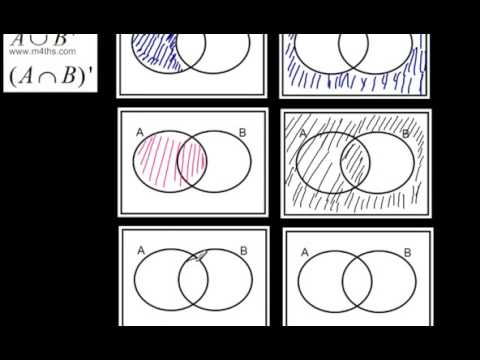
- •Shading A U B: Includes all of A and all of B.
- •Shading A ∩ B: Only the overlapping region.
- •Shading A ∩ B': Region in A but not in B.
- •Shading A' ∩ B': Region outside both A and B.
- •Shading A U B': Region in A or outside B.
- •Shading A ∩ B': Region in A and not in B (same as A but not B).
- •Shading A ∩ B (not): All regions except the intersection of A and B.
- •Tip: Use two separate diagrams to build up complex shaded regions.
- •Probabilities must sum to 1 within the universal set.
- •Start by placing the probability of the intersection.
- •Calculate probabilities of 'only' regions by subtraction.
- •Calculate the probability of the 'neither' region.
- •Use the diagram to find probabilities of unions, intersections, and complements.
- •Given P(A), P(B), and P(A U B), find P(A ∩ B).
- •Use algebra: Let intersection be 'x', express other regions in terms of 'x'.
- •Sum of regions in the union equals P(A U B).
- •Solve for 'x' (the intersection probability).
- •Calculate P(A' ∩ B') as 1 - P(A U B).
Key Takeaways
- 1A set is a collection of items, and Venn diagrams visually represent relationships between sets.
- 2The intersection of sets contains elements common to all sets involved.
- 3The union of sets contains elements belonging to any of the sets involved.
- 4When solving problems, always start by filling in the intersection of the Venn diagram.
- 5The sum of probabilities for all mutually exclusive regions within the universal set must equal 1.
- 6Set notation symbols (∪, ∩, ') correspond to specific regions and operations in Venn diagrams.
- 7Venn diagrams are powerful tools for solving problems involving counts and probabilities in overlapping groups.