16:49
Linear Equations – Algebra – Clear and Understandable
TabletClass Math
Overview
This video explains the fundamental concept of linear equations in algebra. It clarifies what makes an equation linear, focusing on the highest power of variables being one. The video also distinguishes linear equations from other types, like quadratic equations. A significant portion is dedicated to solving a linear equation step-by-step, emphasizing the distributive property and the process of isolating the variable by balancing operations on both sides of the equation. The presenter highlights the importance of understanding linear equations for future math studies.
How was this?
Save this permanently with flashcards, quizzes, and AI chat
Chapters
- An equation is any mathematical statement containing an equal sign.
- The term 'linear' relates to lines; linear equations can be represented graphically as straight lines.
- Linear equations are fundamental in algebra and appear in various forms, such as slope-intercept (y = mx + b) and standard form (Ax + By = C).
- Lines can be sloped, horizontal (y = constant), or vertical (x = constant).
Understanding the definition and graphical representation of linear equations is crucial for visualizing algebraic concepts and forms the basis for more complex mathematical topics.
The equation y = 2x + 3 represents a sloped line, while x = -7 represents a vertical line.
- A key characteristic of a linear equation is that the highest power of any variable is one (e.g., x, not x² or x³).
- Equations where the highest variable power is greater than one, such as x², are not linear and represent different shapes (e.g., parabolas for quadratic equations).
- Distinguishing between linear and non-linear equations is essential for applying the correct solution methods and understanding their graphical behavior.
Knowing how to identify a linear equation based on its algebraic form prevents applying incorrect solution strategies and helps in predicting the shape of its graph.
The equation 2x + 3 = 9 is linear because the highest power of x is 1, whereas 2x² + 3x + 9 = 0 is quadratic because the highest power of x is 2.
- The primary goal when solving a linear equation is to isolate the variable (e.g., solve for x).
- Begin by applying the distributive property to eliminate parentheses: multiply the term outside the parentheses by each term inside.
- Combine like terms on each side of the equation to simplify it.
- Isolate the variable by moving all terms containing the variable to one side (usually the left) and all constant terms to the other side (usually the right).
- Perform inverse operations (addition/subtraction, multiplication/division) on both sides of the equation to maintain balance and solve for the variable.
Mastering the process of solving linear equations is a foundational skill in algebra, enabling you to find unknown values in various mathematical and real-world problems.
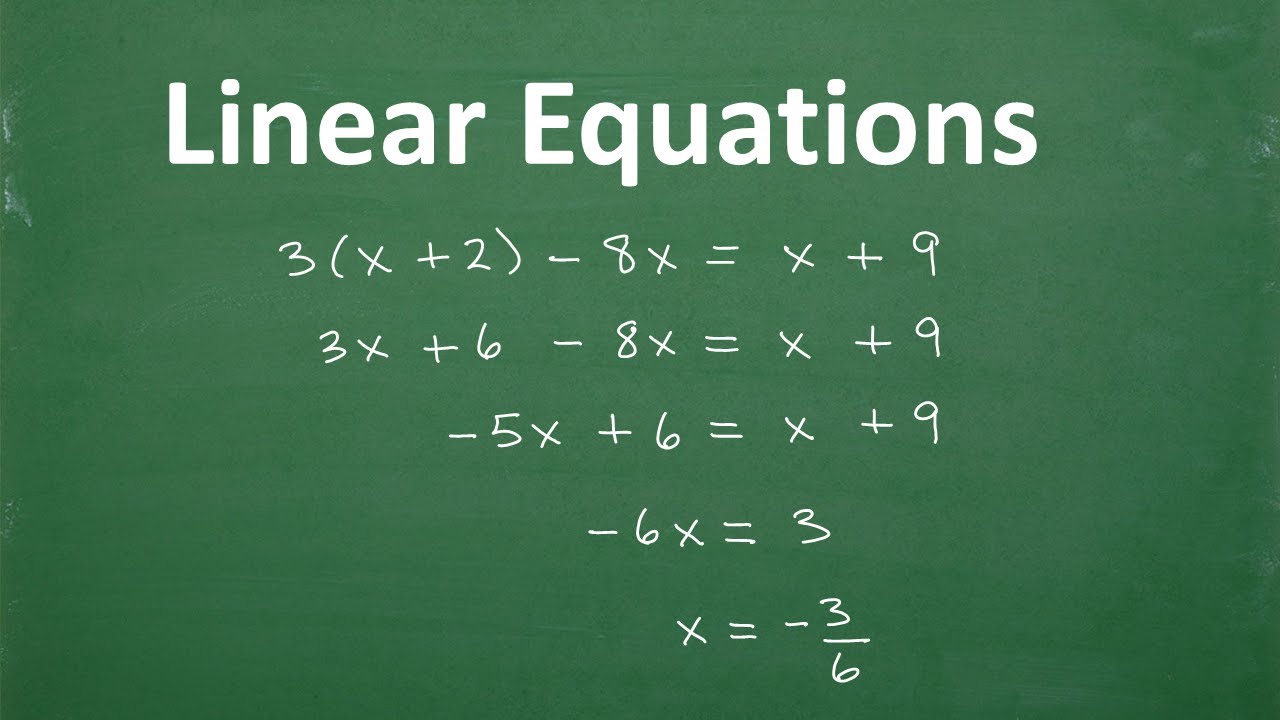
In solving 3(x + 2) - 8x = x + 9, first distribute the 3 to get 3x + 6 - 8x = x + 9, then combine like terms to get -5x + 6 = x + 9, and proceed to isolate x.
- The core principle of solving equations is maintaining balance: whatever operation is performed on one side must be performed identically on the other side.
- This balance can be visualized like a teeter-totter; changes on one side require corresponding changes on the other to keep it level.
- This principle ensures that the equality remains true throughout the solving process.
Understanding the balance principle is key to correctly manipulating equations and ensuring that the final solution is accurate.
To move a term like 'x' from the right side of an equation to the left, you subtract 'x' from both sides to keep the equation balanced.
Key takeaways
- Linear equations represent straight lines and are characterized by variables raised only to the first power.
- The distributive property is a critical first step in simplifying many linear equations involving parentheses.
- Combining like terms simplifies equations by grouping similar terms together on each side.
- The process of solving equations relies on the fundamental principle of performing the same operation on both sides to maintain equality.
- Isolating the variable requires systematically moving variable terms to one side and constant terms to the other.
- Linear equations are a cornerstone of algebra, essential for understanding more advanced mathematical concepts.
- Recognizing the difference between linear and non-linear equations (e.g., quadratic) is vital for choosing the correct solution methods.
Key terms
Linear EquationEquationVariableEqual SignSlope-Intercept FormStandard FormDistributive PropertyCombine Like TermsQuadratic EquationSolve for x
Test your understanding
- What distinguishes a linear equation from a quadratic equation?
- Why is the distributive property often the first step in solving complex linear equations?
- How does the principle of balance apply when solving an equation?
- What is the overall strategy for isolating a variable in a linear equation?
- Why is understanding linear equations considered fundamental for further study in mathematics?