19:19
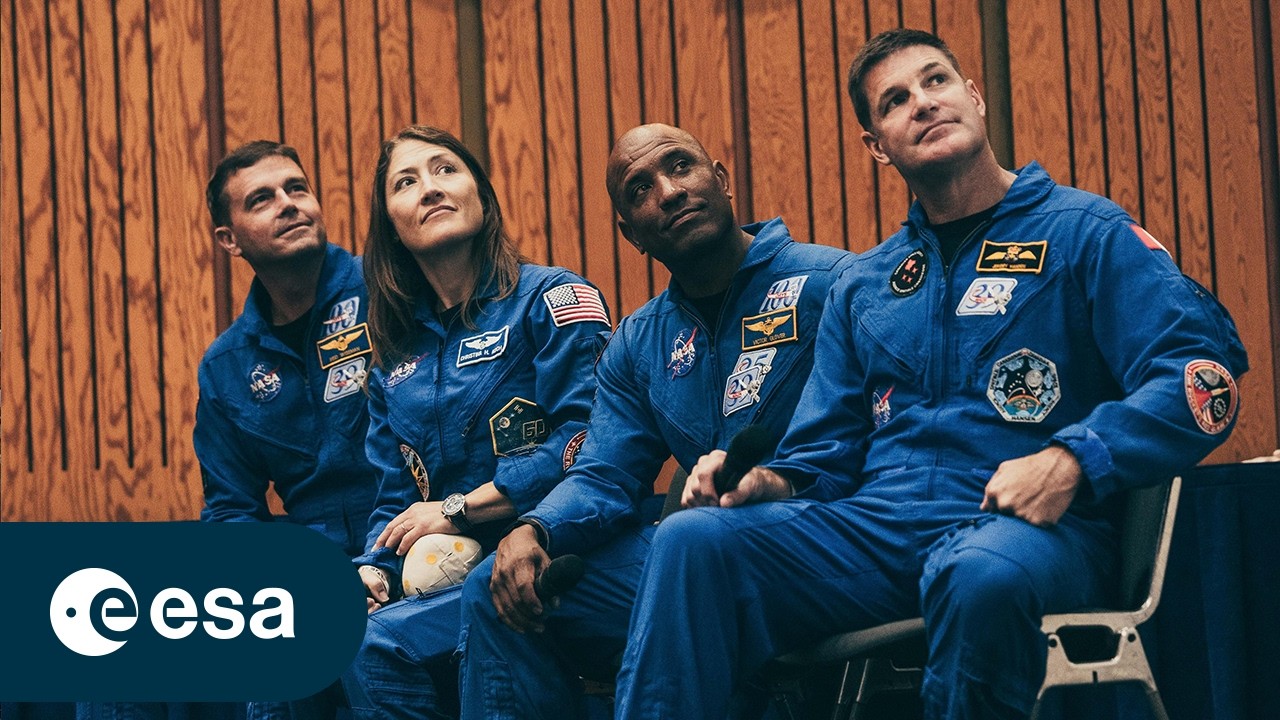
Artemis II astronauts visit ESA's technical centre (ESTEC)
European Space Agency, ESA
Overview
This video captures a post-Artemis II mission debrief and celebration, focusing on the collaborative spirit between NASA and ESA. Astronauts share personal reflections on their lunar journey, highlighting the critical role of ground control teams, the intimate experience of living in the Orion capsule, and the profound significance of international partnership. The discussion extends to future missions, the importance of innovation for human thriving, and the overarching goal of sustained human presence on the Moon, emphasizing that collaboration amplifies achievements and inspires hope.
How was this?
Save this permanently with flashcards, quizzes, and AI chat
Chapters
- Astronauts expressed deep appreciation for the ground control engineers who monitored their mission, viewing them as essential teammates.
- The experience of seeing the engineers at their consoles highlighted the shared mission and mutual reliance between space and ground crews.
- The process of diagnosing issues, like a propellant leak, demonstrated the complex communication and problem-solving between the crew and mission control.
Understanding the symbiotic relationship between astronauts and ground control emphasizes that space missions are a collective effort, not solely the responsibility of those in orbit.
An astronaut recalled a moment where they saw the Orion displays showing a propellant leak and heard a colleague say, 'They're working hard down there,' referring to the engineers in the room, underscoring the direct connection.
- The 10-day mission in Orion fostered an intimate, organism-like existence where every action, from eating to exercising, was a shared experience.
- The European Service Module, a key component of Orion, represents a significant physical manifestation of the international partnership between NASA and ESA.
- The ability to manually fly the vehicle was a critical capability tested successfully, performing even better than simulated, which is rare for aerospace systems.
This chapter illustrates how close-quarters living and reliance on international components shape the astronaut experience and enable advanced vehicle capabilities.
The solar arrays on the Service Module, manufactured in Europe, served as a tangible reminder of the international collaboration that powered the mission.
- Witnessing Earth set behind the Moon from the far side was a profound and humbling experience, emphasizing the vastness of space and the crew's isolation.
- Despite being out of contact with Earth, the crew felt safe due to the reliability of the Orion vehicle, which had communicated effectively throughout the mission.
- The 'Earthset' view, with the Earth's crescent digging into the lunar surface, was a unique and personally memorable perspective for the astronauts.
This experience highlights the psychological impact of deep space travel and the critical importance of a reliable spacecraft when communication is lost.
The visual of the Earth disappearing behind the Moon, described as 'spines of the Earth digging into the surface of the moon,' created a lasting memory for the crew.
- The Artemis II mission aimed to connect the world, with the 'All for All' motto reflecting the desire to bring people together through a shared, extraordinary endeavor.
- The global response and engagement with the mission demonstrated a collective craving for togetherness and shared achievement as a species.
- The symbolic handover of the mission to the Artemis III crew signifies building upon a foundation and moving closer to sustained human presence on the Moon.
This section underscores how space exploration can serve as a unifying force, inspiring collective action and shared pride on a global scale.
During a family conference, one astronaut's repeated exclamations of 'No way!' upon hearing about the global support for the mission conveyed the overwhelming positive reaction.
- The 'Caves of Sardinia' (NISS) training simulated the risks and decision-making complexities inherent in space exploration, comparable in danger to flying around the Moon.
- The training involved international astronauts learning to manage risks, conduct proxy science, and navigate challenging subterranean environments.
- This experience fostered teamwork and decision-making skills essential for future space missions, transforming perspectives on exploring hidden environments.
Simulated environments like caves provide invaluable, high-stakes training for astronauts, developing critical skills for managing risk and working collaboratively in extreme conditions.
Astronauts navigated tight squeezes and explored vast, cathedral-like chambers illuminated only by helmet lights, mirroring the challenges of exploring unknown extraterrestrial terrains.
- A key scientific question is how 8 billion people can thrive on Earth, with solutions potentially overlapping with the needs for sustained lunar and Martian presence.
- Space exploration is seen as a driver for innovation that can provide much-needed solutions for Earth's challenges.
- The profound question of whether humanity is alone in the universe is a driving force behind space exploration, and current missions are on a path to potentially answer it.
This chapter connects the immediate goals of space exploration to long-term human survival and fundamental existential questions, highlighting the broader impact of scientific inquiry.
The speaker posits that the basic needs for humans to survive on the Moon or Mars might offer solutions for supporting a large population on Earth.
- Collaboration across different cultures, time zones, and engineering philosophies is crucial and yields benefits far greater than working in isolation.
- The success of missions like Artemis II is amplified by international partnerships, symbolized by joint logos on mission imagery.
- The ESA workforce is recognized for their courage and positive impact, setting a global example of what collaboration can achieve.
This section emphasizes that complex space endeavors are not only possible but significantly enhanced through international cooperation, inspiring future generations.
A photograph showing both NASA and ESA logos alongside the spacecraft and celestial bodies serves as a powerful symbol of unified effort and shared accomplishment.
Key takeaways
- Space missions are built on deep trust and collaboration between astronauts, ground control, and international partners.
- The intimate and shared living conditions in spacecraft like Orion forge strong bonds and unique experiences among crews.
- International partnerships, like that between NASA and ESA, are fundamental to the success and ambition of modern space exploration.
- Witnessing Earth from afar, especially during moments of communication blackout, provides a profound perspective on humanity's place in the universe.
- Training in extreme environments, such as caves, is critical for developing the risk management and teamwork skills needed for space missions.
- Space exploration drives innovation that can address pressing challenges on Earth, from resource management to understanding our place in the cosmos.
- The ultimate goal of sustained human presence on the Moon and beyond requires continuous innovation and unwavering international cooperation.
- The collective human drive for togetherness and shared achievement can be powerfully amplified through ambitious, collaborative projects like the Artemis program.
Key terms
Artemis IIESA (European Space Agency)ESTEC (European Space Research and Technology Centre)OrionService ModuleMission ControlCapCom (Capsule Communicator)Trans-Lunar InjectionEarthsetNISS CavesInternational PartnershipInnovationSustained Human Presence
Test your understanding
- How did the astronauts describe their relationship with the ground control engineers during the Artemis II mission?
- What was the significance of the European Service Module to the Orion spacecraft and the international partnership?
- Describe the emotional and psychological impact of witnessing 'Earthset' from the far side of the Moon.
- Why is international collaboration considered essential for the success of ambitious space exploration goals like returning to the Moon?
- How does training in simulated extreme environments, like caves, prepare astronauts for the challenges of spaceflight?