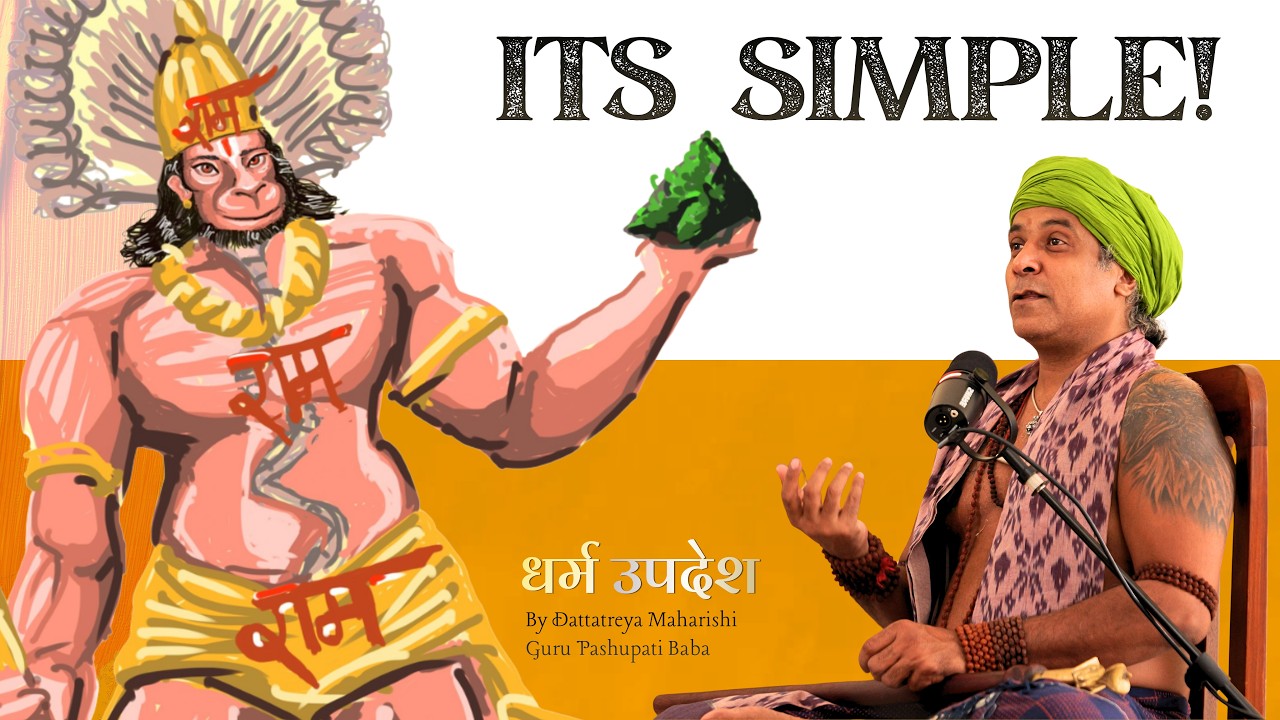
Confused about WHAT TO EAT? Watch This Video | Guru Pashupati
Guru Pashupati
Overview
This video introduces fundamental concepts of human constitution and well-being, drawing from ancient wisdom traditions. It explains how the body is composed of three primary elements: water, fire, and wind, which originate from the broader cosmic elements of earth and sky. The speaker emphasizes the importance of understanding one's unique 'Prakriti' (nature) – Vata, Pitta, or Kapha – to make informed food choices and live a balanced life. The video also touches upon the concepts of 'Punya' (merit) and 'Papa' (sin) and how dietary habits can influence this spiritual 'bank balance,' ultimately advocating for a return to natural principles for optimal health and harmony.
Save this permanently with flashcards, quizzes, and AI chat
Chapters
- Human beings are fundamentally composed of three elements: water, fire, and wind.
- These bodily elements originate from two primary cosmic elements: earth (represented by the 'Om' vibration) and sky (represented by the 'Ah' vibration).
- We are wirelessly connected to earth and sky, but physically, only water, fire, and wind exist within us.
- Unlike plants, humans and animals possess consciousness and the instinct to know what to eat, though this instinct can be trained out of us.
- Beyond the three physical elements, five primary 'winds' (Vayu) govern bodily functions, with Prana and Apana being key.
- Prana is the life-force energy, akin to the sun, supplying energy to all cells and generated in the heart.
- Apana is the downward-moving energy, like the moon, responsible for healing and detoxification.
- Abusing Apana (e.g., through unhealthy habits) is like abusing the moon, leading to a decline in bodily functions.
- Human constitutions, or 'Prakriti,' are primarily categorized into three types: Vata (wind-dominated), Pitta (fire-dominated), and Kapha (water-dominated).
- Vata individuals are sensitive, intuitive, and energetic, but prone to instability and easily affected by external environmental changes (cold, heat, electricity).
- Pitta individuals are characterized by fire, making them good leaders, planners, and strategists, but they must be cautious of excessive heat and certain tastes like sour and pungent.
- Kapha individuals are stable, dependable, and grounded, akin to water, and are good at repetitive tasks but can become lethargic without external motivation.
- Punya (merit) and Papa (sin) can be understood as a spiritual 'bank balance'; Punya brings positive outcomes, while Papa leads to losses.
- Food choices are a significant source of accumulating Papa if they are not aligned with one's Prakriti or nature.
- Unhealthy or inappropriate food choices can deplete one's Punya, leading to negative consequences and a weakened ability to navigate life's challenges.
- Learning to eat in a way that creates Punya is a key aspect of maintaining well-being and spiritual balance.
- Each Prakriti (Vata, Pitta, Kapha) has unique strengths and weaknesses, and they are meant to work together harmoniously.
- Human society functions best when individuals of different Prakriti cooperate, forming balanced units.
- Sticking only with people of the same Prakriti leads to a lack of understanding and cooperation, perpetuating societal imbalances.
- Ancient texts like the Puranas contain profound knowledge about these principles, but understanding them requires deep study and often a specific constitution (like Pitta).
Key takeaways
- Our bodies are composed of elemental energies (water, fire, wind) influenced by cosmic forces (earth, sky).
- Understanding your unique constitution (Prakriti: Vata, Pitta, Kapha) is fundamental to making appropriate food and lifestyle choices.
- Prana (life force) and Apana (elimination) have distinct daily cycles that should guide our activity levels.
- Dietary choices significantly impact our spiritual 'bank balance' of Punya (merit) and Papa (sin).
- True well-being comes from balancing internal elemental energies and cooperating with others of different constitutions.
- Ancient wisdom traditions offer essential knowledge about human nature and health that has been largely overlooked.
- Eating in accordance with your Prakriti is a direct path to creating Punya and maintaining optimal health.
Key terms
Test your understanding
- How do the cosmic elements of earth and sky relate to the physical elements within the human body?
- What is the difference between Prana and Apana, and how do their cycles influence daily activities?
- Describe the core characteristics and sensitivities of Vata, Pitta, and Kapha Prakriti.
- Explain the concept of Punya and Papa and how food choices contribute to this balance.
- Why is cooperation between different Prakriti types considered essential for both individual and societal well-being?