1:24:27
Stanford CS224N: NLP with Deep Learning | Winter 2021 | Lecture 1 - Intro & Word Vectors
Stanford Online
Overview
This lecture introduces Natural Language Processing (NLP) with Deep Learning, focusing on the foundational concept of word vectors. It explains the limitations of traditional NLP methods, which treat words as discrete symbols, and introduces the distributional hypothesis: a word's meaning is defined by the company it keeps. The lecture details the word2vec algorithm as a method to learn dense, real-valued vector representations (embeddings) of words from large text corpora. These embeddings capture semantic relationships, enabling tasks like analogy and similarity calculations, and form the basis for more advanced NLP models.
How was this?
Save this permanently with flashcards, quizzes, and AI chat
Chapters
- The course, CS224N, focuses on Natural Language Processing (NLP) using Deep Learning.
- Primary goals include understanding modern deep learning methods for NLP, grasping the complexities of human language, and building NLP systems in PyTorch.
- The course will cover foundational concepts, recurrent networks, attention, transformers, and applications like machine translation and question answering.
- A key learning objective for the first lecture is to understand the power and surprising effectiveness of deep learning word vectors.
Understanding the course's objectives and structure helps learners set expectations and focus on the most critical concepts for success in the field of NLP.
The instructor outlines the course structure, starting with word vectors and progressing to more complex models like recurrent networks and transformers.
- Human language is a complex, social system that is constantly evolving, making it difficult for computers to fully grasp.
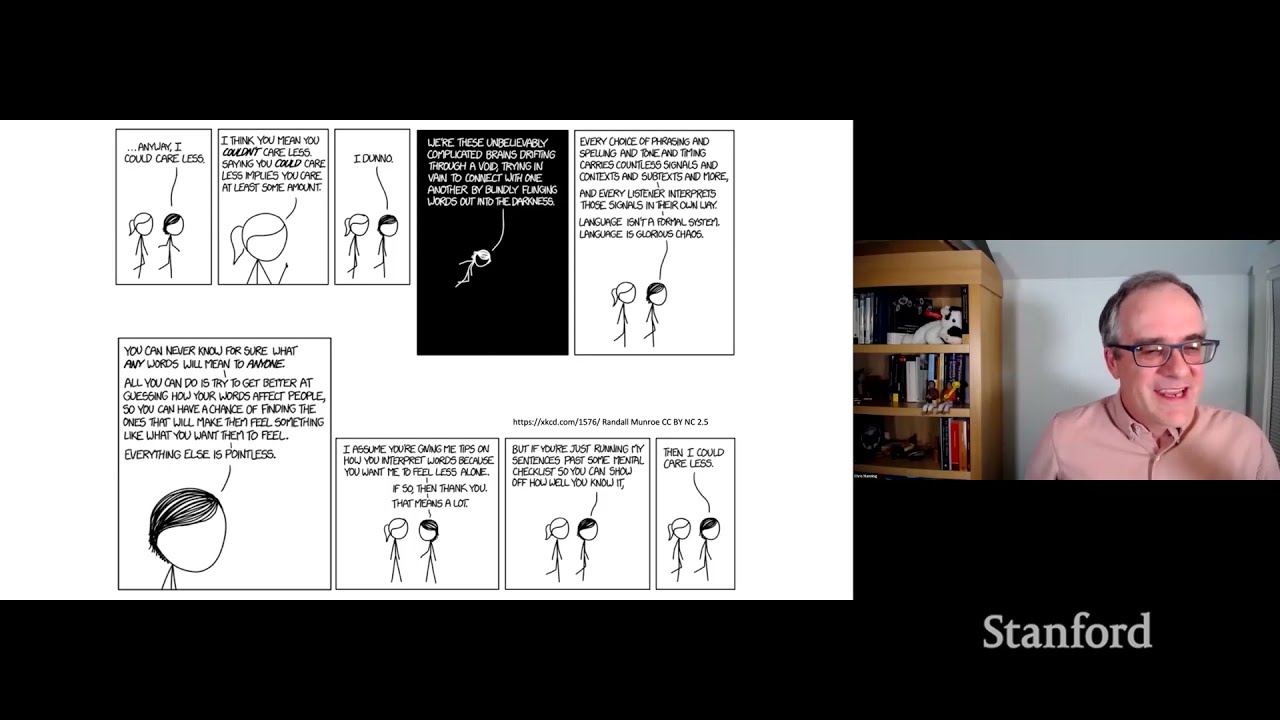
- Language is more than just words; it involves subtext, context, and individual interpretation, making it 'glorious chaos'.
- The development of language (around 100,000-1 million years ago) and writing (around 5,000 years ago) were pivotal for human advancement.
- The goal of NLP is to build computational systems that can better understand and predict how words affect people and their meanings.
Recognizing the inherent complexity and social nature of human language highlights the challenges and importance of developing sophisticated NLP techniques.
An xkcd comic illustrates the ambiguity and social nuances of language, showing a conversation where 'I could care less' is used to mean 'I couldn't care less,' emphasizing how context and intent shape meaning.
- Traditional NLP often treats words as discrete symbols (one-hot encoding), leading to very large, sparse vectors and an inability to capture semantic similarity.
- Resources like WordNet, while useful, are limited by human construction, lack nuance, and struggle to keep up with evolving language.
- The distributional hypothesis states that a word's meaning can be inferred from the words that frequently appear near it ('You shall know a word by the company it keeps').
- Deep learning models learn dense, real-valued vector representations called word embeddings, where semantic similarity is encoded within the vector space.
Understanding the shortcomings of older methods justifies the need for new approaches like word embeddings, which provide a more powerful and nuanced way to represent word meaning.
Searching for 'Seattle motel' should ideally also match documents containing 'Seattle hotel,' but discrete symbol representations make this difficult because 'motel' and 'hotel' are treated as entirely separate entities.
- Word2Vec learns word embeddings by predicting context words given a center word (or vice-versa) from a large corpus of text.
- The objective is to adjust word vectors to maximize the probability of observing actual context words around a given center word.
- The model uses a softmax function to convert dot products of word vectors into probability distributions.
- The learning process involves minimizing a loss function, which is achieved by calculating gradients and iteratively updating word vectors using calculus.
Word2Vec provides a concrete, computationally efficient method for learning high-quality word representations that capture semantic relationships, forming a cornerstone of modern NLP.
Given the center word 'banking,' the algorithm learns vectors such that words frequently appearing nearby (e.g., 'financial,' 'loan,' 'account') have a higher probability of being predicted as context words.
- Word embeddings create a vector space where semantically similar words are located near each other.
- These vectors exhibit fascinating properties, such as capturing analogies through vector arithmetic (e.g., king - man + woman ≈ queen).
- Word vectors can be used for tasks like finding similar words (e.g., 'croissant' is similar to 'baguette') and performing analogy tasks.
- While effective, single word vectors struggle to represent words with multiple distinct meanings (polysemy) and often group antonyms together due to similar contexts.
The ability of word vectors to capture semantic similarity and analogies demonstrates their power and versatility, making them a fundamental tool for various NLP applications.
The analogy 'Australia is to beer as France is to X' results in 'champagne,' showcasing the model's ability to understand cultural associations and relationships beyond simple similarity.
Key takeaways
- Human language is inherently complex and social, posing significant challenges for computational understanding.
- Traditional NLP's discrete word representations are limited; dense word embeddings learned via deep learning offer a more powerful alternative.
- The distributional hypothesis (meaning is defined by context) is a core principle enabling the learning of effective word vectors.
- Word2Vec is a key algorithm for learning word embeddings by predicting context words based on distributional similarity.
- Word embeddings capture semantic relationships, allowing for similarity calculations and analogical reasoning through vector arithmetic.
- Despite their power, single word vectors have limitations in representing polysemy and antonyms effectively without further techniques.
- Word vectors serve as a foundational representation for many advanced NLP tasks and models.
Key terms
Natural Language Processing (NLP)Deep LearningWord VectorsWord EmbeddingsDistributional HypothesisDistributional SemanticsWord2VecContext WordsCenter WordSoftmax FunctionGradient DescentVector SpaceSemantic SimilarityAnalogy TaskOne-Hot EncodingDiscrete SymbolsDense RepresentationPolysemy
Test your understanding
- Why is human language considered difficult for computers to understand, and how does the distributional hypothesis offer a solution?
- What are the main limitations of traditional NLP methods like one-hot encoding compared to word embeddings?
- How does the Word2Vec algorithm leverage the concept of distributional semantics to learn word representations?
- Explain the significance of vector arithmetic in word embedding spaces, using an example like the 'king - man + woman' analogy.
- What are some of the challenges or limitations of using single, fixed word vectors to represent words, especially concerning words with multiple meanings or antonyms?