Top 17 New Technology Trends That Will Define 2026
AI Uncovered
Overview
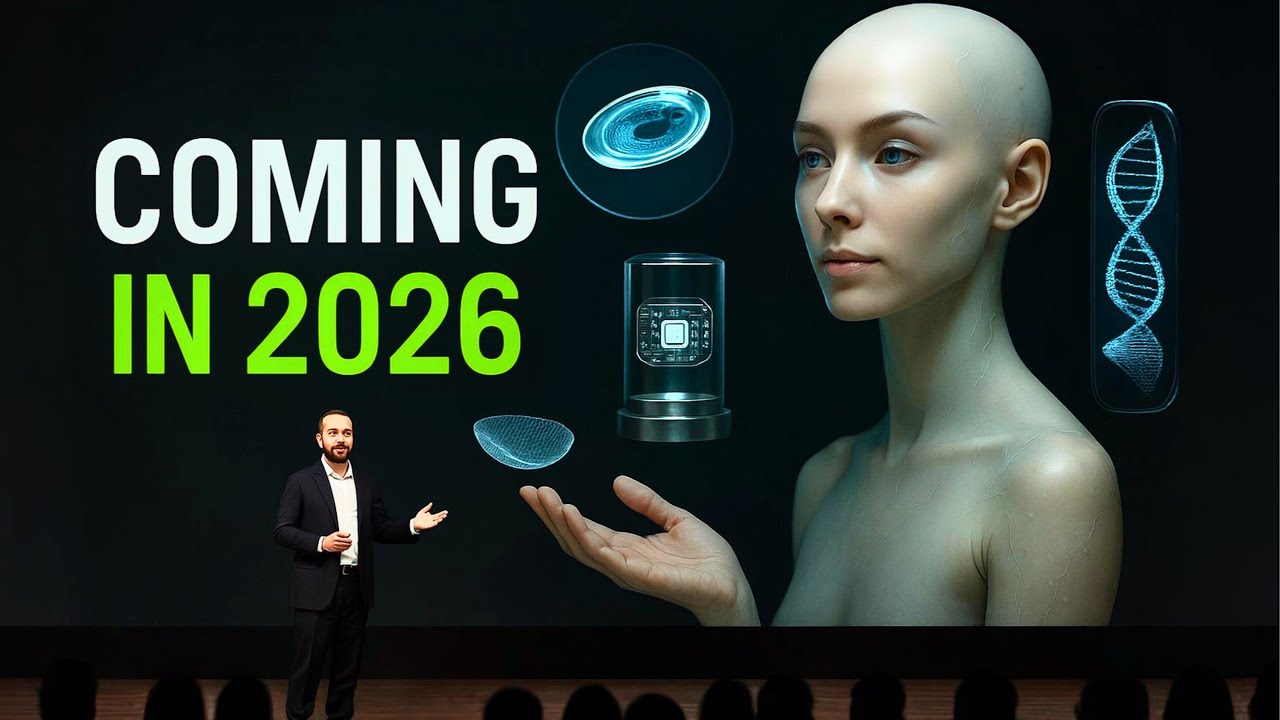
This video explores 17 emerging technology trends poised to significantly impact daily life and various industries by 2026. It covers advancements in AI, robotics, extended reality, and computing, highlighting how these innovations are moving from theoretical concepts to practical applications. Key areas include the rise of low-code development, AI-driven personalized experiences, smart infrastructure, privacy-focused AI, workflow automation, advanced robotics in logistics and retail, AI-native operating systems, sophisticated wearables, the growing utility of quantum computing, augmented reality glasses, personalized AI in healthcare, edge AI chips, intelligent home assistants, commercial humanoid robots, autonomous AI agents, the ubiquity of generative AI, and the nascent but powerful field of brain-computer interfaces.
Save this permanently with flashcards, quizzes, and AI chat
Chapters
- Low-code/no-code platforms are enabling individuals without traditional programming skills to build applications and tools, with a projected 75% of new apps using these methods by 2026.
- AI is enhancing extended reality (XR) by creating dynamic, self-generating virtual spaces and more interactive, responsive avatars and virtual environments.
- These trends empower more people to create digital solutions and engage with technology in more intuitive and immersive ways.
- The Internet of Things (IoT) is expanding rapidly, with over 30 billion devices expected by 2026, leading to smarter infrastructure like adaptive traffic lights and automated inventory management.
- Privacy-first AI is becoming crucial, with a focus on local processing and on-device AI capabilities to keep user data secure and comply with regulations like GDPR.
- These advancements aim to create more efficient, responsive environments while prioritizing user privacy in an increasingly connected world.
- Workflow automation is scaling up, with tools automating entire processes from hiring to invoicing, significantly reducing repetitive human tasks.
- AI is enhancing robotics in retail and logistics, enabling autonomous robots for tasks like shelf scanning, warehouse operations, and delivery, especially to address labor shortages.
- AI-native operating systems are integrating AI capabilities directly into the OS, allowing for system-wide intelligent assistance like summarizing files or generating content without switching applications.
- Wearable technology is evolving into comprehensive 24/7 health monitors, tracking vital signs, stress, and even offering early illness detection, with AI providing personalized health insights.
- Quantum computing is moving closer to practical utility, with advancements in qubit count and error correction enabling complex simulations for drug discovery and supply chain optimization.
- Augmented reality (AR) glasses are becoming more practical, aiming to replace screens by overlaying real-time information like navigation and captions directly into the user's field of vision.
- AI in healthcare is becoming highly personalized, aiding in disease detection, risk assessment, and tailoring treatment plans based on individual patient data and genetics.
- Edge AI chips are becoming standard in devices, enabling fast, on-device AI processing for tasks like translation and voice recognition without relying on the cloud.
- AI-powered home assistants are becoming more capable, evolving from simple speakers to mobile robots that can perform tasks like home monitoring and elder care.
- Humanoid robots are transitioning to commercial use, performing tasks in manufacturing, logistics, and even domestic settings, with decreasing costs making them more scalable.
- AI agents are emerging as autonomous workers capable of handling complex tasks from start to finish, such as software development or managing business processes.
- Generative AI is becoming the default for content creation, with advanced multimodal models capable of generating text, images, video, and audio, fundamentally changing content production.
- Brain-computer interfaces (BCIs) are moving from research labs to real-world applications, enabling individuals to control devices with their thoughts.
- BCIs have the potential to restore mobility and communication for people with severe physical impairments.
- While still in early stages, BCI technology holds massive implications for human augmentation and assistive technologies.
Key takeaways
- The development landscape is democratizing, allowing non-programmers to create sophisticated applications using low-code/no-code tools.
- AI is increasingly integrated into everyday technologies, from operating systems and wearables to robotics and virtual experiences, making them more intelligent and personalized.
- Data privacy is a growing concern, driving the development of AI solutions that process information locally on devices rather than relying on cloud storage.
- Automation is expanding beyond simple tasks to encompass entire workflows and physical processes, driven by advancements in AI and robotics.
- The lines between the digital and physical worlds are blurring with the rise of AR glasses and increasingly capable AI-powered home assistants and robots.
- Generative AI is set to become a foundational tool in content creation, impacting how we produce and consume information across various media.
- Emerging technologies like quantum computing and brain-computer interfaces, though still developing, hold the potential for transformative breakthroughs in science and human augmentation.
Key terms
Test your understanding
- How are low-code/no-code platforms changing software development by 2026?
- What are the implications of AI-driven personalization in extended reality and healthcare?
- Why is privacy-first AI and local processing becoming increasingly important?
- How are AI and robotics transforming industries like retail, logistics, and manufacturing?
- What potential do brain-computer interfaces hold for individuals with physical limitations?