1:01:20
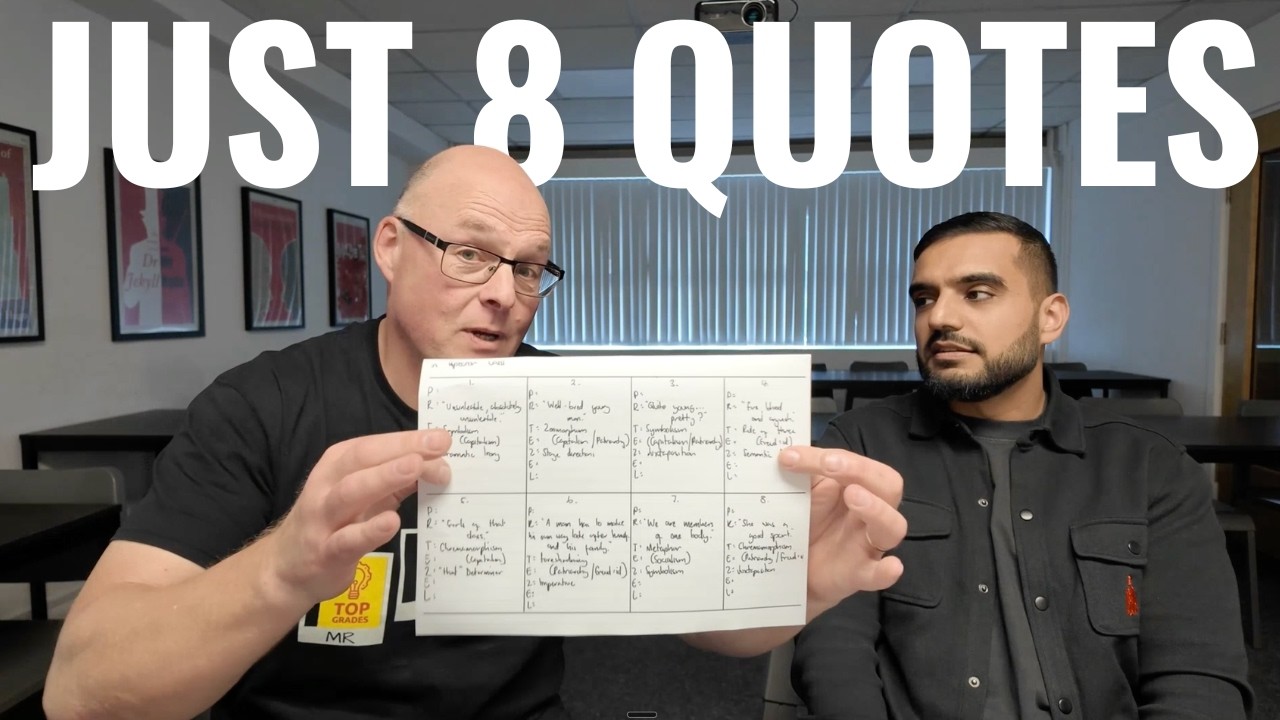
8 quotes that fit EVERY question in An Inspector Calls.
Mr Salles Teaches English
Overview
This video explores how to effectively use eight key quotes from J.B. Priestley's "An Inspector Calls" to answer any potential exam question. The presenters, Mr. Everything English and Mr. Salah, analyze each quote and demonstrate its applicability to various characters, themes, and literary devices within the play. They emphasize understanding the underlying messages of social responsibility, class inequality, and the consequences of individual actions, providing a framework for deeper analysis and higher grades.
How was this?
Save this permanently with flashcards, quizzes, and AI chat
Chapters
- The video introduces a strategy of using only eight specific quotes to answer any question about "An Inspector Calls."
- The eight selected quotes are: 'unsinkable, absolutely unsinkable,' 'well-bred young man,' 'quite young, pretty,' 'fire, blood, anguish,' 'girls of that class,' 'man's got to make his own way,' 'members of one body,' and 'she was a good sport.'
- The goal is to demonstrate how these versatile quotes can be applied to characters, themes, and broader concepts within the play.
This approach helps students focus their revision and develop a deeper understanding of how specific phrases encapsulate the play's core messages, making essay writing more efficient and effective.
The presenters list the eight quotes that will be the focus of their analysis.
- Edna is presented as a symbol of the working class and a victim of a system that believes itself 'unsinkable,' highlighting class inequality.
- Eva Smith, like Edna, is a victim, and the quotes 'members of one body,' 'fire, blood, anguish,' and 'girls of that class' all apply to her suffering and dehumanization.
- The quote 'well-bred young man' is linked to Gerald Croft, illustrating how societal expectations and inherited wealth can shape behavior and limit freedom, particularly in relationships.
- Sheila Berling's reaction to Eva's death, asking 'was she quite young, pretty?', reveals a superficiality and a tendency towards 'girl-on-girl crime,' showing how women can internalize patriarchal standards.
- Mrs. Birling, through the quote 'girls of that class,' exemplifies prejudice and a lack of solidarity among women, acting as a victim of patriarchy herself while perpetuating its norms.
Understanding how these quotes apply to individual characters deepens the analysis of their motivations, societal roles, and the impact of their actions, providing concrete evidence for essay arguments.
The presenters discuss how 'unsinkable, absolutely unsinkable' can be applied to Edna, symbolizing the arrogance of the upper class and the system that oppresses her.
- Inspector Goole is presented as Priestley's mouthpiece, embodying socialist ideals and social responsibility.
- The possibility of the Inspector being a supernatural 'ghost' is discussed, drawing parallels to Dickens' 'A Christmas Carol' as a morality tale.
- The quote 'fire, blood, and anguish' serves as a warning about the consequences of unchecked capitalism and the potential for social unrest and war.
- The Inspector's arrival and questioning directly challenge Mr. Birling's philosophy of 'a man's got to make his own way,' highlighting the conflict between individualism and collective responsibility.
The Inspector's role is crucial for understanding the play's didactic purpose; he represents the force of social conscience and the urgent need for change.
The presenters suggest that the Inspector, like the ghosts in 'A Christmas Carol,' uses a moral framework to teach the wealthy characters about their social obligations.
- Gender: Quotes like 'girls of that class' and 'quite young, pretty' highlight the victimization of women and how they can perpetuate patriarchal standards.
- Class: 'Unsinkable, absolutely unsinkable' illustrates the arrogance of the capitalist upper class, while 'members of one body' promotes the socialist ideal of unity.
- Capitalism vs. Socialism: The conflict is embodied by Mr. Birling's individualistic 'man's got to make his own way' versus the Inspector's call for collective responsibility ('members of one body').
- War: The quote 'fire, blood, and anguish' is directly linked to the destructive potential of capitalism and the cyclical nature of war, suggesting that societal failures lead to conflict.
- Responsibility: The entire play, and particularly the Inspector's role, emphasizes the interconnectedness of individuals and their shared responsibility for societal well-being.
Connecting the eight quotes to major themes allows for a comprehensive understanding of Priestley's social commentary and provides a structured approach to analyzing the play's deeper meanings.
The presenters explain how 'fire, blood, and anguish' can be interpreted as a warning about the link between capitalist greed and the outbreak of war.
- Gerald Croft, described as a 'well-bred young man,' can be seen as both a product of and a victim of his privileged background, yet he ultimately exploits his position.
- Sheila Birling is presented as a complex character who initially seems to change but may ultimately remain trapped by societal expectations and patriarchal control.
- The idea of Sheila as a 'female capitalist' is introduced, valuing others based on appearance ('quite young, pretty') rather than inherent worth.
- Both Gerald and Sheila, despite their potential for change, are shown to be products of a system that limits their true freedom and perpetuates inequality.
Examining these characters through the lens of the key quotes reveals nuances in their development and their roles within the play's social critique, particularly regarding privilege and the limitations placed upon individuals.
The presenters discuss how Gerald's actions, like keeping Eva in a flat, demonstrate his exploitation of privilege, while Sheila's initial dismissal of Eva highlights her own internalized class prejudice.
Key takeaways
- A limited set of powerful quotes can unlock comprehensive analysis of "An Inspector Calls" for exam purposes.
- Characters like Edna and Eva Smith serve as potent symbols of the working class, highlighting their exploitation within a capitalist society.
- The play critiques the arrogance and self-interest of the upper class, symbolized by the belief in being 'unsinkable.'
- Inspector Goole represents a moral and socialist counterpoint to the Birling family's individualism, warning of societal consequences.
- The theme of interconnectedness ('members of one body') is central, contrasting with the destructive nature of individualism and greed.
- Priestley uses the play to warn against the social and political dangers of unchecked capitalism, linking it to potential conflict and suffering ('fire, blood, anguish').
- Even characters who seem to change, like Sheila, may remain fundamentally influenced or trapped by the patriarchal and capitalist systems they inhabit.
Key terms
An Inspector CallsJ.B. PriestleyCapitalismSocialismClass SystemPatriarchyIndividualismCollective ResponsibilitySymbolismMorality Tale
Test your understanding
- How does the quote 'unsinkable, absolutely unsinkable' apply to both the Birling family's ideology and the broader societal issues presented in the play?
- Explain how the quote 'girls of that class' reveals the prejudices held by characters like Mrs. Birling and the societal pressures faced by women like Eva Smith.
- What does the Inspector mean when he warns of 'fire, blood, and anguish,' and how does this relate to the play's critique of capitalism?
- Analyze how the quote 'members of one body' serves as a direct challenge to the individualistic philosophy espoused by Mr. Birling.
- Discuss how the quote 'she was a good sport' illustrates the dehumanization and commodification of women within the play's social context.