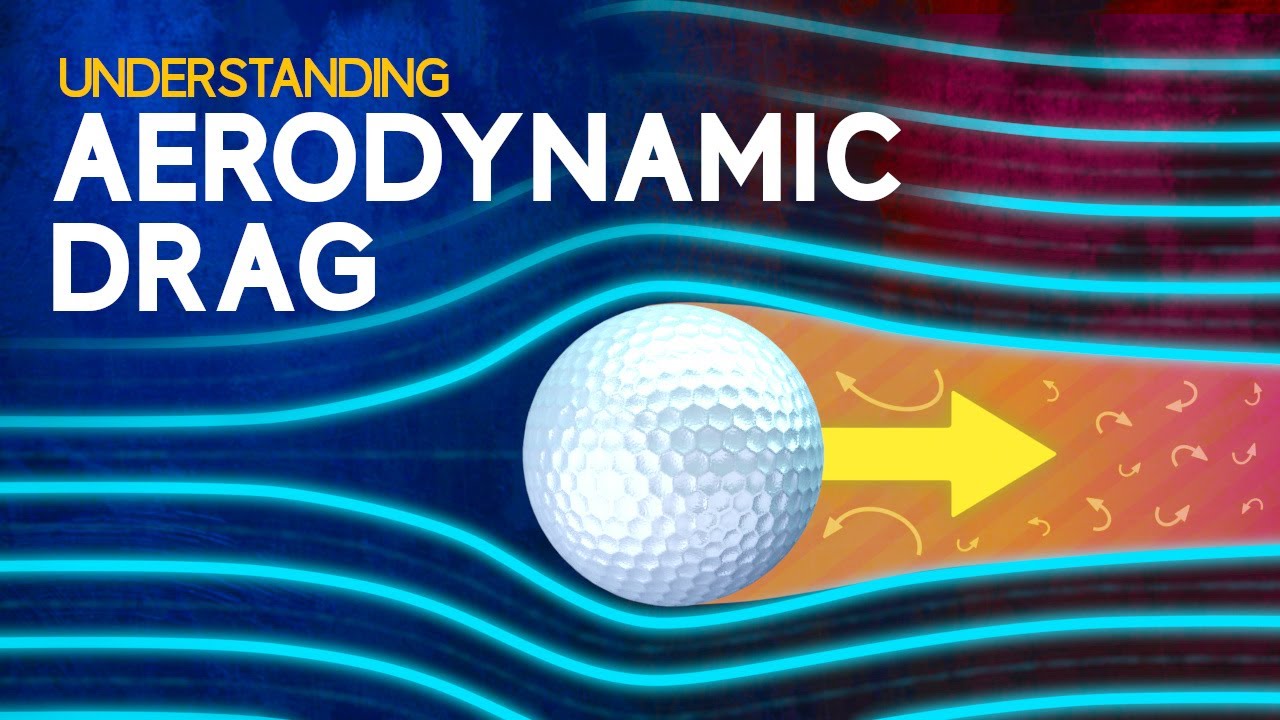
Understanding Aerodynamic Drag
The Efficient Engineer
Overview
This video explains the fundamental concepts of aerodynamic drag, the force that opposes an object's motion through a fluid. It breaks down drag into two primary components: friction drag, caused by fluid viscosity and shear stress on the surface, and pressure drag (or form drag), resulting from pressure differences between the front and rear of an object. The video details how factors like object shape, flow separation, and the transition from laminar to turbulent flow significantly influence these drag components. It also introduces the drag equation and Stokes' Law, illustrating practical applications like viscometry and the calculation of terminal velocity.
Save this permanently with flashcards, quizzes, and AI chat
Chapters
- When a fluid moves past an object or vice versa, it exerts forces.
- These forces can be divided into lift (perpendicular to flow) and drag (parallel to flow).
- Aerodynamic forces apply to gases like air, while hydrodynamic forces apply to liquids.
- Drag is often undesirable, impacting vehicle efficiency and performance, making its reduction a key engineering goal.
- Drag arises from two main types of surface stress: wall shear stress and pressure stress.
- Friction drag is caused by the fluid's viscosity acting tangentially to the surface.
- Pressure drag (or form drag) is caused by pressure differences acting perpendicularly to the surface, particularly significant for blunt objects.
- The total drag is the combined effect of friction and pressure drag in the direction of flow.
- Pressure drag is significant for blunt bodies and increases dramatically with flow separation.
- Flow separation occurs when the fluid boundary layer detaches from the object's surface, creating a low-pressure wake behind it.
- This separation is driven by adverse pressure gradients, where pressure increases along the flow direction, causing the flow to reverse and detach.
- Minimizing flow separation is a primary goal for reducing drag.
- A turbulent boundary layer, due to mixing, can stay attached to a surface longer than a laminar one, delaying flow separation and reducing pressure drag.
- This is why dimples on a golf ball or vortex generators on airplane wings create turbulence to reduce pressure drag.
- Conversely, turbulence increases friction drag because the velocity gradient at the wall is steeper, leading to higher shear stress.
- Therefore, for friction drag, maintaining laminar flow is preferable, while for pressure drag, inducing turbulence can be beneficial.
- Streamlined shapes, like teardrops, are designed to delay or prevent flow separation, minimizing pressure drag.
- For highly streamlined bodies, friction drag becomes the dominant component.
- Friction drag is higher in turbulent flow than in laminar flow.
- Techniques like Hybrid Laminar Flow Control aim to maintain laminar flow over surfaces to reduce friction drag.
- Nature provides inspiration for drag reduction, such as the microstructure of shark skin.
- Micro-ridges on shark scales modify the turbulent boundary layer to reduce friction drag.
- Artificial shark skin coatings could potentially reduce aircraft drag by 2%, leading to significant fuel savings.
- The overall drag is a balance between pressure and friction drag, and the optimal shape minimizes their sum, not necessarily each individually.
- The drag force is often calculated using the drag equation: Drag = 0.5 * Rho * V^2 * A * Cd.
- The drag coefficient (Cd) encapsulates complex factors like geometry and flow regime, determined experimentally or via simulation.
- The reference area (A) depends on the object's shape (e.g., frontal area for blunt bodies, planform area for airfoils).
- The drag coefficient varies significantly with the Reynolds number, which characterizes the flow regime (laminar vs. turbulent).
- At very low Reynolds numbers (less than 1), drag on a sphere is described by Stokes' Law, where drag is directly proportional to velocity.
- Stokes' Law is an analytical solution for drag, unlike the empirical drag equation.
- This law can be used to calculate the terminal velocity of a falling object when drag balances gravity and buoyancy.
- This principle is applied in viscometers to measure fluid viscosity by observing the terminal velocity of a falling sphere.
Key takeaways
- Aerodynamic drag is a force opposing motion through air, composed of friction drag (viscosity) and pressure drag (shape).
- Flow separation, caused by adverse pressure gradients, significantly increases pressure drag, especially for blunt objects.
- Turbulence can reduce pressure drag by delaying flow separation but increases friction drag by steepening the velocity gradient near the surface.
- Streamlined shapes minimize pressure drag, but friction drag becomes more dominant, requiring a balance between the two.
- Nature, like shark skin, offers inspiration for reducing friction drag through surface microstructures.
- The drag equation uses a drag coefficient (Cd) to quantify drag, which is influenced by object shape and Reynolds number.
- Stokes' Law provides an analytical solution for drag at very low Reynolds numbers, enabling applications like viscometry.
Key terms
Test your understanding
- What are the two primary components of aerodynamic drag and what causes each?
- How does flow separation contribute to pressure drag, and what is its relationship with adverse pressure gradients?
- Explain the dual effect of turbulence on pressure drag versus friction drag.
- How can the design of an object's shape influence the balance between pressure and friction drag?
- What is Stokes' Law, and in what conditions is it applicable for calculating drag?