47:28
Fundamental Right | AK 47 Series | Polity | Crazy GkTrick | By Akshay Shrivastava
Crazy GkTrick
Overview
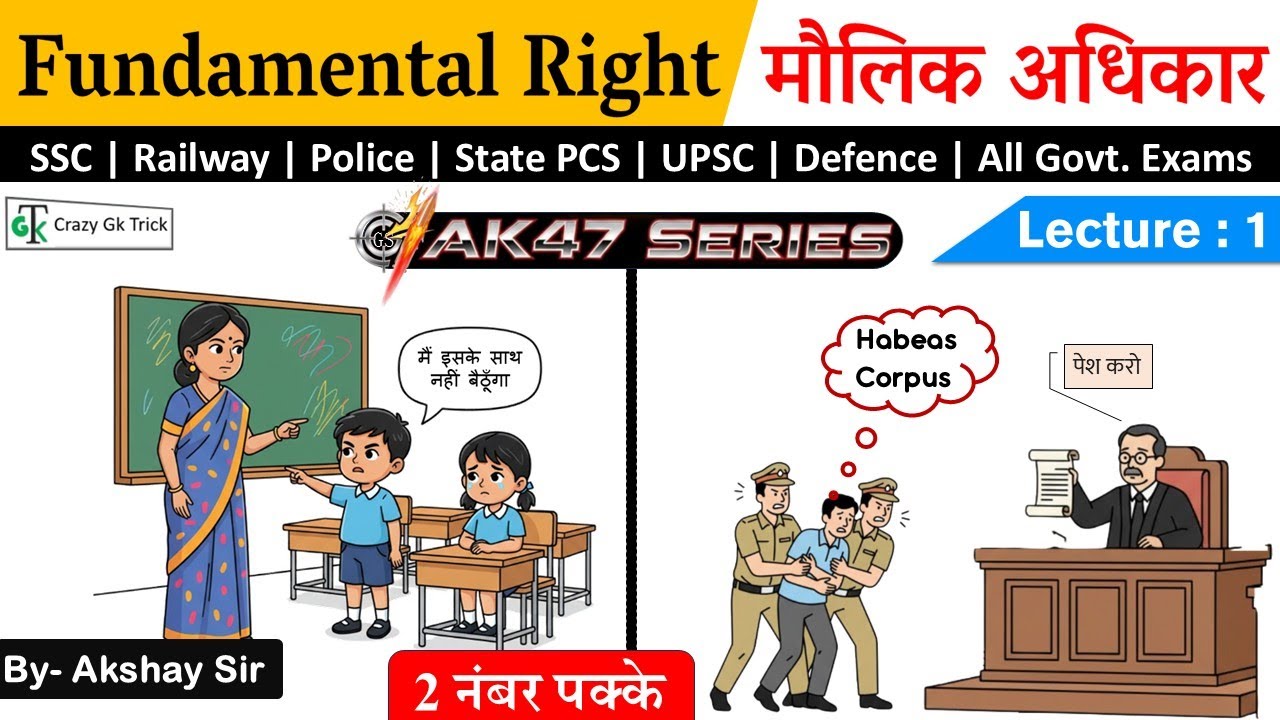
This video introduces the 'AK-47 Series' for competitive exam preparation, focusing on high-weightage General Studies (GS) topics. The first lecture delves into 'Fundamental Rights' in Indian Polity. It emphasizes understanding concepts over rote memorization, explaining the historical background, evolution, and significance of fundamental rights. The video covers key articles, landmark Supreme Court cases, and the importance of these rights for democracy, detailing the Right to Equality, Right to Freedom, Right Against Exploitation, Right to Freedom of Religion, Cultural and Educational Rights, and the Right to Constitutional Remedies, including various writs.
How was this?
Save this permanently with flashcards, quizzes, and AI chat
Chapters
- GS is crucial for competitive exam success, often determining selection.
- Many students struggle with GS due to vast syllabus and lack of revision.
- The AK-47 series covers 47 high-weightage GS topics to ensure 60-70% score.
- Each lecture includes theory, examples, concepts, and 40-50 practice questions.
- A special package with PDFs, practice questions, and mock tests is available.
This series aims to provide a structured and effective approach to mastering General Studies, a subject often found challenging by students, thereby boosting their confidence and chances of selection.
The AK-47 series is named to represent 47 essential GS topics that, if mastered, can secure a significant portion of the exam score.
- Fundamental Rights are dynamic and protected by the Supreme Court, the guardian of these rights.
- Article 32, termed the 'Soul and Heart of the Constitution' by Dr. Ambedkar, is crucial for enforcing these rights.
- The concept of fundamental rights evolved from historical demands during British rule, with key milestones like the 1895 Constitution Bill, Annie Besant's demand in 1925, and the Nehru Report in 1928.
- These rights are enshrined in Part III of the Indian Constitution and were inspired by the US Constitution.
- Initially seven, the Right to Property was removed as a fundamental right and made a legal right (Article 300A) via the 44th Amendment in 1978 to facilitate development.
Understanding the historical context and conceptual evolution of fundamental rights is essential for grasping their significance and how they protect citizens from arbitrary state action.
The removal of the Right to Property as a fundamental right in 1978, making it a legal right under Article 300A, illustrates how these rights can be amended to balance individual claims with national development needs.
- Article 14 guarantees equality before the law and equal protection of laws, prohibiting arbitrary state action (Mainka Gandhi case).
- Article 15 prohibits discrimination on grounds of religion, race, caste, sex, or place of birth, though special provisions for backward classes are allowed (State of Madras vs. Champakam Dorairajan case).
- Article 16 ensures equality of opportunity in public employment, with provisions for reservations for backward classes, subject to a 50% cap and the 'creamy layer' exclusion (Indra Sawhney case).
- Article 17 abolishes untouchability, and the Protection of Civil Rights Act, 1955, provides penalties for its practice.
- Article 18 abolishes titles, except those related to military or academic distinctions, to maintain equality.
The Right to Equality forms the bedrock of a democratic society by ensuring that all individuals are treated equally under the law and have equal opportunities, regardless of their background.
The Indra Sawhney case (1992) established that reservations for Other Backward Classes (OBCs) in public employment are permissible but must not exceed 50% of total vacancies, and the 'creamy layer' among OBCs should be excluded.
- Article 19 guarantees six freedoms: speech and expression, assembly, association, movement, residence, and profession.
- Freedom of speech and expression includes the right to express views online, protected against arbitrary censorship (Shreya Singhal case).
- Article 20 provides protection against double jeopardy and ex-post facto laws.
- Article 21, the Right to Life and Personal Liberty, is interpreted broadly to include the right to live with dignity, a clean environment (MC Mehta case), and privacy (KS Puttaswamy case).
- Article 21A, added by the 86th Amendment, guarantees the right to free and compulsory education for children aged 6-14.
- Article 22 provides protection against arbitrary arrest and detention, including the right to be informed of grounds, produced before a magistrate within 24 hours, and consult a lawyer.
These rights are fundamental to individual liberty, allowing citizens to express themselves, move freely, and live with dignity, while also providing safeguards against state overreach.
The Shreya Singhal vs. Union of India (2015) case struck down Section 66A of the IT Act, reinforcing that freedom of speech online is a fundamental right and individuals cannot be arrested merely for expressing opinions disagreeable to the government.
- Article 23 prohibits traffic in human beings and forced labor, ensuring fair wages for work (P.U.D.R. vs. Union of India case).
- Article 24 prohibits the employment of children below 14 years in hazardous occupations like factories and mines (MC Mehta case guidelines).
- These articles aim to protect vulnerable sections of society, particularly laborers and children, from exploitation.
- The P.U.D.R. case clarified that not paying full wages to a laborer constitutes a form of forced labor.
- The MC Mehta case led to stricter guidelines and enforcement against child labor in hazardous industries.
These rights are crucial for ensuring basic human dignity and protecting the most vulnerable populations from forced labor and child exploitation, promoting a more just society.
In the People's Union for Democratic Rights (P.U.D.R.) vs. Union of India (1982) case, the Supreme Court held that not paying minimum wages to workers engaged in construction for the Asian Games amounted to forced labor, thus violating Article 23.
- Article 25 guarantees freedom of conscience and the right to profess, practice, and propagate any religion.
- Article 26 allows religious denominations to manage their own affairs, subject to public order, morality, and health.
- Article 27 prohibits compelling individuals to pay taxes for the promotion of any particular religion, ensuring state neutrality.
- Article 28 restricts religious instruction in state-funded educational institutions, while allowing it in private or community-run ones.
- These articles collectively uphold India's secular character by ensuring religious freedom for all citizens and non-interference by the state in religious matters, and vice-versa, within defined limits.
These rights are fundamental to maintaining India's secular fabric, allowing individuals to practice their faith freely while ensuring the state remains neutral and does not favor any particular religion.
The Shirlur Mutt case (1954) clarified that while the state cannot interfere with the purely religious aspects of a religious denomination's affairs, it can regulate secular activities like financial management if they affect public order or morality.
- Article 29 protects the interests of minorities, granting them the right to conserve their distinct language, script, and culture.
- Article 30 empowers all minorities, whether based on religion or language, to establish and administer educational institutions of their choice.
- These rights are designed to preserve the rich diversity of India's cultural heritage.
- They ensure that minority groups can maintain their identity and pass it on to future generations.
- The right under Article 30 is not absolute and is subject to reasonable regulations by the state.
These rights are vital for preserving India's multicultural identity by safeguarding the distinct cultures and languages of minority communities and ensuring their educational needs are met.
A religious minority group establishing a school to teach its language and cultural traditions to its children exemplifies the application of Article 30.
- Article 32, considered the 'Soul and Heart of the Constitution,' provides the right to move the Supreme Court for the enforcement of Fundamental Rights.
- The Supreme Court can issue five types of writs: Habeas Corpus (produce the body), Mandamus (we command), Prohibition (to forbid), Certiorari (to be certified), and Quo Warranto (by what authority).
- Habeas Corpus protects against illegal detention.
- Mandamus compels public officials to perform their duty.
- Prohibition and Certiorari are issued to lower courts or tribunals to prevent or quash illegal proceedings or decisions.
- Quo Warranto questions the legal right of a person to hold a public office.
- High Courts can also issue writs under Article 226 for both Fundamental Rights and other legal rights, making them more accessible.
This right is the ultimate guarantor of all other fundamental rights, providing a powerful legal mechanism to seek redressal against any violation, making the constitution a living document.
If a government official refuses to grant a legally entitled scholarship without valid reason, a citizen can file a writ of Mandamus to compel the official to perform their duty.
Key takeaways
- Fundamental Rights are not absolute and can be subject to reasonable restrictions.
- The judiciary, particularly the Supreme Court, plays a vital role as the guardian of Fundamental Rights.
- Understanding the historical context and landmark cases is crucial for a deep comprehension of Fundamental Rights.
- The Right to Life (Article 21) has been expansively interpreted to include dignity, privacy, and a clean environment.
- The Right to Constitutional Remedies (Article 32) empowers citizens to directly approach the Supreme Court for the enforcement of their fundamental rights.
- While rote learning of articles is insufficient, conceptual clarity and understanding the rationale behind each right are key to mastering this topic.
- The AK-47 series emphasizes a conceptual and case-study-based approach to make learning effective and exam-oriented.
Key terms
Fundamental RightsArticle 14Article 21Right to EqualityRight to FreedomRight to Constitutional RemediesWritsHabeas CorpusMandamusSecularismMinoritiesRight to PropertySupreme CourtGuardian of Rights
Test your understanding
- What is the significance of Article 32 in the Indian Constitution, and why is it called the 'Soul and Heart'?
- How has the interpretation of Article 21 (Right to Life and Personal Liberty) evolved through landmark Supreme Court judgments?
- Explain the difference between Fundamental Rights and Legal Rights, using the Right to Property as an example.
- What are the five types of writs, and in what circumstances would each be issued?
- Why is the concept of 'equality before the law' (Article 14) crucial for a democratic society, and what are its limitations?