Avoiding Common Scoping Pitfalls in Venture Science Doctorate (VSD) Applications
Deep Science Ventures
Overview
This video explains the common pitfalls encountered in the scoping section of Venture Science Doctorate (VSD) applications, particularly focusing on the round two case study. It outlines Deep Science Ventures' scoping ontology, which involves working backward from a desired outcome to identify potential solutions and constraints. The presentation details the four questions in the case study, emphasizing the critical role of the fourth question in demonstrating problem-solving skills, creativity, and technical depth. It contrasts ineffective 'ChatGPT-like' and 'pitch' approaches with a structured, logical chain of reasoning, providing examples to illustrate how to develop strong, well-reasoned answers that address potential barriers and explore viable solutions.
Save this permanently with flashcards, quizzes, and AI chat
Chapters
- The Venture Science Doctorate (VSD) is a three-year PhD program focused on launching science companies to solve global challenges.
- Scoping is a crucial process within VSD applications, involving working backward from a global challenge to define the necessary technology.
- The application process includes a round two case study focused on scoping, after initial CV and summary submissions.
- Deep Science Ventures (DSV) uses a specific scoping ontology to understand and articulate paths to desired outcomes.
- The scoping ontology defines terms like 'solution' (high completeness and possibility), 'hypothesized solution' (high possibility, low completeness), 'tactics' (low completeness, generic approaches), 'constraints' (impossibility), and 'requirements' (implicit assumptions).
- A 'solution' is a confidently achievable outcome, like using clinical trials for vaccine development.
- A 'hypothesized solution' explores possibilities with less certainty, such as running clinical trials in a fraction of the usual time.
- Constraints are barriers that prevent achieving an outcome, while requirements are foundational assumptions.
- The case study consists of four questions designed to assess an applicant's ability to define outcomes, understand the state-of-the-art, identify constraints, and propose solutions.
- Question 1 asks for two hypothesized outcomes for venture creation within provided opportunity areas.
- Question 2 requires mapping the state-of-the-art for one chosen outcome, covering commercial and research aspects.
- Question 3 asks for hypothesized constraints (barriers) identified through a SWOT analysis.
- Question 4 is the most critical, asking applicants to flip a hypothesized constraint and probe it to develop potential solutions, demonstrating problem-solving logic and creativity.
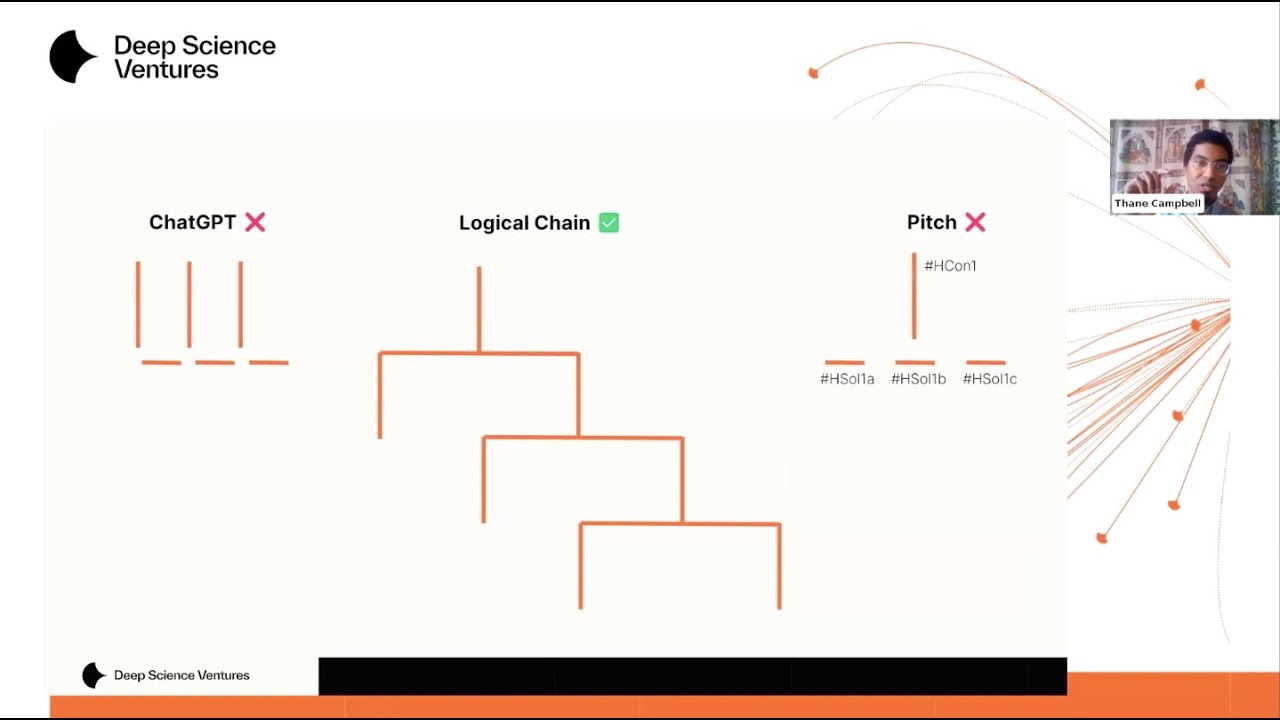
- A common pitfall is providing a series of parallel, shallow responses to constraints rather than a deep, logical chain of reasoning.
- This 'ChatGPT-like' approach often yields generic statements like 'invest in research' or 'explore techniques' without specific technological details.
- It lacks depth, fails to connect ideas logically, and doesn't demonstrate a clear understanding of how to overcome specific barriers.
- While AI tools can help explore options, they should not replace the applicant's critical thinking, problem-solving, and detailed analysis.
- The 'pitch' approach involves presenting a single, favored idea without adequately exploring weaknesses or alternative solutions.
- It often lacks deep questioning, fails to identify subsequent constraints, and may embed the solution within the constraint statement.
- This approach demonstrates bias towards a specific technology and doesn't show idea agnosticism or a rigorous evaluation of options.
- Applicants should explore weaknesses and potential improvements rather than solely advocating for one solution.
- A strong answer utilizes a logical chain of reasoning, often structured as Hypothesis (HCON) -> First Principles Question (FPQ) -> Hypothesized Solution (HSOL).
- This structure demonstrates a systematic approach to problem-solving, moving from identifying a barrier to questioning why it exists and then proposing targeted solutions.
- Applicants can compress steps, summarizing initial probing questions if the narrative remains clear and logical.
- The focus should be on demonstrating technical depth, creativity, and a clear thought process, not just listing potential solutions.
- The climate example illustrates a strong logical chain, starting with a constraint and progressively probing it through first principles questions.
- It shows how to systematically explore potential solutions (e.g., thermal swing vs. pressure swing absorption) and even challenge the proposed solutions themselves (e.g., cost of membrane separation).
- The process involves identifying multiple branching points and selecting the most convincing path, demonstrating critical evaluation and decision-making.
- A strong answer effectively compresses months of research into a few hundred words, presenting an executive summary of a thoroughly explored space.
Key takeaways
- Scoping is a critical process in the VSD application, requiring a backward-thinking approach from global challenges to technological solutions.
- Understanding DSV's specific terminology (solution, hypothesized solution, constraint) is vital for clear communication.
- The round two case study's fourth question is paramount for demonstrating problem-solving skills, creativity, and logical reasoning.
- Avoid superficial, generic answers; focus on deep, specific technological exploration and a clear logical chain.
- A structured approach using Hypothesis -> First Principles Question -> Hypothesized Solution is key to building a strong, defensible argument.
- Demonstrate idea agnosticism by exploring multiple options and their weaknesses, rather than pitching a single pre-determined solution.
- Compress extensive research into a concise, logical narrative that highlights the most promising paths forward.
Key terms
Test your understanding
- How does the VSD program utilize the scoping process in its application and curriculum?
- What is the difference between a 'solution' and a 'hypothesized solution' according to DSV's ontology, and why is this distinction important?
- Describe the typical structure of a strong answer to question four of the scoping case study, including the role of first principles questions.
- What are the main weaknesses of a 'ChatGPT-like' or 'pitch' approach to answering the scoping case study questions?
- How can an applicant effectively demonstrate technical depth and creativity within the word limits of the scoping case study?