24:11
Bio151 Week 11 Video 4 Enzyme Inhibitors
Laura Francis
Overview
This video explains how molecules can influence enzyme activity, focusing on cofactors, coenzymes, and various types of enzyme inhibitors. It details the roles of inorganic cofactors (like magnesium) and organic coenzymes (often vitamins) in assisting enzyme function. The majority of the video is dedicated to explaining three types of reversible enzyme inhibitors: competitive, non-competitive, and uncompetitive. It illustrates how each type affects enzyme kinetics, specifically by altering the Michaelis-Menten parameters Vmax and Km, and provides examples of how these concepts are applied in drug development, particularly for cancer treatments.
How was this?
Save this permanently with flashcards, quizzes, and AI chat
Chapters
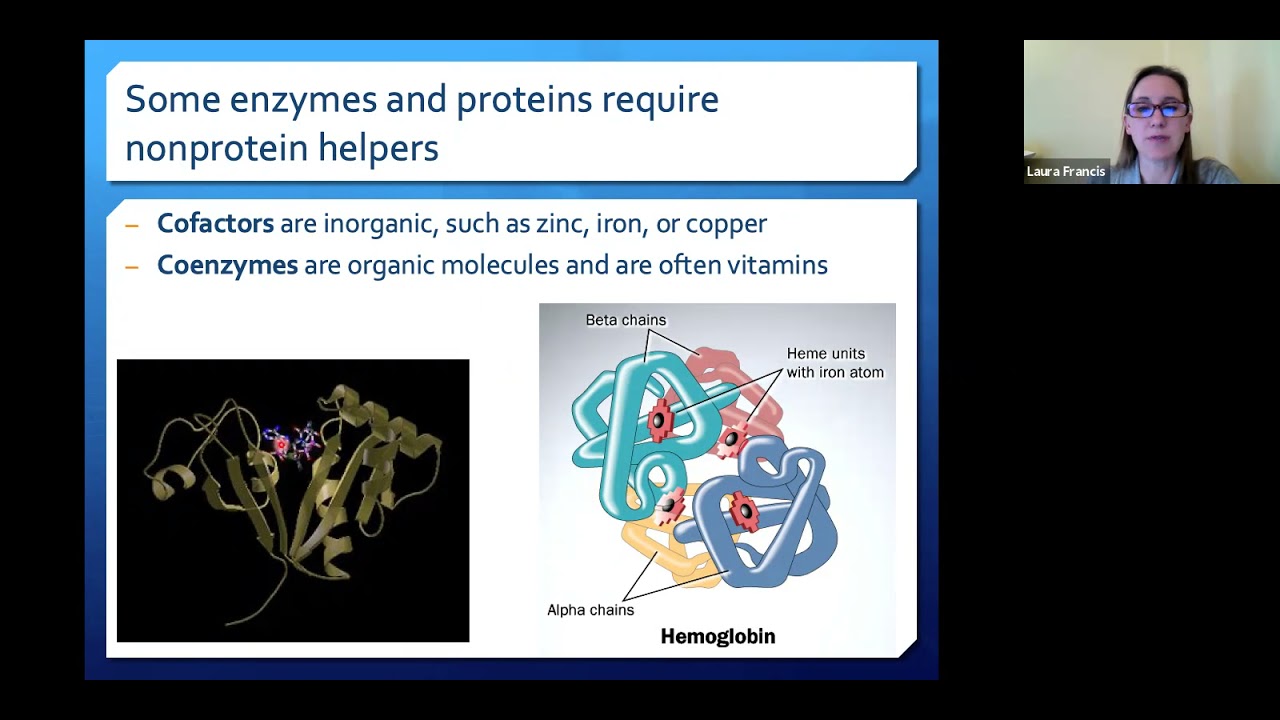
- Enzymes can be assisted by cofactors (inorganic molecules, often metals) and coenzymes (organic molecules, often vitamins).
- These molecules are frequently required for enzymes and other proteins to function correctly.
- The need to ingest certain metals and vitamins stems from their role as essential cofactors and coenzymes for our bodily functions.
- Some real-world enzyme inhibitors do not fit neatly into standard categories, such as the drug Gleevec used for chronic myelogenous leukemia, which exhibits semi-competitive inhibition.
Understanding cofactors and coenzymes highlights why certain nutrients are essential for life, while recognizing that inhibitors can be complex explains the challenges and nuances in drug design.
Hemoglobin requires iron (a cofactor) within its heme groups to bind oxygen; iron deficiency leads to anemia because hemoglobin cannot function properly.
- Enzyme inhibitors are molecules that reduce or block enzyme activity.
- The video focuses on reversible inhibitors, which can bind and unbind from the enzyme.
- Irreversible inhibitors bind permanently, but are not the focus of this discussion.
- Studying inhibitors is crucial for understanding enzyme kinetics and is a fundamental aspect of drug development, especially for targeting overactive enzymes in diseases like cancer.
Enzyme inhibitors are vital tools for both understanding biological processes and for developing therapeutic drugs that can modulate enzyme activity to treat diseases.
Drug companies develop inhibitors for overactive kinases involved in cancer cell signaling pathways to slow or stop disease progression.
- Competitive inhibitors bind to the enzyme's active site, directly competing with the substrate.
- They prevent the substrate from binding to the active site, thus blocking the reaction.
- Competitive inhibitors increase the apparent Km (making the enzyme appear to have lower affinity for the substrate) but do not change Vmax.
- This effect on Km is 'apparent' because the inhibitor can be outcompeted by high substrate concentrations, allowing Vmax to still be reached.
Understanding competitive inhibition explains how drugs can work by blocking the active site of an enzyme, and how their effectiveness can be influenced by substrate concentration.
A competitive inhibitor binds to the Pac-Man-shaped active site of an enzyme, preventing the yellow substrate from entering and being converted to product.
- Non-competitive inhibitors bind to a site other than the active site (an allosteric site).
- They alter the enzyme's conformation, reducing its catalytic efficiency without preventing substrate binding.
- Non-competitive inhibitors decrease Vmax (reducing the maximum reaction rate) but do not change Km (substrate binding affinity remains unaffected).
- Because they bind reversibly, some enzyme molecules remain unbound and can still catalyze reactions at normal rates.
Non-competitive inhibitors demonstrate that enzyme regulation can occur at sites distant from the active site, affecting the enzyme's overall function rather than its ability to bind its target.
A non-competitive inhibitor binds to an enzyme away from the active site, like a clamp, which changes the enzyme's shape and makes it less effective at converting bound substrate into product.
- Uncompetitive inhibitors bind only to the enzyme-substrate (ES) complex, not to the free enzyme.
- They bind at a site that is formed or exposed only after the substrate has bound.
- Uncompetitive inhibitors decrease both Vmax and Km, making the enzyme appear to have a higher affinity for the substrate.
- They effectively trap the substrate within the enzyme, preventing product release and catalysis.
Uncompetitive inhibition shows a more complex regulatory mechanism where the inhibitor's action is dependent on the enzyme already being engaged with its substrate.
An uncompetitive inhibitor binds to the enzyme only after the substrate has attached, forming an enzyme-substrate complex, and then blocks the enzyme's ability to complete the reaction and release the product.
- Drug A was analyzed using Michaelis-Menten kinetics to determine its inhibitory effect.
- Drug A increased both Km and Vmax, which does not fit the definition of a competitive inhibitor (which only increases Km).
- While Drug A appears to inhibit at low substrate concentrations, it paradoxically enhances enzyme activity at high substrate concentrations.
- Scientists often focus on inhibitor effects at low, physiologically relevant substrate concentrations, as drugs must be effective at the doses achievable in the body.
This example illustrates that real-world drug effects can be complex and may not always fit perfectly into theoretical categories, requiring careful analysis of kinetic data.
Drug A increases the substrate concentration needed to reach half Vmax (higher Km) and also increases the maximum possible reaction rate (higher Vmax), a behavior inconsistent with typical competitive inhibition.
Key takeaways
- Enzymes often require cofactors (inorganic) and coenzymes (organic, like vitamins) to function.
- Enzyme inhibitors are crucial for understanding biological regulation and for developing drugs.
- Competitive inhibitors block substrate binding at the active site, increasing apparent Km but not Vmax.
- Non-competitive inhibitors bind elsewhere, reducing Vmax but not Km, by impairing catalysis.
- Uncompetitive inhibitors bind only to the enzyme-substrate complex, decreasing both Vmax and Km.
- Real-world inhibitors may not always fit neatly into these defined categories.
- Understanding how inhibitors affect Michaelis-Menten kinetics is key to analyzing enzyme function and drug efficacy.
Key terms
CofactorCoenzymeEnzyme InhibitorReversible InhibitorCompetitive InhibitorNon-competitive InhibitorUncompetitive InhibitorActive SiteAllosteric SiteEnzyme-Substrate Complex (ES Complex)VmaxKmApparent Km
Test your understanding
- What is the difference between a cofactor and a coenzyme, and why are they important for enzyme function?
- How does a competitive inhibitor affect an enzyme's active site, and what are the consequences for Vmax and Km?
- Explain the mechanism of non-competitive inhibition and how it alters enzyme kinetics compared to competitive inhibition.
- Under what specific condition does an uncompetitive inhibitor bind to an enzyme, and what is its effect on Vmax and Km?
- Why is it important for drug developers to understand enzyme inhibition and Michaelis-Menten kinetics?