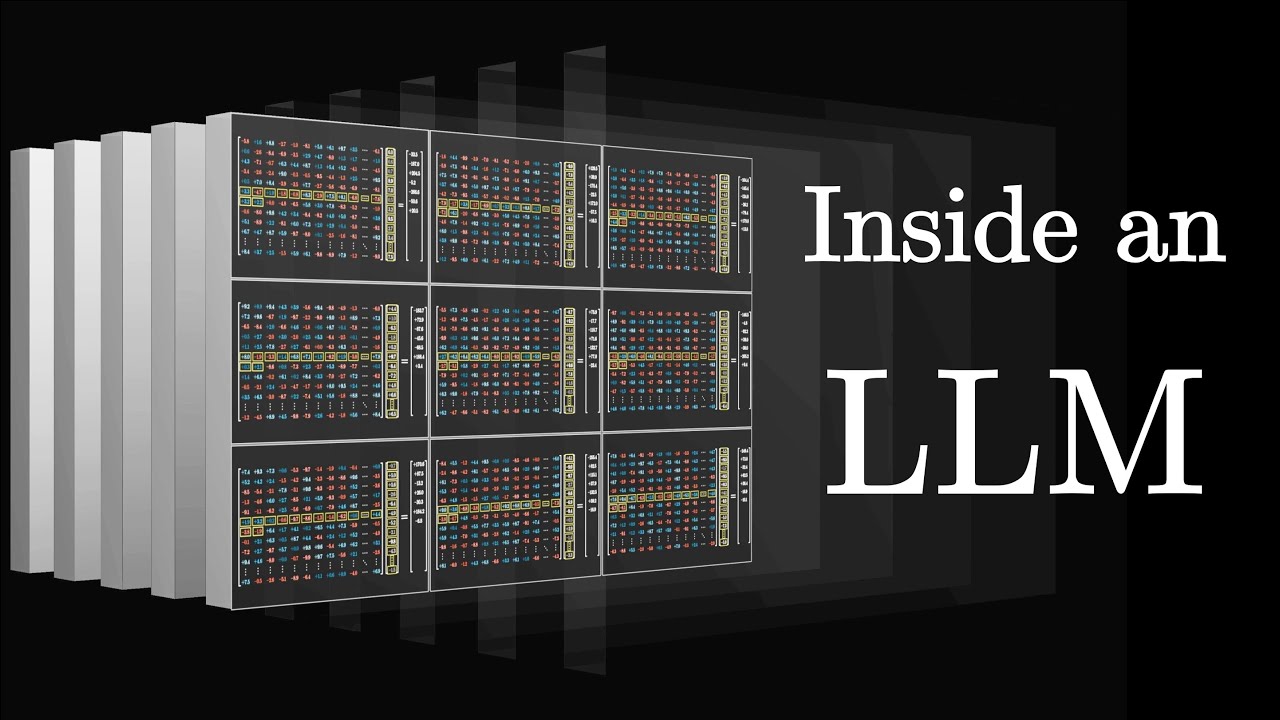
Transformers, the tech behind LLMs | Deep Learning Chapter 5
3Blue1Brown
Overview
This video introduces the Transformer architecture, the foundational technology behind modern Large Language Models (LLMs) like ChatGPT. It explains that Transformers are a type of neural network designed to process sequential data, initially for translation but now powering diverse AI applications from image generation to speech synthesis. The video breaks down the core components of a Transformer, including tokenization, embeddings, attention mechanisms, and feed-forward layers, emphasizing how these elements work together to understand and generate human-like text by predicting the next token in a sequence. It also touches upon the mathematical underpinnings, such as matrix multiplication and the softmax function, crucial for transforming raw data into meaningful predictions.
Save this permanently with flashcards, quizzes, and AI chat
Chapters
- LLMs like GPT are built upon the Transformer architecture, a specific type of neural network.
- Transformers excel at processing sequential data and are the core innovation driving the current AI boom.
- Beyond text generation, Transformers power applications like image generation (DALL-E), speech synthesis, and machine translation.
- The fundamental task of many Transformers, especially those powering chatbots, is to predict the next token (word or sub-word) in a sequence.
- Input data (text, images, audio) is first broken down into smaller units called tokens.
- Each token is converted into a numerical representation called a vector (embedding), capturing its meaning.
- These vectors then pass through 'attention blocks' where they interact to refine their contextual meaning.
- Following attention, vectors are processed by 'multi-layer perceptron' (feed-forward) layers for further transformation.
- This process of attention and feed-forward layers repeats, allowing vectors to accumulate rich, context-dependent meaning.
- Tokens are converted into high-dimensional vectors (embeddings) using an embedding matrix.
- These vectors can be visualized as points in a high-dimensional space where proximity indicates semantic similarity.
- Directions within this vector space can encode semantic relationships (e.g., gender, nationality).
- The embedding matrix is a set of learned weights, initially random, that maps each token to its vector representation.
- Transformers operate within a fixed 'context size' (e.g., 2048 tokens for GPT-3), limiting the amount of input they can consider at once.
- The final vector in the sequence is used to predict the next token by generating a probability distribution over the entire vocabulary.
- This prediction is achieved using an 'unembedding matrix' followed by a 'softmax' function.
- The process of repeatedly predicting, sampling, and appending tokens generates longer sequences of text.
- The softmax function converts raw model outputs (logits) into a valid probability distribution, ensuring values are between 0 and 1 and sum to 1.
- The 'temperature' parameter modifies the softmax output, controlling the randomness of token selection.
- A low temperature makes the model more deterministic and focused on high-probability tokens.
- A high temperature increases randomness, allowing for more creative but potentially less coherent output.
Key takeaways
- The Transformer architecture is the fundamental building block of modern LLMs, enabling their ability to understand and generate complex sequential data.
- Transformers process information by breaking it into tokens, converting tokens into meaningful vectors (embeddings), and iteratively refining these vectors through attention and feed-forward layers.
- Word embeddings exist in a high-dimensional space where geometric relationships and directions capture semantic meaning and analogies.
- The core function of many Transformers is predicting the next token in a sequence, which can be used iteratively to generate extended text.
- The context window limits how much information a Transformer can consider simultaneously, impacting its ability to maintain coherence in long sequences.
- The softmax function is essential for converting model outputs into probabilities, and the temperature parameter allows control over the randomness and creativity of generated text.
Key terms
Test your understanding
- What is the primary function of the attention block within a Transformer model?
- How do word embeddings represent semantic meaning, and what is an example of this representation?
- Why is the softmax function necessary when generating predictions for the next token?
- What is the role of the 'temperature' parameter in controlling text generation, and how does it affect the output?
- Explain the concept of a 'context size' and its implications for Transformer models like ChatGPT.