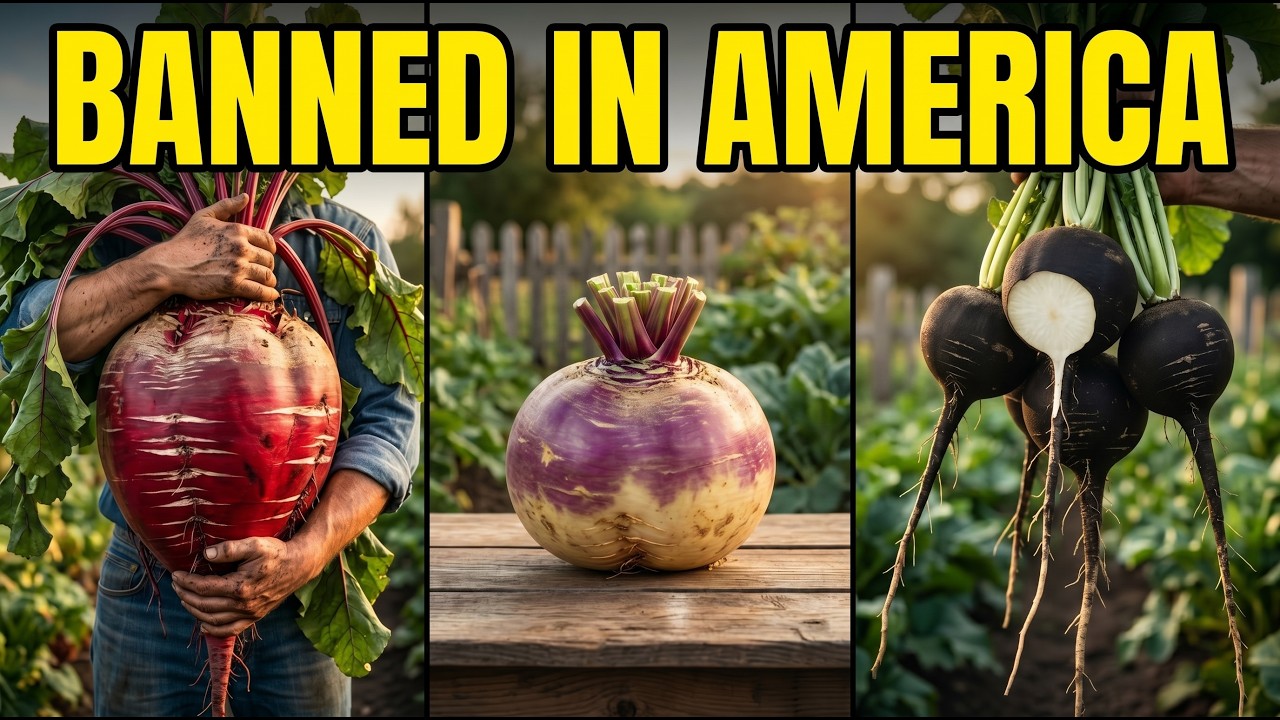
9 Most ABANDONED Survival Vegetables — Forgotten Root Crops That Fed America Before The Takeover
Forgotten Harvest Vault
Overview
This video explores nine forgotten root vegetables that were once staples in the American diet, providing sustenance through difficult times like depressions and wars. Between 1903 and 1983, a significant portion of available seed varieties disappeared due to industrial agriculture's focus on efficiency, patentability, and uniformity. These abandoned crops, such as the rudabaga and parsnip, offered resilience, nutritional density, and adaptability to poor soil and storage conditions, unlike modern, highly processed alternatives. The video argues for the recovery of this lost agricultural knowledge through home gardening and seed saving, promoting self-sufficiency and a more robust food system.
Save this permanently with flashcards, quizzes, and AI chat
Chapters
- Historically, American families relied on resilient root vegetables for food security during challenging periods.
- Between 1903 and 1983, 93% of food seed varieties vanished from American agriculture.
- These forgotten crops offered superior storage, yield, and adaptability compared to modern varieties.
- The disappearance was driven by industrialization, patenting of seeds, and a move towards uniform crops.
- The rudabaga was a primary source of Vitamin C during the Great Depression, even more so than oranges.
- It thrives in poor soil conditions where other crops fail.
- A single rudabaga can grow to the size of a bowling ball and stores for six months without refrigeration.
- Its decline is due to the convenience of year-round shipping and the difficulty of industrial processing due to its tough, irregular shape.
- The Mangelwurzel is a large beet variety (20-40 lbs per root) that can sustain a family and livestock through winter.
- It was historically known as the 'root of scarcity' because it provided food during famines.
- Its disappearance is linked to its above-ground growth, making mechanical harvesting difficult, and its need for cold storage to develop sweetness.
- Salsify, or 'vegetable oyster,' has a unique flavor and can be harvested from frozen ground throughout winter.
- It is a good source of inulin, a prebiotic fiber beneficial for gut health.
- Jerusalem artichokes (sunroots) are perennial, require no replanting, and are nutritionally dense with inulin.
- Both were marginalized due to their irregular shapes, making industrial processing difficult, and Salsify's sticky latex, while Jerusalem artichokes' inulin content caused digestive issues for the unaccustomed.
- Winter radishes (black Spanish, daikon) are large, store well, deter pests naturally, and 'biodrill' compacted soil.
- Hamburg parsley (rooted parsley) provides both edible leaves and a flavorful root, offering two harvests from one plant.
- Winter radishes were replaced by chemical pesticides and machinery, while Hamburg parsley was split into two specialized crops by the industry for greater profitability.
- Both faced issues with cosmetic standards for industrial processing.
- Parsnips were the primary sweetener in the American diet before cheap sugar, becoming sweeter after frost.
- They are slow to germinate and require a long growing season, making them inefficient for industrial agriculture.
- Turnips are a fast-growing staple crop (40-60 days) providing both edible roots and greens, historically used as an emergency crop.
- Turnips were devalued as potatoes became dominant, and modern varieties suffer from bitterness due to lack of breeding focus.
- Skirret, a perennial from the carrot family, produces sweet, slender white roots described as tasting like parsnip and coconut.
- It thrives in moist, boggy soil unsuitable for most other vegetables.
- Its cluster-like root growth and fibrous core made it incompatible with mechanical harvesting and processing.
- Skirret was systematically removed from seed catalogs and agricultural education, making it nearly extinct in American horticulture.
- These nine root crops represent a resilient food system built on adaptability and self-sufficiency.
- Their marginalization was not due to failure, but incompatibility with industrial logistics, patentability, and cosmetic standards.
- The country traded a resilient food system for one based on logistics and efficiency.
- Seeds for these plants are still available through heritage seed networks and seed savers.
- Home gardening and seed saving are crucial for restoring this lost agricultural knowledge and self-sufficiency.
Key takeaways
- Modern industrial agriculture prioritized efficiency, patentability, and uniformity, leading to the loss of 93% of historical seed varieties.
- Forgotten root vegetables offered superior resilience, storage, and nutritional value compared to many modern crops.
- Logistical challenges, such as difficult harvesting or processing, were primary reasons for these crops disappearing from commercial production.
- Crops like Salsify and Jerusalem Artichoke provided unique health benefits, such as prebiotic fiber, that were overlooked.
- Parsnips served as a natural sweetener before the widespread availability of refined sugars.
- Winter radishes offered multiple benefits including pest deterrence and soil improvement, acting as a natural agricultural tool.
- The systematic erasure of these crops represents a significant loss of agricultural knowledge and self-sufficiency.
- Reclaiming these forgotten vegetables through home gardening and seed saving is vital for restoring food system resilience.
Key terms
Test your understanding
- Why did the rudabaga, despite its nutritional value and hardiness, disappear from widespread cultivation?
- How did the parsnip function as a primary sweetener in the American diet before the advent of cheap sugar, and what natural process enhanced its sweetness?
- What unique agricultural and pest-control benefits did winter radishes provide that are largely absent in modern farming practices?
- Explain how the physical characteristics of Skirret roots, despite the plant's nutritional value and perennial nature, led to its near-extinction in commercial horticulture.
- What does the video mean by 'trading a food system built on resilience for a food system built on logistics,' and what are the implications for consumers?