41:52
Lecture 15
AMU MOOCs
Overview
This lecture introduces citation indexing as a powerful method for information retrieval, particularly in the face of rapidly growing scholarly literature. It explains how citation indexing links documents through references, enabling users to discover related earlier and later works. The lecture details the historical development from early initiatives to modern digital databases like Web of Science and Scopus. It covers the core concepts, process, structure, advantages, and limitations of citation indexing, highlighting its importance for literature searching, research evaluation, and impact analysis.
How was this?
Save this permanently with flashcards, quizzes, and AI chat
Chapters
- Citation indexing is a method to retrieve relevant literature by linking documents through their references.
- It addresses the limitations of traditional subject indexing systems in managing the vast growth of scholarly publications.
- It establishes relationships between documents, allowing users to navigate from a citing document to cited (earlier) or citing (later) works.
- Citation analysis is crucial for research evaluation, bibliometrics, and understanding scholarly communication.
Understanding citation indexing is essential for researchers to effectively navigate the vast landscape of academic literature and identify influential or related works.
A document citing previous work implies a relationship, allowing a researcher to move from the current document to earlier, related research.
- A citation is a reference made by one document to another.
- Key components of a citation include author, year, title, source (journal, book), volume, issue, and page numbers.
- A citation is distinct from a reference list; the source article is the citing document, and its references are the cited documents.
- Citation indexing links documents by analyzing these citing and cited relationships.
Knowing the components of a citation helps in understanding how individual references contribute to the larger network of scholarly connections.
A citation like 'Smith J (2020) Digital Libraries and Artificial Intelligence, Journal of Information Science, Vol. 10, Issue 2, pp. 45-60' provides specific details to locate and link documents.
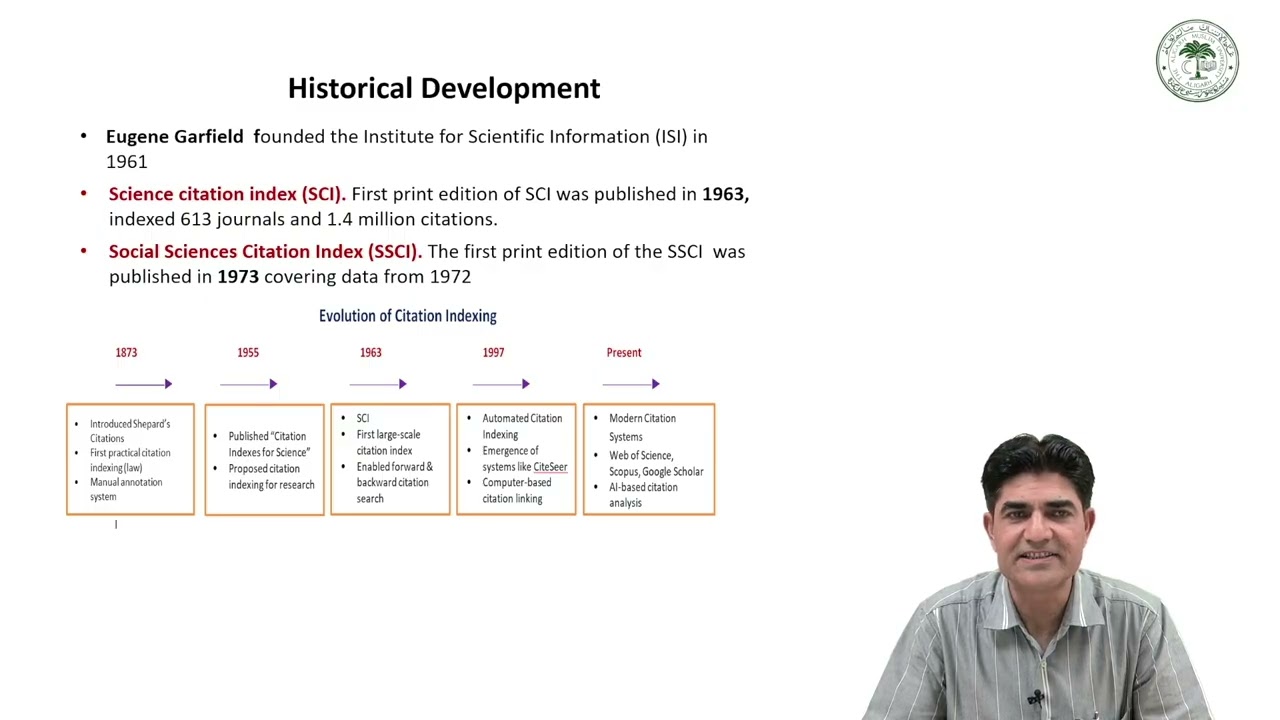
- Early efforts include Shepard's Citations in law (1877) and proposals for science citation indexing in 1955.
- Eugene Garfield founded the Institute for Scientific Information (ISI) in 1961, leading to the first Science Citation Index in 1963.
- ISI later published the Social Sciences Citation Index (1973) and Arts & Humanities Citation Index (1976).
- The advent of computers led to automated citation indexing and the development of online databases like Web of Science, Scopus, and Google Scholar.
Tracing the history reveals how citation indexing evolved from print to sophisticated digital tools, reflecting advancements in information technology.
The Science Citation Index, first published in 1963, included 613 journals and 1.4 million citations, marking a significant step in organizing scientific literature.
- It's crucial for managing the overwhelming volume of scholarly publications and identifying related literature.
- It facilitates interdisciplinary retrieval by linking research across different fields.
- It helps trace the development of research ideas and identify seminal works.
- Key objectives include establishing links between documents, facilitating literature searches, identifying influential work, and supporting research evaluation.
Understanding the 'why' behind citation indexing clarifies its indispensable role in modern research and academic assessment.
If a search yields only a few articles on an emerging topic, their reference lists can be scanned to discover dozens more related publications.
- A citation index lists cited articles, each with a list of citing articles.
- The 'citing document' is the source article, and the 'cited document' refers to its bibliography or references.
- Citation number indicates how many times a source document has been cited.
- Types of links include backward citation (references within a document), forward citation (documents that cite a given document), bibliographic coupling (documents sharing cited references), and co-citation (documents that cite the same work).
Differentiating between citing and cited documents, and understanding various link types, is fundamental to interpreting citation data accurately.
In a database result, the main article is the citing document, its references are the cited documents, and the number of times it's been cited shows its influence.
- The process involves collecting relevant documents, extracting references, and recording citation links.
- These links are organized into structured citation index databases.
- Users can search backward (through references) or forward (through citing documents).
- Modern databases like Web of Science and Scopus integrate multiple citation indexes and offer advanced search capabilities.
Knowing the process and available tools empowers users to effectively leverage citation databases for their research needs.
Web of Science allows searching by document, author, or cited reference, and clicking on 'cited by' reveals all documents that have referenced a particular article.
- Advantages include identifying influential work, discovering related literature, tracking research development, and supporting research evaluation (e.g., impact factor, h-index).
- Limitations include that citations don't always indicate quality or relevance, potential for citation bias, and a time lag for newly published research to gain citations.
- Applications span literature search, research evaluation, impact analysis (of authors, journals, institutions), and building academic networks.
- Modern systems increasingly use artificial intelligence for citation indexing.
A balanced understanding of citation indexing's strengths and weaknesses is crucial for its responsible and effective application in research.
While a high citation count suggests influence, a paper might be cited critically or erroneously, highlighting a limitation of relying solely on citation metrics.
Key takeaways
- Citation indexing is a vital tool for navigating and understanding the relationships within the vast body of scholarly literature.
- It complements traditional subject indexing by linking documents based on their reference patterns.
- The historical progression from print indexes to sophisticated online databases like Web of Science has revolutionized information retrieval.
- Understanding citation links (forward, backward, bibliographic coupling, co-citation) is key to effective research discovery.
- Citation analysis provides valuable metrics for evaluating research impact at the article, author, journal, and institutional levels.
- While powerful, citation data should be interpreted cautiously due to potential biases and the time lag in citation accrual.
Key terms
Citation IndexingCited DocumentCiting DocumentCitation AnalysisBibliometricsScholarly CommunicationForward CitationBackward CitationBibliographic CouplingCo-citationImpact FactorH-index
Test your understanding
- How does citation indexing differ from traditional subject indexing in its approach to retrieving information?
- What are the primary components of a citation, and why is understanding them important?
- Explain the historical evolution of citation indexing from its early forms to modern digital databases.
- Describe the different types of citation links (e.g., forward, backward, co-citation) and how they help in understanding research relationships.
- What are the main advantages and limitations of using citation indexing for research evaluation and literature discovery?