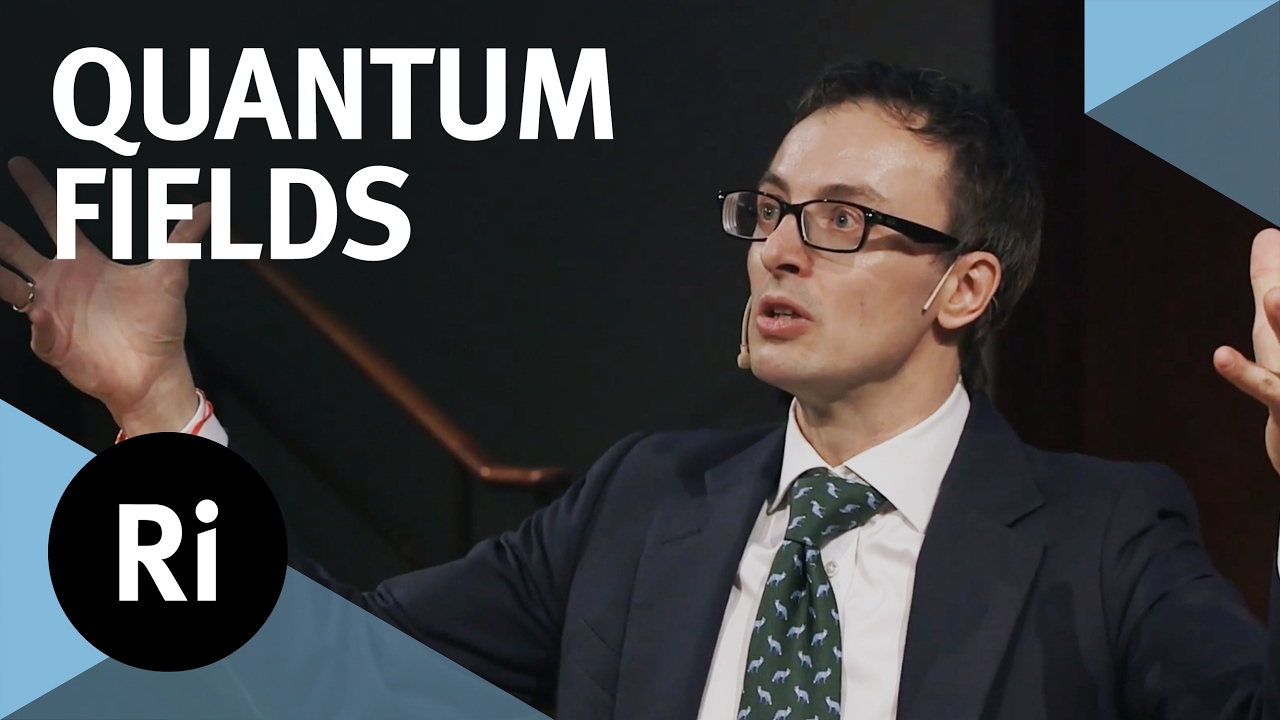
Quantum Fields: The Real Building Blocks of the Universe - with David Tong
The Royal Institution
Overview
This video explores the fundamental building blocks of the universe, moving from the ancient Greek concept of atoms to the modern understanding of quantum fields. It explains how our view has evolved from the periodic table to subatomic particles like electrons and quarks, and finally to the idea that fields, not particles, are the true fundamental constituents. The talk delves into the concept of quantum field theory, its mathematical complexities, its successes like predicting the electron's magnetic moment, and its limitations in calculating things like proton mass. It also touches upon the Standard Model, the discovery of the Higgs boson, and the ongoing search for physics beyond the Standard Model, including mysteries like dark matter and dark energy, and the implications of recent experimental results from the Large Hadron Collider.
Save this permanently with flashcards, quizzes, and AI chat
Chapters
- The enduring question in science is: what are the most fundamental constituents of the universe?
- Historically, this question evolved from ancient Greek ideas of atoms to the periodic table of elements.
- The periodic table, while a triumph, is not the ultimate answer, as elements are composed of smaller particles.
- Early discoveries like the electron by J.J. Thomson and the structure of the atom (nucleus with orbiting electrons) by Rutherford marked significant progress.
- Further refinement revealed that protons and neutrons are made of even smaller particles called quarks.
- The common understanding of the universe being made of discrete particles like electrons and quarks is a simplification and ultimately inaccurate according to our best theories.
- Modern physics suggests that the fundamental building blocks are not particles, but rather pervasive, fluid-like substances called fields.
- Fields are spread throughout the universe, taking a specific value at every point in space and time.
- This concept of fields originated with Michael Faraday's work on electricity and magnetism, envisioning invisible 'lines of force' permeating space.
- Faraday's experiments demonstrated that changing magnetic fields could induce currents, showing fields could transmit influence across space without direct contact.
- Quantum mechanics revealed that energy is quantized (comes in discrete packets), contrasting with the continuous nature of fields.
- Quantum field theory (QFT) combines quantum mechanics with the concept of fields, proposing that particles are localized excitations or 'ripples' in these fields.
- For example, photons are quantized excitations of the electromagnetic field, and electrons are quantized excitations of the electron field.
- This means all particles of a given type (e.g., all electrons) are manifestations of the same underlying field, connecting everything.
- The vacuum, far from being empty, is a dynamic place filled with constantly fluctuating quantum fields.
- The Standard Model is our current best theory describing the fundamental particles and forces, built upon the framework of quantum field theory.
- It comprises 12 matter fields (quarks and leptons like electrons and neutrinos) and 4 force-carrying fields (electromagnetism, strong nuclear, weak nuclear, and gravity).
- The Higgs field is a crucial addition, responsible for giving mass to fundamental particles through their interaction with it.
- The Standard Model has achieved spectacular success, accurately predicting experimental results to an astonishing degree of precision, such as the electron's magnetic moment.
- The discovery of the Higgs boson at the LHC in 2012 was a major confirmation of the Standard Model.
- Despite its success, the Standard Model does not explain phenomena like dark matter, dark energy, or the rapid expansion of the early universe (inflation).
- The mathematical complexity of QFT makes it extremely difficult to solve problems, such as calculating the mass of a proton with high accuracy.
- Current theoretical ideas like grand unification, supersymmetry, and string theory attempt to unify forces and particles or provide a more comprehensive framework.
- Experiments like the Large Hadron Collider (LHC) are designed to test these theories and search for new physics beyond the Standard Model.
- The lack of new discoveries at the LHC so far has led to a period of re-evaluation and speculation about the direction of theoretical physics.
- The cosmic microwave background radiation (CMB) provides a snapshot of the universe shortly after the Big Bang, showing temperature fluctuations.
- These fluctuations are believed to be the stretched-out remnants of microscopic quantum vacuum fluctuations from the universe's earliest moments.
- This observation is a major triumph for QFT, demonstrating how quantum phenomena on microscopic scales can have macroscopic consequences.
- Future experiments aim to study the CMB's polarization to better understand the field responsible for these early fluctuations, potentially revealing new physics.
- The search for new physics continues through experiments like the LHC, theoretical exploration, and connections to other fields like condensed matter and quantum information science.
Key takeaways
- The fundamental constituents of the universe are not particles, but rather pervasive quantum fields.
- Particles like electrons and quarks are localized excitations or 'ripples' within these underlying fields.
- Quantum Field Theory is the mathematical framework that successfully describes these fields and their interactions.
- The Standard Model, a triumph of QFT, accurately describes known particles and forces but does not explain phenomena like dark matter or dark energy.
- The vacuum is not empty but a dynamic realm of quantum fluctuations.
- The universe's earliest moments, as seen in the cosmic microwave background, provide evidence for quantum phenomena having macroscopic effects.
- The search for physics beyond the Standard Model is driven by unexplained observations and the quest for a more unified understanding of nature.
Key terms
Test your understanding
- What is the fundamental difference between the particle view and the field view of the universe's building blocks?
- How does quantum field theory explain the existence of particles like electrons and photons?
- What are the main successes of the Standard Model, and what phenomena does it fail to explain?
- How do quantum vacuum fluctuations in the early universe relate to the cosmic microwave background radiation?
- What are the primary challenges and future directions in the search for physics beyond the Standard Model?