Concept of disaster phenomena
Dipak Nath
Overview
This video explores the concept of disaster phenomena, moving beyond a simple definition to understand the complex interplay of factors that lead to crisis situations. It contrasts traditional approaches like the natural science and applied science perspectives, which often view disasters as solely natural events or their immediate consequences, with more progressive views. The social science approach links disasters to unresolved development issues, while the holistic approach emphasizes the critical conditions of system risk, hazard exposure, and vulnerability. Effective disaster management, therefore, requires a comprehensive understanding of these elements, focusing on risk assessment, vulnerability reduction, capacity building, and the active participation of all stakeholders within a strong institutional framework.
Save this permanently with flashcards, quizzes, and AI chat
Chapters
- A disaster is a crisis situation affecting living beings, particularly humans, characterized by loss of life, damage to resources, economic disruption, and breakdown of social systems.
- Disasters can also result from the environmental system becoming unsuitable for survival.
- A disaster-like situation arises when a system is at risk.
- The natural science approach views devastating natural phenomena themselves as disasters, offering little scope for management due to human limitations in controlling nature.
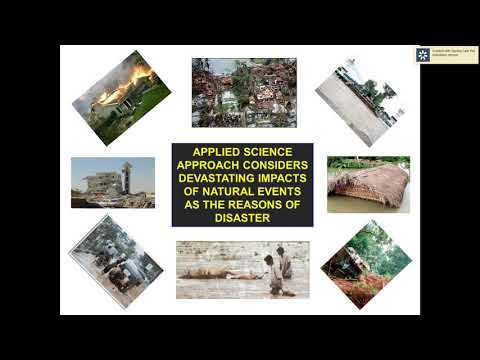
- The applied science approach focuses on the devastating outcomes of natural phenomena, treating them as disasters but neglecting risk mitigation and centering management on relief.
- Both approaches have limitations in addressing the root causes and proactive management of disasters.
- The social science approach connects disasters to unresolved development problems and identifies factors contributing to unsustainable development, which is more dangerous than new development.
- Unsustainable development creates systems that are highly susceptible to large-scale damage and disruption from external threats.
- The holistic approach defines disaster occurrence based on two primary conditions: system exposure to hazards and system vulnerability to those hazards.
- A system is hazard-prone when exposed to various threats, including geophysical, hydrological, meteorological, environmental, biological, and man-made hazards.
- A system becomes vulnerable when it possesses unsafe elements that can be damaged by external hazards.
- The possibility of disaster is significantly reduced if a system is exposed to hazards but is not vulnerable to them.
- Mitigation involves either preventing hazards or minimizing their impacts, though not all hazards can be prevented (e.g., earthquakes).
- Vulnerability reduction is a key strategy, achieved by making system elements resilient and removing unsafe conditions.
- Practical disaster management requires integrated planning based on genuine risk assessment, combining hazard and vulnerability analysis.
- Capacity building is vital, enhancing the resources, means, and strengths of communities and counter-disaster resources for mitigation and response.
- Damage mitigation measures can be structural, non-structural, or involve alternative adjustment processes for coexisting with disasters.
- A strong legal and institutional framework is necessary to support disaster management.
- Active participation of all stakeholders, especially vulnerable communities, is essential for effective disaster management.
Key takeaways
- Disasters are complex events resulting from the interaction of hazards and vulnerable systems, not just natural phenomena.
- Understanding the root causes of disasters, including development issues, is crucial for effective management.
- The holistic approach, focusing on hazard exposure and system vulnerability, provides a framework for risk assessment.
- Disaster management strategies should prioritize risk mitigation and vulnerability reduction over solely relief efforts.
- Capacity building and the development of resources are essential for enhancing a community's resilience.
- Effective disaster management requires integrated planning, strong institutional support, and the active involvement of all stakeholders.
- Unsustainable development significantly increases a system's susceptibility to disaster.
Key terms
Test your understanding
- What are the key components that define a disaster-like situation according to the holistic approach?
- How does the social science approach differ from the natural science approach in understanding disasters?
- Why is vulnerability reduction considered a critical strategy in disaster risk mitigation?
- What role does unsustainable development play in increasing disaster risk?
- How can capacity building contribute to a community's resilience against disasters?