12:24
Ancient Delphi: The Center of the Universe Explained
Manuel Bravo
Overview
This video explores the ancient Greek sanctuary of Delphi, renowned as the 'center of the world' or 'Omphalos.' It details the site's mythical origins, its importance as a religious and cultural hub, and the architectural principles that integrated its structures with the dramatic natural landscape of Mount Parnassus. The summary covers the Oracle of Delphi, the role of the Pythia, the procession along the Sacred Way, the function of treasuries, the significance of the theater and Temple of Apollo, and the rituals at the Castalian Spring, ultimately explaining Delphi's decline and enduring spiritual significance.
How was this?
Save this permanently with flashcards, quizzes, and AI chat
Chapters
- Delphi is considered one of the most extraordinary ancient Greek sites, set in a magnificent landscape.
- Ancient Greeks believed Delphi was the 'Omphalos' or 'Navel of the Earth,' the center of the universe.
- Legend states Zeus sent two eagles from opposite ends of the world, and they met at Delphi, marking the spot with a stone.
- The site became the sanctuary of Apollo after he defeated the serpent Python.
Understanding Delphi's mythical origin as the center of the world is crucial to grasping its profound spiritual and cultural significance for the ancient Greeks.
Zeus sending two eagles from opposite ends of the universe to meet at Delphi, marking the spot with the Omphalos stone.
- Delphi flourished as a sacred, independent site accessible to people from across the Greek world.
- Pilgrims visited Delphi to seek guidance from the Oracle.
- The Oracle was a priestess named the Pythia, believed to communicate directly with the god Apollo.
- The Pythia would enter an ecstatic trance, possibly induced by vapors from a chasm, to deliver prophecies.
The Oracle of Delphi was a central institution, influencing major decisions in politics, warfare, and personal life across the ancient Greek world.
The Pythia sitting on a tripod over a chasm within the Temple of Apollo, inhaling vapors to deliver prophecies.
- Delphi's architecture masterfully integrates with the steep mountain slope of Mount Parnassus.
- Greek architects aimed to make the inherent sacredness and spiritual meaning of a site visible through their designs.
- Buildings were positioned to complement the natural features like cliffs and mountains, enhancing the site's spiritual power.
- The design avoided direct visual competition between major structures like the Temple of Apollo and the theater.
The architectural philosophy at Delphi demonstrates a deep respect for nature, using it as a canvas to amplify the site's sacred character and guide the visitor's experience.
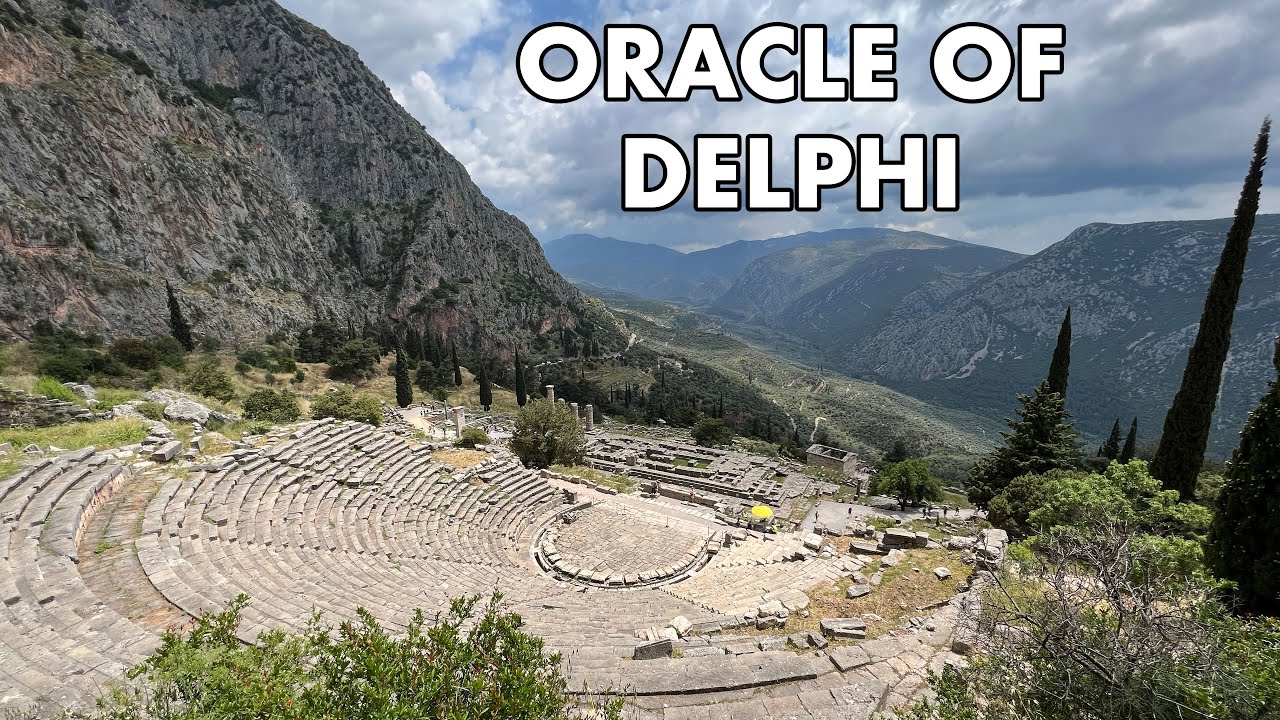
The theater being gently placed on the mountainside, framed by the architecture to direct views towards the sacred mountain range.
- A 'Sacred Way' guided processions through the sanctuary, similar to the Acropolis in Athens.
- This path was lined with 'thesauroi' (treasuries), small temple-like buildings funded by individual Greek city-states.
- Treasuries stored offerings to Apollo and served as monuments, often decorated with sculpture to commemorate victories or wealth.
- The arrangement of these buildings was designed to enhance the understanding of the landscape from vantage points like the theater.
The treasuries highlight the pan-Hellenic nature of Delphi and how individual city-states expressed their devotion and political prestige through monumental offerings.
The Athenian treasury, commemorating a military victory, and the treasury of Siphnos, celebrating a silver discovery.
- The theater, integral to religious practice, was strategically placed to engage with the natural landscape.
- The gymnasium, the oldest surviving in Greece, was where athletes trained for the Pythian Games.
- The Temple of Apollo was the most important building, designed to dominate views and be appreciated as a three-dimensional object from all angles.
- The Delphic Maxims, such as 'Know yourself' and 'Nothing too much,' were inscribed on the temple, offering profound ethical guidance.
These structures represent the multifaceted nature of Delphi as a center for prophecy, athletic competition, religious ritual, and philosophical reflection.
The inscription 'Know yourself' (Gnōthi sauton) on the Temple of Apollo, reminding visitors of their place in the universe.
- Visitors followed a specific route, passing through the Marmaria complex (dedicated to Athena) and the gymnasium.
- The Castalian Spring was a vital stop for purification rituals before entering the main sanctuary (Temenos).
- The Temenos, the sacred precinct of Apollo, was entered via a southeastern gate, leading along the Sacred Way.
- Architectural design intentionally created intrigue and varied views of the Temple of Apollo as visitors approached.
The carefully designed processional route and purification rituals emphasize the transition from the secular world to the sacred space of Delphi, preparing pilgrims for their encounter with the divine.
Pilgrims washing themselves and drinking water at the Castalian Spring before proceeding to the Temenos.
- With the Roman Empire's expansion and the Pax Romana, the need for prophetic guidance diminished as security increased.
- Pilgrims began consulting the oracle for trivial matters, leading to a decline in Delphi's importance.
- The site faced neglect, depopulation, and lack of maintenance, exacerbated by its location in a seismic zone.
- Despite its decline, Delphi's dramatic landscape and history continue to evoke a sense of the spiritual and supernatural.
Understanding Delphi's decline reveals how external political shifts and changing societal needs can impact even the most revered ancient sites, while its enduring mystique speaks to its profound historical impact.
The shift from consulting the oracle on matters of founding cities or military campaigns to asking trivial questions during the Roman era.
Key takeaways
- Delphi's significance stems from its dual identity as a mythical 'center of the world' and a real-world sanctuary of Apollo.
- The Oracle of Delphi, through the Pythia, served as a crucial source of divine guidance influencing ancient Greek society.
- Delphi's architecture is a masterclass in integrating human structures with a dramatic natural landscape to enhance spiritual experience.
- The Sacred Way, treasuries, and specific building placements demonstrate a deliberate, narrative approach to guiding visitors and conveying meaning.
- The Pythian Games and the presence of the gymnasium highlight Delphi's role as a major center for athletic and cultural activities.
- The Delphic Maxims inscribed on the Temple of Apollo offer timeless wisdom on self-awareness and moderation.
- Delphi's eventual decline illustrates the impact of geopolitical changes and evolving societal priorities on religious centers.
Key terms
OmphalosSanctuary of DelphiApolloPythonOracle of DelphiPythiaMount ParnassusSacred WayThesauroi (Treasuries)TemenosCastalian SpringDelphic MaximsPythian Games
Test your understanding
- What was the mythical significance of Delphi as the 'Omphalos' for the ancient Greeks?
- How did the Pythia function as the Oracle of Delphi, and what role did the physical site play in her prophecies?
- Describe the architectural philosophy at Delphi and how it aimed to integrate buildings with the natural landscape.
- What was the purpose of the 'thesauroi' (treasuries) along the Sacred Way, and what did they represent?
- What profound messages were conveyed by the Delphic Maxims inscribed on the Temple of Apollo, and why were they important?