18:10
Give Me 18 Minutes, and You’ll Learn Faster Than 99.9% of People
Justin Sung
Overview
This video introduces two powerful, yet simple, learning strategies designed to accelerate comprehension and retention: increasing prediction errors and employing multi-pass encoding. It challenges the common misconception of learning speed as mere material coverage, advocating instead for 'time to outcome,' which prioritizes genuine understanding and mastery. By focusing on making deliberate predictions and learning from mistakes, and by revisiting material in iterative passes, learners can build a stronger foundation of knowledge and achieve their learning goals more effectively and efficiently.
How was this?
Save this permanently with flashcards, quizzes, and AI chat
Chapters
- Learning speed is often misconstrued as the amount of material covered per unit of time.
- A more effective metric is 'time to outcome,' which measures the total time needed to achieve a desired level of mastery or understanding.
- Focusing solely on coverage can lead to superficial learning, requiring extensive, inefficient rehearsal to achieve actual competence.
- Methods that prioritize deeper understanding, even if slower in initial coverage, ultimately reduce the total time to reach the desired outcome.
Understanding the difference between coverage speed and time to outcome is crucial for selecting learning strategies that lead to genuine mastery rather than just superficial familiarity.
A doctor studying for specialist exams initially covered material quickly but lacked deep understanding. By switching to a method that slowed coverage but increased mastery, she achieved her learning goals more effectively, even if her initial pace seemed slower.
- Prediction errors occur when you make a prediction about information and then discover you were wrong.
- This error signal prompts the brain to learn more effectively and strengthens memory recall.
- To generate prediction errors, actively predict what content will be about before engaging with it (e.g., after scanning headings or objectives).
- The key is to try your best to make logical predictions based on existing knowledge, which helps build connections and a framework for new information.
Actively engaging with material by predicting and then correcting your understanding creates a powerful learning loop that enhances comprehension and memory.
Before reading a book chapter, scan the headings and keywords, then pause to predict what the main points will be. After reading, you'll likely find many predictions were wrong, creating valuable prediction errors that reinforce learning.
- Multi-pass encoding means not trying to understand everything in a single, linear pass through the material.
- Instead, focus on and engage with the parts that are easiest to understand based on your existing knowledge (prior knowledge).
- Subsequent passes allow you to gradually build understanding of more complex or previously inaccessible information as your knowledge base expands.
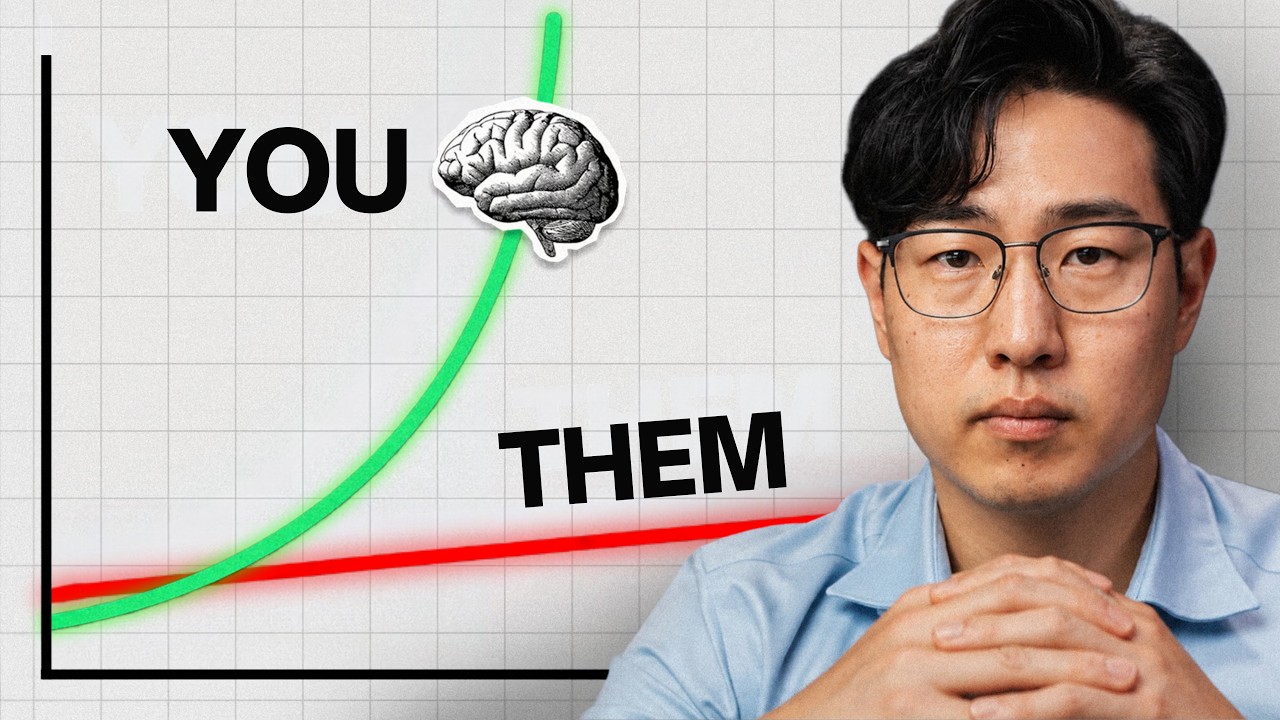
- This approach is more efficient because it avoids getting bogged down in difficult sections and leverages existing connections, making learning exponential.
By strategically revisiting material and focusing on what's currently comprehensible, you build a stronger foundation and make complex information accessible over time, leading to faster overall learning.
When encountering a technical document, initially skim for concepts you already grasp. In later passes, as your understanding of those core concepts grows, previously confusing sections will become clearer and easier to integrate.
Key takeaways
- Prioritize 'time to outcome' over 'coverage speed' for effective learning.
- Learning is most efficient when it leverages and builds upon existing knowledge.
- Actively predicting and being wrong (prediction errors) is a fundamental mechanism for deeper learning and memory formation.
- Multi-pass encoding allows learners to gradually build understanding by focusing on accessible information first and revisiting complex parts later.
- These simple techniques, when consistently applied, can significantly improve learning efficiency and effectiveness.
- Don't get discouraged by slower initial coverage; focus on building understanding and mastery.
Key terms
Time to OutcomeCoverage SpeedRehearsalMasteryPrediction ErrorPrior KnowledgeMulti-Pass EncodingSemantic EncodingMemory Consolidation
Test your understanding
- How does 'time to outcome' differ from 'coverage speed,' and why is the former a better metric for learning?
- Explain the process of generating a 'prediction error' and how it aids in learning.
- Describe the core principle of 'multi-pass encoding' and how it relates to prior knowledge.
- How can a learner intentionally increase their prediction errors while studying a new topic?
- Why is it more effective to focus on easier-to-understand material first in multi-pass encoding?