13:29
How to Set Price Targets Using the Fractal Model
TTrades
Overview
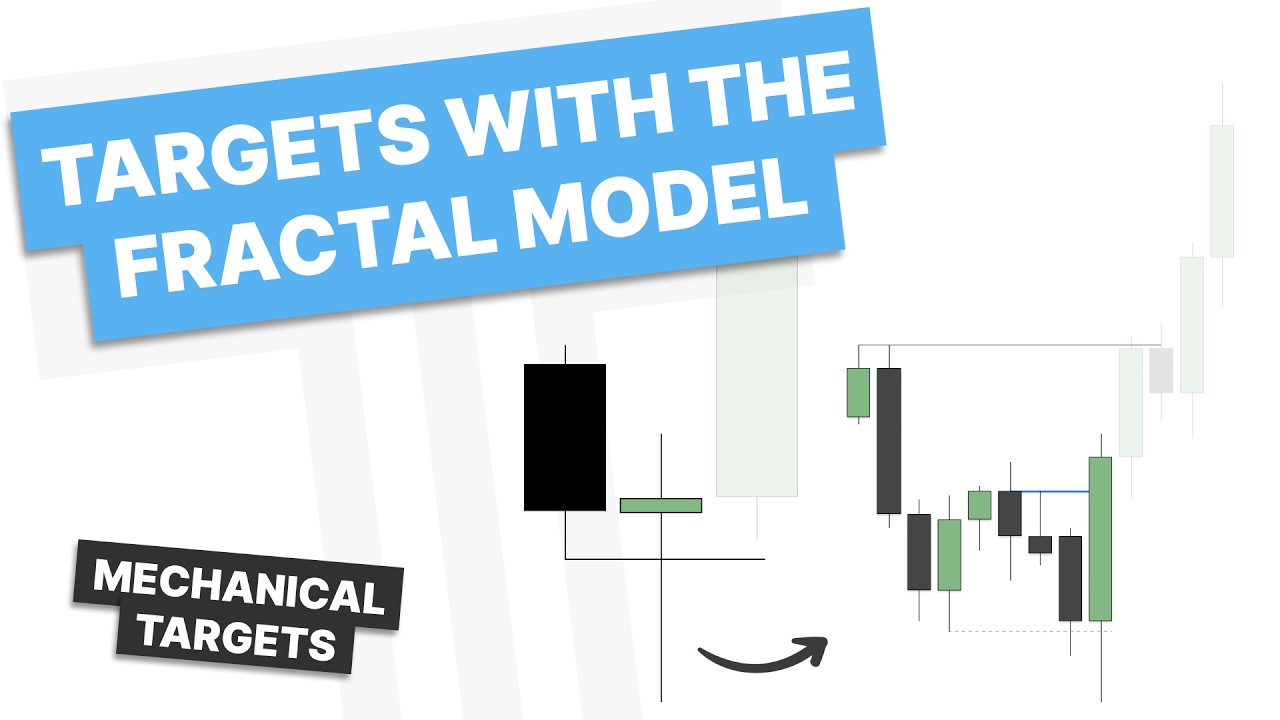
This video explains how to set price targets in trading using the fractal model, emphasizing the use of higher time frames to identify these targets. The core concept is that previous highs and lows on a higher time frame serve as potential price targets for trades initiated on lower time frames. The presenter demonstrates this by showing examples on TradingView, illustrating how to mark targets based on previous candle highs/lows and swing points, and how this method can lead to higher risk-reward ratios by allowing traders to capture short-term gains while holding runners for larger, higher time frame objectives.
How was this?
Save this permanently with flashcards, quizzes, and AI chat
Chapters
- Price targets in the fractal model are determined by looking at a higher time frame than the entry time frame.
- Previous candle highs and lows on the higher time frame are the primary reference points for setting targets.
- This method helps identify where a trade can be held for potential profit, extending beyond immediate price movements.
Understanding how to use higher time frame levels for targets simplifies trade management and allows for the capture of larger price movements.
On an hourly chart, if a trade is initiated based on a five-minute fractal, the targets are identified by looking at the previous highs or lows on the hourly chart.
- When a lower time frame fractal aligns with a higher time frame expansion (e.g., candle three on daily), targets from the higher time frame can be used.
- This allows for taking initial trades with short-term targets and then holding a portion of the trade (a runner) to aim for these higher time frame objectives.
- Aligning targets across different time frames improves the risk-reward ratio of a single trade.
This strategy enables traders to maximize profit potential from a single trade by setting both immediate and long-term profit goals.
A trader uses hourly chart levels as targets for a trade initiated on the five-minute chart, aiming for both short-term gains and potential larger moves indicated by the hourly structure.
- In a bearish setup, targets are previous candle lows or swing lows.
- In a bullish setup, targets are previous candle highs or swing highs.
- Only consider highs or lows that have not yet been taken out (mitigated) on the higher time frame.
- Equal highs or lows are often significant targets.
Focusing on unmitigated previous highs and lows provides clear, objective levels for potential price reversals or continuations.
On a daily chart, if price is moving lower, the targets are the previous daily lows. If price is moving higher, the targets are the previous daily highs.
- Example 1: A daily chart shows a candle two closure, with targets set at the previous daily lows.
- Example 2: A trade is looking to go higher after a candle two closure at a fair value gap; the target is the previous high on the daily chart, and potentially higher weekly swing highs.
- Example 3: Identifying swing points on the daily chart and marking their corresponding previous highs or lows as targets.
- Example 4: A range-bound market with a candle two closure; targets are marked at previous highs that have not yet been taken out.
Seeing these concepts applied across different scenarios reinforces the universality of the fractal target-setting method.
On a daily chart, after a candle two closure, the previous lows are marked as targets. Price moves down, hits the first target, consolidates, and then continues to the next target.
- When a higher time frame target has been mitigated by a correlated asset (e.g., Silver taking out a Gold target), it validates that the target has been met.
- Combining lower time frame entries with higher time frame targets allows for high risk-reward trades, potentially achieving 1:11 or 1:16 ratios.
- Taking partial profits at short-term targets and holding runners for higher time frame objectives is a key risk management technique.
This approach integrates market correlation and strategic profit-taking to significantly enhance trading profitability and manage risk effectively.
A trader takes partial profit at a short-term target on a five-minute chart and holds a runner to a higher time frame target on the hourly chart, achieving a substantial risk-reward ratio.
Key takeaways
- Higher time frame previous highs and lows are the most reliable price targets in the fractal model.
- Always reference a higher time frame for target identification, regardless of your entry time frame.
- Unmitigated swing highs and lows are the primary levels to watch for potential price targets.
- The fractal model allows for capturing both short-term gains and longer-term moves within a single trade by using tiered targets.
- Trading correlated assets can help validate whether a target on one asset has likely been met.
- Partial profit-taking at short-term targets while holding runners for higher time frame objectives is a powerful strategy for maximizing returns.
- Understanding the concept of 'candle two closure' is crucial for identifying potential trade setups and their corresponding targets.
Key terms
Fractal ModelPrice TargetsHigher Time FrameLower Time FrameCandle Two ClosureCandle Three ExpansionPrevious Highs/LowsSwing Highs/LowsTime Frame AlignmentRisk-Reward RatioRunnersSMT (Smart Money Technique)Fair Value Gap
Test your understanding
- How does referencing a higher time frame simplify the process of setting price targets in the fractal model?
- What specific price levels on a higher time frame should a trader look for when setting targets for a lower time frame trade?
- Why is it important to consider only unmitigated highs and lows when setting fractal targets?
- How can a trader use both short-term and long-term targets within a single trade to improve their risk-reward ratio?
- What is the significance of a 'candle two closure' in relation to setting price targets?