21:26
Maximise Your Exam Marks with 'An Essay on Man' by Alexander Pope: Key Themes Explained
Claire's Notes
Overview
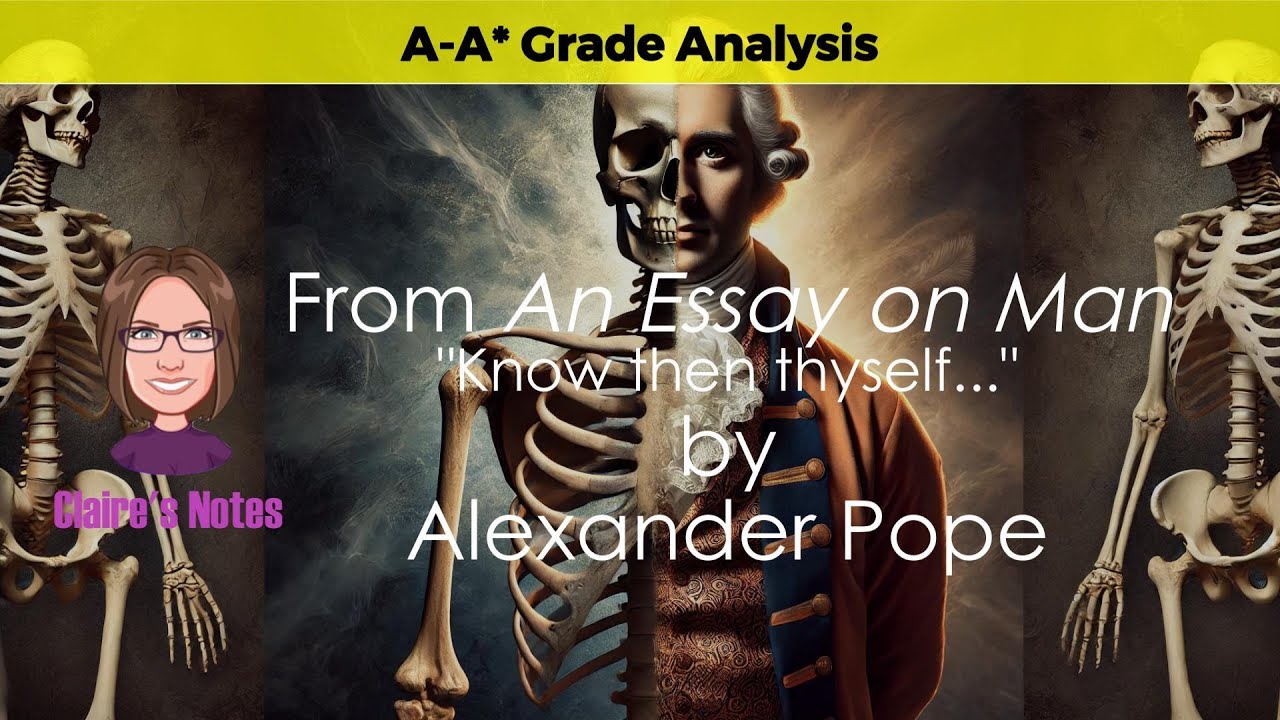
This video explains Alexander Pope's philosophical poem 'An Essay on Man,' focusing on its exploration of humanity's place in the natural and divine order. It details the poem's structure, particularly the use of heroic couplets and rhetorical devices like anaphora and mesodiplosis to convey complex ideas about human nature. The summary highlights Pope's portrayal of humans as paradoxical beings, caught between reason and passion, greatness and frailty, and emphasizes the poem's Enlightenment-era context, which balanced optimism about human potential with an acknowledgment of our inherent limitations and the inevitability of error and mortality.
How was this?
Save this permanently with flashcards, quizzes, and AI chat
Chapters
- Pope's 'An Essay on Man' (1733-34) aims to justify God's ways by explaining the natural order.
- Humans, unable to fully grasp God's plan, should accept their place in the 'great chain of being.'
- The poem is structured into four 'Epistles,' formal instructional works exploring humanity's relationship with the universe, self, society, and happiness.
Understanding the poem's purpose and structure provides a framework for appreciating its philosophical arguments about humanity's role and limitations.
The poem is divided into four Epistles, formal instructional works exploring important ideas, much like the Epistles of the Apostles.
- The Second Epistle examines humanity's dual nature: a mix of divine aspirations and animalistic instincts, reason and passion, greatness and frailty.
- This tension reflects Enlightenment ideals, celebrating human potential while acknowledging inherent limitations.
- Pope balances rationality with an awareness of human fallibility, viewing it as part of a divine order.
Recognizing humanity's inherent contradictions is central to Pope's argument and helps explain why humans often struggle with their place and purpose.
The extract explores our position as flawed beings caught between Divinity and animality, reason and passion, greatness and frailty.
- The extract uses heroic couplets (two rhyming lines in iambic pentameter) to create balance and reinforce themes of order.
- This form lends authority and finality to Pope's philosophical assertions and conclusions.
- Heroic couplets were a hallmark of 18th-century neoclassical poetry, emphasizing harmony, precision, and reason.
The poem's form is not merely decorative; it actively supports its message by mirroring the structured universe Pope describes and lending weight to his arguments.
A heroic couplet is a pair of rhyming lines with a base meter of iambic pentameter, like 'With too much knowledge for the skeptic side / With too much weakness for the stoics pride.'
- Pope employs anaphora (repetition at the beginning of clauses) like 'with too much' to emphasize human flaws and limitations.
- Mesodiplosis (repetition in the middle of clauses) highlights the paradox that strengths are linked to weaknesses (e.g., 'born but to die').
- Figurative language is restrained, favoring precise diction and concise phrasing over elaborate imagery.
These techniques help Pope distill complex philosophical ideas into memorable and impactful statements, reinforcing the poem's core themes.
The repetition of 'with too much' emphasizes the many contradictions within humanity, highlighting how we are caught between extremes.
- Pope begins by commanding: 'Know then thyself; presume not God to scan,' urging focus on human limitations rather than divine mysteries.
- The 'isthmus' metaphor powerfully illustrates humanity's precarious middle state between the spiritual and the animal.
- Oxymorons like 'Darkly wise' and 'rudely great' capture the paradoxical blend of knowledge and ignorance, potential and imperfection.
This section establishes the poem's central focus on introspection and the acceptance of our inherently conflicted nature.
Pope uses the metaphor of an isthmus, a narrow strip of land, to represent humanity's position caught between two extremes.
- Humans are too knowledgeable to fully embrace skepticism but too weak for Stoic detachment, existing in a state of limbo ('hangs between').
- Constant uncertainty ('in doubt') paralyzes humanity, torn between action/rest and mind/body.
- The phrase 'born but to die' underscores our mortality, while 'reasoning but to err' highlights the fallibility inherent in our intellect.
This illustrates the constant internal conflict and existential uncertainty that defines the human condition, according to Pope.
The repetition of 'in doubt' underscores humanity's deep uncertainty and internal conflict, creating a sense of paralysis.
- Pope suggests reason itself is prone to ignorance ('alike in ignorance his reason such'), leading to flawed understanding.
- Human experience is a 'chaos of thought and passion,' where reasoning can either deceive ('abused') or enlighten ('disabused').
- Humanity is 'created half to rise and half to fall,' reflecting a divine plan that includes both potential greatness and the capacity for moral failure, possibly referencing the Fall of Man.
This deepens the understanding of human fallibility, showing it's not just a lack of knowledge but an inherent aspect of our reasoning and creation.
The line 'created half to rise and half to fall' suggests a divine plan that incorporates humanity's dual potential for moral greatness and failure.
- Humans are paradoxically the 'great Lord of All Things' yet 'a prey to all,' possessing dominion but subject to vulnerability.
- This duality is summed up as the 'glory, jest, and riddle of the world.'
- Glory represents potential, jest our follies, and riddle the ultimate mystery of our existence.
The conclusion encapsulates the complex, contradictory, and ultimately mysterious nature of humanity, leaving the reader to ponder its significance.
The final lines describe humanity as 'the glory, jest, and riddle of the world,' capturing our potential, our flaws, and our enigmatic nature.
Key takeaways
- Alexander Pope's 'An Essay on Man' argues that understanding and accepting human limitations is key to comprehending our place in the universe.
- The poem uses the structure of heroic couplets and rhetorical devices to reinforce its message about order, balance, and the paradoxical nature of humanity.
- Humans are presented as inherently contradictory beings, caught between reason and passion, divine aspirations and animalistic instincts.
- Pope emphasizes that our capacity for reason is not infallible; it is intertwined with ignorance and prone to error, reflecting an Enlightenment-era tension.
- Accepting our mortality ('born but to die') and the inevitability of mistakes ('reasoning but to err') is crucial to understanding the human condition.
- Humanity's existence is a complex blend of potential greatness ('glory') and inherent flaws ('jest,' 'riddle'), making us a source of both wonder and confusion.
- The poem suggests that embracing our 'middle state' and acknowledging our limitations, rather than striving for unattainable perfection, is the path to wisdom.
Key terms
An Essay on ManAlexander PopeEpistleGreat Chain of BeingHeroic CoupletIambic PentameterAnaphoraMesodiplosisIsthmus (metaphor)OxymoronEnlightenment
Test your understanding
- What is the primary goal of Alexander Pope's 'An Essay on Man'?
- How does Pope use the structure of heroic couplets to convey his philosophical ideas?
- Explain the significance of the 'isthmus' metaphor in describing humanity's position.
- Why does Pope suggest that human reason is paradoxically linked to ignorance and error?
- What does Pope mean when he calls humanity 'the glory, jest, and riddle of the world'?